Lesson 05 — Sharing Roles on a Team
Learners discover what makes a team work: every person holds a role, and the roles are shared and rotated so no one is stuck doing only one thing. They meet four roles — stepper, counter, encourager, director — and practice the traveling step in small teams while rotating roles each round. The aim is cooperative, not competitive: every contribution matters.
Objectives
Objectives
- D03.S2.06.02 Work cooperatively with teammates, sharing roles and encouraging others regardless of skill level.
Essential question
How does a team work well when every person shares a role?
Key vocabulary
Materials
Standard materials
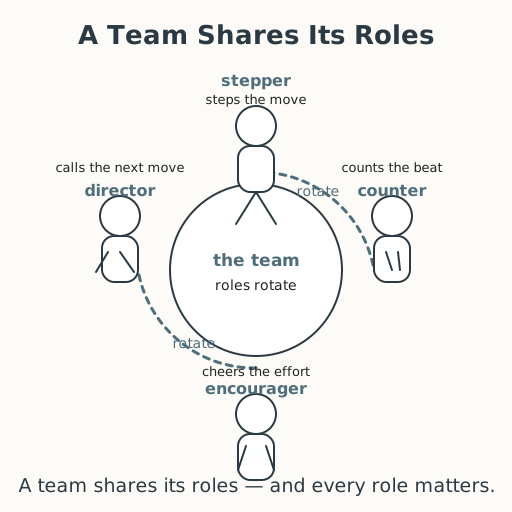
- Sharing-roles poster · 1 A poster showing a team of four around a circle, each labeled with a role — stepper, counter, encourager, director — with arrows showing the roles rotating
- Role cards · 1 set per team Four small cards naming a role and its job — stepper, counter, encourager, director
- Open floor space · 1 per team Space for a small team to practice the step together
Low-tech / no-cost
- Voice and bodies in a circle Assign the four roles aloud and practice rotating them with no cards or pages
- Role marks drawn in the dirt Draw four role spots in a circle and stand in each one as the roles rotate
Enriched / lab & device
- A class 'role wheel' chart · 1 A shared wheel showing which learner held which role each round, so every role gets shared fairly over time
- A short video of a team sharing roles · 1 per group To watch a team rotate roles and notice how the group improves when everyone contributes
Works in different contexts
- large-group Model the four roles on one example team, then have teams of four practice and rotate roles every round
- multi-age Older learners model a role for younger ones, then roles rotate so every learner tries each job at their own depth
- self-directed A learner works a small task alone but role-plays each of the four roles in turn — stepping, counting, encouraging, directing themselves
- level-grouped Learners ready to extend reflect on why rotating roles is fairer than one person always leading, and propose a fair rotation rule
- outdoor-only Stand in a circle on the ground, name each role aloud, and rotate around the circle as each learner takes a turn
Lesson 5 — Sharing Roles on a Team
Summary
Learners discover what makes a team work: every person holds a role, and roles are shared and rotated so no one is stuck doing only one thing. They meet four roles — stepper, counter, encourager, director — and practice the traveling step in small teams while rotating roles each round. The aim is cooperative, not competitive: every contribution matters, and no role outranks another.
Objectives
- Work cooperatively with teammates, sharing roles and encouraging others regardless of skill level. (D03.S2.06.02)
Connection
Think of preparing a meal together, building a shelter, or running a market stall: one person minds the fire, another chops, another counts the money, another welcomes people. If one person tried to do it all, the work would stall; if the same person always got the easiest job, the team would sour. A team works when everyone holds a role and the roles are shared fairly. Whether it is a fishing crew, a dance troupe, or a study group, the same truth holds everywhere: each person contributes, and the roles turn so everyone learns everything.
Materials
- Sharing-roles poster
- Role cards
- Open floor space
Preparation
- Print or draw the sharing-roles poster (four roles around a circle, with rotating arrows).
- Copy role cards — stepper, counter, encourager, director — one set per team.
- Clear space for teams of four to practice together.
Facilitator note
This lesson is written to the learner (“you”). The idea to land is teamwork = shared,
rotated roles, and that no role outranks another. The roles are deliberately designed so
that skill is not what qualifies a learner: the encourager and director are as essential as
the stepper. Rotate roles so every learner tries each one — this is the egalitarian core, and
it prevents one learner from being fixed as “the skilled one.” Offer seated/adapted versions of
every role (a seated stepper taps the counts; the director can direct with a hand; the counter
counts for any pace). See docs/contexts.md and docs/facilitation.md.
Procedure
- Gather (5 min). You have practiced a new skill and learned to give feedback. Today you learn what makes a team work: shared roles.
- Meet the roles (10 min). Look at the poster — a worked example of a team of four: the stepper shows the step; the counter counts the four beats aloud; the encourager cheers and names what is going well; the director watches and calls the next move. Notice the arrows: the roles rotate, so each person tries each one. No role is the “best” — the team needs all four.
- Read the cards (5 min). Take a role card and read its job. Say it to your team so everyone knows what each role does.
- Practice with rotating roles (20 min). In teams of four, practice the traveling step together while each person holds their role. After each round, rotate the cards to the left and try the new role. Go around until everyone has tried all four. Notice: does the team feel different when you are the encourager, or the counter?
- Close (5 min). A team is not one star and three helpers; it is four contributors, each role turning so everyone grows. That is how cooperation beats competition.
Differentiation
- Support: Use only two roles at first (stepper and encourager), then add the others; provide a picture cue on each role card; allow a seated version of every role.
- Extension: Propose a fair rotation rule for a larger team and explain, in one sentence, why rotating roles is fairer than always letting the strongest person lead.
Assessment
- Formative (observation/peer): Does the learner hold a role, do its job, and rotate to a new role when it is their turn — treating every role as important?
- Self-check: The learner asks, “Did I do my role fully, and did I treat the next person’s role as equal to my own?”
Home connection
At home, try rotating roles for one shared job (setting a table, tidying up) so each person does a different part today than yesterday.
Resources
- Cooperative learning that assigns roles and holds each member accountable is a well-evidenced classroom structure (see the cooperative-learning literature, e.g., Slavin; Johnson & Johnson). Rotating roles so every member tries each one supports equity — no learner is fixed by skill or background. For classroom SEL framing of teamwork, see CASEL’s relationship-skills competency: https://casel.org/fundamentals-of-sel/