Lesson 04 — Feedback and Correction Refine My Skill
Learners discover that feedback and correction — not just repetition — refine a new skill. They meet a feedback-correction loop, learn a two-part starter ('I noticed ___. Try ___.'), and practice the traveling step while a partner gives one specific, kind tip about the action; then they correct and try again. This is the heart of the standard: practice, feedback, correction.
Objectives
Objectives
- D03.S2.06.01 Learn a new movement skill, such as a dance step or sport skill, through practice, feedback, and correction.
Essential question
How do feedback and correction turn a clumsy step into a smooth one?
Key vocabulary
Materials
Standard materials
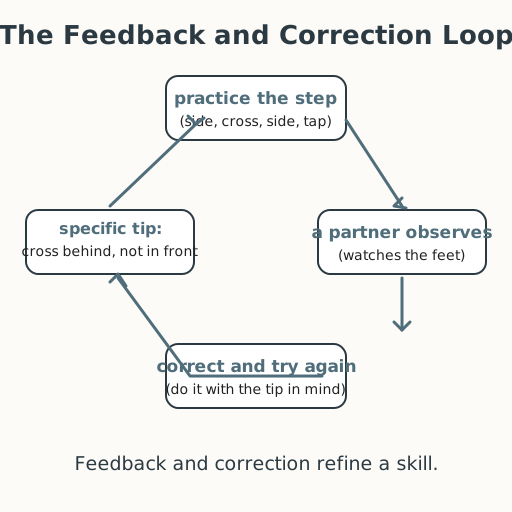
- Feedback-correction loop poster · 1 A poster showing a cycle — practice, observe, specific tip, correct, practice again — with a label on each arrow
- Feedback sentence-starter card · 1 per pair A card with the starter 'I noticed ___. Try ___.' for giving one specific, kind tip about the step
- Practice log page (continued) · 1 per learner The running log from Lesson 3, with a new column to note each correction tried
Low-tech / no-cost
- Voice and a partner Give one specific, kind tip about the step aloud — 'I noticed your cross came in front; try crossing behind' — then try again
- A 'helpful vs. hurtful' sorting game Say a comment aloud and have partners sort it into 'helps' or 'hurts' with a thumbs up or down
Enriched / lab & device
- A class 'correction wall' · 1 A shared wall where learners post the specific tips that helped them improve, building a bank of useful corrections
- A video replay of the step · 1 per group Replay a practice round to see the exact moment a correction changed the step
Works in different contexts
- large-group Model one helpful and one hurtful comment on the board, then have pairs practice the starter while one steps and the other gives a tip
- multi-age Older learners give the full feedback starter while younger learners practice naming one specific thing they noticed
- self-directed A learner films or watches their own step and writes one specific correction for themselves using the starter, then tries again
- level-grouped Learners ready to extend distinguish feedback about the *action* from feedback about the *person* and explain why one helps and the other hurts
- outdoor-only In pairs, one steps while the other gives one specific, kind tip aloud, then they swap; no paper needed
Lesson 4 — Feedback and Correction Refine My Skill
Summary
Learners discover that feedback and correction — not just repetition — refine a new skill. They meet a feedback-correction loop, learn a two-part starter (“I noticed ___. Try ___.”), and practice the traveling step while a partner gives one specific, kind tip about the action; then they correct and try again. This is the heart of the standard: practice, feedback, and correction.
Objectives
- Learn a new movement skill, such as a dance step or sport skill, through practice, feedback, and correction. (D03.S2.06.01)
Connection
A mirror shows you what you cannot see from inside — and a good teammate is a mirror for your movement. When you are stepping, you cannot watch your own feet; a partner who says “I noticed your cross came in front — try crossing behind” gives you information you could not get alone. Feedback names what is real, kindly, so you can correct it. Whether in a dance circle, a workshop, or a field, the people who help us grow are the ones who tell us the truth about one small thing at a time — and believe we can improve.
Materials
- Feedback-correction loop poster
- Feedback sentence-starter card
- Practice log page (continued)
Preparation
- Print or draw the feedback-correction loop poster (practice → observe → specific tip → correct → practice again).
- Copy a feedback sentence-starter card for each pair.
- Continue the running practice log with a new “correction tried” column.
Facilitator note
This lesson is written to the learner (“you”). The idea to land is feedback about the
action, not the person — specific, kind, and usable — and that correction is how skill
grows. Model the difference vividly and stop any feedback about the person the moment it
appears, redirecting to the action. Feedback is among the strongest influences on learning
(Hattie, Visible Learning), but only when it is clear and kind. Honor every body’s pace:
feedback is about a next step, never about ranking. Offer seated/adapted versions of the step
for learners who need them. See docs/contexts.md and docs/facilitation.md.
Procedure
- Gather (5 min). Last time you started the traveling step. Today you add the part that turns practice into skill: feedback and correction.
- Meet the loop (10 min). Look at the poster — a worked example of a cycle: practice the step → a partner observes → they give a specific tip → you correct and try again. Notice: correction is not failure; it is the point. A step corrected once is worth ten uncorrected repeats.
- Learn the starter (5 min). Read the two-part starter: “I noticed ___ . Try ___ .” Practice it once aloud about the step, using kind words. It names one thing and one next try.
- Give real feedback (15 min). Partner up. One partner steps the four counts; the other observes quietly, then gives one specific, kind tip using the starter — about the step, never the person. The stepper corrects and tries again. Then swap. Log each correction you tried.
- Close (5 min). A skill grows fastest when practice meets a kind, specific word. You can be that help for someone — and ask for it for yourself.
Differentiation
- Support: Provide the starter printed large with blanks and model one full example before partners begin; allow a tip about one single, visible thing.
- Extension: Distinguish feedback about the action from feedback about the person, and rewrite two hurtful comments into helpful corrections.
Assessment
- Formative (peer/performance): Does the learner give feedback that is specific, kind, and about the action, and can their partner correct and try again with the tip in mind?
- Self-check: The learner asks, “Was my tip about the action, not the person, and was it kind enough that I would welcome hearing it myself?”
Home connection
Give one specific, kind piece of feedback to someone at home today — and notice whether it helps them more than a general “good job.”
Resources
- Feedback is among the strongest influences on learning (Hattie, Visible Learning); it works best when it is specific, timely, and about the work, not the person. Corrective feedback — a cue plus a next try — is a well-established part of motor-skill learning. For classroom SEL framing of giving and receiving feedback, see CASEL’s relationship-skills competency: https://casel.org/fundamentals-of-sel/