Lesson 07 — Skill and Teamwork Together
Learners put the unit together: they build a shared eight-count sequence — the traveling step plus one move from each teammate — and perform it as a cooperative game in which the goal is collective, not competitive. Every person contributes, roles rotate, and everyone is encouraged. This lesson carries both movement standards at once: the refined skill and true teamwork.
Objectives
Objectives
- D03.S2.06.01 Learn a new movement skill, such as a dance step or sport skill, through practice, feedback, and correction.
- D03.S2.06.02 Work cooperatively with teammates, sharing roles and encouraging others regardless of skill level.
Essential question
How do my skill and my teamwork come together in one cooperative game?
Key vocabulary
Materials
Standard materials
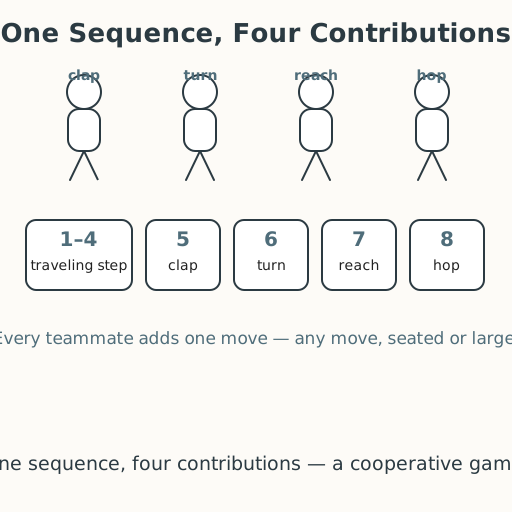
- Team step-sequence poster · 1 A poster showing a team of four building one eight-count sequence — four counts of the traveling step plus one added move from each member — into a shared performance
- Sequence planner page · 1 per team A page to write an eight-count sequence — the four-count step plus one move from each of four teammates
- Practice log page (final) · 1 per learner The running log, with a final line to note the team's shared goal and one thing that went well together
Low-tech / no-cost
- Bodies, voices, and a circle Build and perform the sequence aloud together with no page or poster
- A sequence marked in the dirt Draw the eight counts in a line or circle and step them together, adding one move from each teammate
Enriched / lab & device
- A steady beat or simple percussion · 1 per team A beat to keep the whole team in time through the shared sequence
- A video of the team performance · 1 per team To watch the team's sequence back and celebrate what each person contributed
Works in different contexts
- large-group Have teams build and rehearse their sequence in parallel, then perform for one other team in a rotating gallery
- multi-age Each learner adds a move they can do — seated, slow, or large — and the team weaves them all into one sequence; older learners help count the beat
- self-directed A learner builds an eight-count sequence alone — the four-count step plus four of their own moves — and performs it, noting which move felt smoothest
- level-grouped Learners ready to extend lead the team's count or design a second, mirror-image sequence, and reflect on how sharing roles shaped the result
- outdoor-only Mark a circle or line on the ground, and the team performs its sequence together in the open, passing the lead by turning to face the next person
Lesson 7 — Skill and Teamwork Together
Summary
Learners put the unit together: they build a shared eight-count sequence — the traveling step plus one move from each teammate — and perform it as a cooperative game whose goal is collective, not competitive. Every person contributes, roles rotate, and everyone is encouraged. This lesson carries both movement standards at once: the refined skill and true teamwork.
Objectives
- Learn a new movement skill, such as a dance step or sport skill, through practice, feedback, and correction. (D03.S2.06.01)
- Work cooperatively with teammates, sharing roles and encouraging others regardless of skill level. (D03.S2.06.02)
Connection
A single voice singing a line is lovely, but many voices weaving one song is something more — each adds its part, and no part outranks another. That is what a cooperative game is: not one team beating another, but a group building something together that no one could make alone. Today you do exactly that with movement — your traveling step becomes four counts of a shared sequence, and each teammate adds one move of their own. The win is the together, not the score.
Materials
- Team step-sequence poster
- Sequence planner page
- Practice log page (final)
Preparation
- Print or draw the team step-sequence poster (four figures, eight labeled counts).
- Copy a sequence planner page for each team.
- Clear space for teams to rehearse and perform; prepare a steady beat if available.
Facilitator note
This lesson is written to the learner (“you”). The idea to land is that skill and teamwork
come together in a cooperative goal. Keep the game collective, never competitive — there
is no winner and no loser, only a shared performance to celebrate. Ensure every learner
contributes a move, and that the move may be any movement — seated, small, slow, or large —
so every body is included. Rotate the counting/directing roles so no one is fixed. The
performance is for encouragement, not judgment; another team responds with the encouraging
words from Lesson 6. See docs/contexts.md and docs/facilitation.md.
Procedure
- Gather (5 min). You have a skill — the traveling step — and you know how to share roles and encourage every teammate. Today you put it all into one cooperative game.
- Meet the sequence (10 min). Look at the poster — a worked example of a team’s eight-count sequence: counts 1–4 are the traveling step (side, cross behind, side, tap), then counts 5–8 are one move added by each of four teammates — a clap, a turn, a reach, a hop (or a seated tap, a nod, a wave). Every teammate’s move is counted in. No move outranks another.
- Build your sequence (10 min). On your planner page, write your eight counts. Decide together: who adds which move, and who counts or directs. Make sure every person has a move and a role. Practice slowly until the whole team can step and move as one.
- Perform and encourage (20 min). Perform your sequence for another team, then watch theirs. Respond with the encouraging words you practiced — cheer their effort and progress, never a rank. Log your team’s goal and one thing that went well together.
- Close (5 min). A cooperative game is won the moment everyone contributes and everyone is cheered. Today you made something together that no one could make alone.
Differentiation
- Support: Use only the four-count step plus one team move at first, then add more; allow seated moves for any count; scribe the planner page.
- Extension: Design a second, mirror-image sequence or lead the team’s count, and reflect in one sentence on how sharing roles shaped the final performance.
Assessment
- Formative (performance/peer/portfolio): Does the sequence combine the refined step with one contribution from every teammate, performed together, with roles shared and everyone encouraged?
- Self-check: The learner asks, “Did every teammate contribute, did I hold and rotate my role, and did I encourage rather than rank?”
Home connection
Perform your eight-count sequence for someone at home, teaching them one count so they can join you for a few steps.
Resources
- Cooperative (rather than competitive) goal structures support belonging and mutual aid — see the cooperative-learning literature (e.g., Slavin; Johnson & Johnson). A shared, built sequence also illustrates transfer and retrieval: performing the step in a new context strengthens the skill. For SEL framing of teamwork and cooperation, see CASEL’s relationship-skills competency: https://casel.org/fundamentals-of-sel/