Lesson 08 — My Body at Work: My Tension-Release Toolkit
Learners close the unit by building a one-page "my body toolkit" — a portfolio artifact that gathers everything they learned: where stress shows up as tension, one named way to release it, the movement skill they built through practice and feedback, and a teamwork reflection. This is retrieval and synthesis: the unit's learning, carried forward for life.
Objectives
Objectives
- D03.S1.06.02 Explain how emotions and body sensations connect, such as stress and tension, and name one way to release tension.
- D03.S2.06.01 Learn a new movement skill, such as a dance step or sport skill, through practice, feedback, and correction.
- D03.S2.06.02 Work cooperatively with teammates, sharing roles and encouraging others regardless of skill level.
Essential question
What do I now know and carry, in my body and my toolkit, from this whole unit?
Key vocabulary
Materials
Standard materials
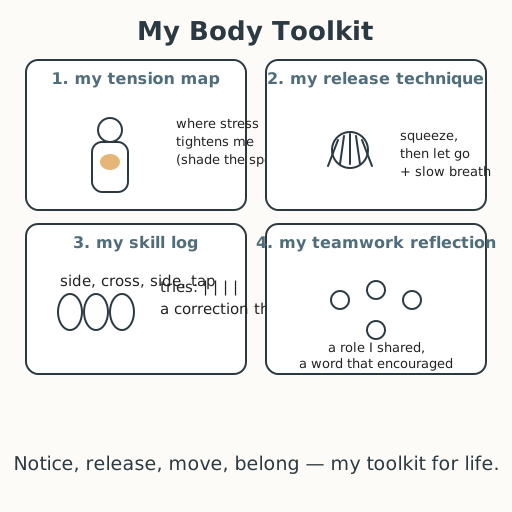
- My body toolkit page · 1 per learner A one-page kit with four labeled sections — my tension map, my release technique, my skill log, my teamwork reflection — to complete as a portfolio artifact
- Practice log and earlier pages · 1 set per learner The learner's own running log and body outline from Lessons 1–7, to carry their answers forward
- Pencils and colors · per learner
Low-tech / no-cost
- A toolkit drawn in the dirt or sand Draw four boxes — map, release, skill, teamwork — and fill each with a word or a mark; no page needed
- Voice and body Say each of the four parts aloud and demonstrate them — point to the tension spot, do the release, step the skill, name a teammate's effort
Enriched / lab & device
- A class 'toolkit gallery' wall · 1 A shared wall where completed toolkits are posted, so learners can see the many valid ways a body works
- A digital toolkit (slides or a short clip) · 1 per learner or group An optional digital version of the toolkit, with a voice note explaining each part
Works in different contexts
- large-group Model one completed toolkit on the board, then have learners fill their own and share one section each in a go-around
- multi-age Younger learners fill each section with a picture or a single word; older learners write full sentences connecting the parts
- self-directed A learner completes all four sections alone and reads the toolkit back as a self-check, then teaches one part to someone else
- level-grouped Learners ready to extend connect the four parts into one paragraph about how noticing, releasing, moving, and belonging work together
- outdoor-only Draw the four boxes on the ground and step to each in turn, demonstrating the map, the release, the step, and a teamwork word aloud
Lesson 8 — My Body at Work: My Tension-Release Toolkit
Summary
Learners close the unit by building a one-page “my body toolkit” — a portfolio artifact that gathers everything they learned: where stress shows up as tension, one named way to release it, the movement skill they built through practice and feedback, and a teamwork reflection. This is retrieval and synthesis: the unit’s learning, carried forward for life.
Objectives
- Explain how emotions and body sensations connect, such as stress and tension, and name one way to release tension. (D03.S1.06.02)
- Learn a new movement skill, such as a dance step or sport skill, through practice, feedback, and correction. (D03.S2.06.01)
- Work cooperatively with teammates, sharing roles and encouraging others regardless of skill level. (D03.S2.06.02)
Connection
A craftsperson carries a small kit — the few tools that do the most work. This unit has been building your kit, and today you lay it out so you can carry it with you. It has four tools: a map of where stress shows up in your body, a release for when it does, a skill you know how to build through practice and feedback, and a team habit of encouraging every person. You do not need any of these tools to be perfect; you only need to know they are yours, and where to reach for them.
Materials
- My body toolkit page
- Practice log and earlier pages
- Pencils and colors
Preparation
- Copy a “my body toolkit” page for each learner (four labeled sections).
- Have learners gather their own running log and body outline from earlier lessons.
- Arrange a quiet space for individual writing and a circle for sharing.
Facilitator note
This lesson is written to the learner (“you”). The idea to land is that the unit’s learning
is now the learner’s own toolkit. This is a summative portfolio artifact and an act of
retrieval — the learner recalls each piece rather than re-reading it. Keep it dignified
and joyful: no two toolkits will match, and that is the point — every body works in its own
way, and every one is honored. If a learner struggles to recall a part, point them to their own
earlier pages (their log, their body outline) rather than telling them the answer. The
reflection should include what helped them improve and who encouraged them, never a ranking.
See docs/facilitation.md.
Procedure
- Gather (5 min). You have learned a lot: how stress shows up as tension, one way to release it, how to build a movement skill, and how to lift up a team. Today you gather it all into a toolkit you can carry with you.
- Meet the toolkit (5 min). Look at the poster — a worked example of the four sections: ① my tension map (a body with one shaded spot); ② my release technique (an open hand — “squeeze, then let go”); ③ my skill log (tallies and footprints); ④ my teamwork reflection (four figures in a circle). Your toolkit will be your own.
- Build your toolkit (30 min). Fill each section, recalling before you check your notes:
- My tension map: where does stress tighten your body? Shade it and name the feeling.
- My release technique: write or draw the four steps — breathe in, squeeze, hold, breathe out and let go — and name it in your own words.
- My skill log: write the four counts of your traveling step and one correction a partner gave you that helped.
- My teamwork reflection: one sentence about a role you shared and one encouraging word you gave or received.
- Share one tool (10 min). In a small circle, each person shares one section and listens to the others. Notice how different — and how complete — the toolkits are.
- Close (5 min). This kit is yours now. Wherever you go, you can notice your body, release its tension, build a skill, and help a team belong. That is a body at work — and a self in good care.
Differentiation
- Support: Offer a partially filled toolkit with pictures and a word bank for each section; scribe as needed; allow one picture per section instead of sentences.
- Extension: Connect the four parts in one paragraph about how noticing, releasing, moving, and belonging work together — and name one new situation where the toolkit will help.
Assessment
- Summative (portfolio): Does the toolkit gather all four pieces — a tension map, a named release technique, the skill with a correction, and a teamwork reflection — in the learner’s own words or drawings?
- Self-check: The learner reads their toolkit back and asks, “If stress arrives tonight, would I know where to reach — and could I teach one of these to a friend?”
Home connection
Show your toolkit to someone at home and teach them one tool from it — the release, the step, or the encouraging word.
Resources
- Retrieval practice — recalling what was learned rather than re-reading it — strengthens
long-term memory (see the learning-science literature and Roediger & Karpicke’s work on
testing effects). Gathering the unit into one portfolio artifact supports synthesis and
metacognition, and honors the developmental turn toward identity at ages 11–14 (see
docs/development.md). For SEL framing of self-awareness and self-management, see CASEL: https://casel.org/fundamentals-of-sel/