Lesson 03 — Passive, Aggressive, Assertive: Three Voices
Learners meet the three communication voices — passive, aggressive, and assertive — and learn to tell them apart by words, tone, and body. They sort real-sounding lines into the three voices and record what each voice sounds like, looks like, and does to a relationship, preparing them to choose assertion in the next lesson.
Objectives
Objectives
- D02.S1.06.02 Distinguish assertive, passive, and aggressive communication and choose assertion.
Essential question
What is the difference between passive, aggressive, and assertive communication?
Key vocabulary
Materials
Standard materials
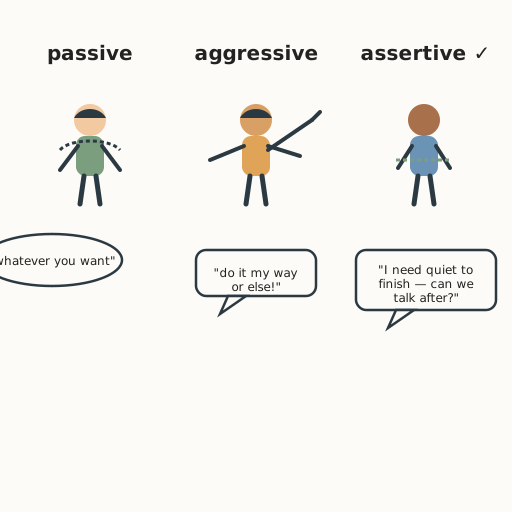
- Three-voices poster · 1 A poster of three figures — one hunched and silent (passive), one pointing and loud (aggressive), one upright and calm (assertive) — each with a sample line
- Three-voices sorting cards · 1 set per pair Cards with spoken lines ("Whatever you want," "Do it my way or else," "I need a little quiet to finish — can we talk after?") to sort into the three voices
- Voice chart page · 1 per learner A three-column chart to record what each voice sounds like, looks like, and does to a relationship
Low-tech / no-cost
- Voice and body only Say a line three ways — passive, aggressive, assertive — using posture and tone, and have a partner name each voice; no cards needed
- A chalk line of three postures Draw or stand in three spots — hunched, pointed, upright — and step to the voice that matches a spoken line
Enriched / lab & device
- A class 'voices' anchor wall · 1 A shared wall with the three voices and example lines learners add over the unit, becoming a norm for choosing assertion
- A short video or audio of the three voices · 1 A brief clip or recording (if available) of the same message delivered passively, aggressively, and assertively, to hear tone and see body
Works in different contexts
- large-group Model the same line in all three voices, then have pairs sort cards and hold up a hand signal (down, up, open) for each voice
- multi-age Older learners act out all three voices while younger learners name each one and point to how the body shows it
- self-directed A learner reads each line, says it three ways aloud or in writing, and records what each voice sounds like, looks like, and does to the relationship
- level-grouped Learners ready to extend explain *why* passive and aggressive voices fail over time (silence breeds resentment; force breeds fear) while assertion builds trust
- outdoor-only Stand in three spots — hunched, pointed, upright — and deliver one line three ways, moving to the matching spot each time; no paper needed
Lesson 3 — Passive, Aggressive, Assertive: Three Voices
Summary
Learners meet the three communication voices — passive, aggressive, and assertive — and learn to tell them apart by words, tone, and body. They sort real-sounding lines into the three voices and record what each voice sounds like, looks like, and does to a relationship, preparing them to choose assertion in the next lesson.
Objectives
- Distinguish assertive, passive, and aggressive communication. (D02.S1.06.02)
Connection
Three people want the same thing: a little quiet to finish their work. One says, “Whatever you want,” and swallows the need — that is the passive voice. Another shouts, “Be quiet, now!” and tramples yours — that is the aggressive voice. The third says, “I need quiet to finish — can we talk after?” — that is the assertive voice: it states the need and respects yours. Same situation, three voices, three very different friendships. Learning to hear the difference is the first step toward choosing the one that builds, everywhere people share space — a schoolroom, a market stall, a shared kitchen.
Materials
- Three-voices poster
- Three-voices sorting cards
- Voice chart page
Preparation
- Print or draw the three-voices poster (hunched/passive, pointing/aggressive, upright/assertive) with a sample line for each.
- Copy a set of sorting cards per pair and a voice chart page per learner.
- Arrange pairs and space to stand in three postures.
Facilitator note
This lesson is written to the learner (“you”). The idea to land is that assertion is the
voice that holds both people’s dignity — it states the need without trampling others
(aggression) or erasing yourself (passivity). Model each voice with tone and body, not just
words; the body carries the meaning and many learners read it faster than text. Be careful
not to mock the passive or aggressive voices or the people who use them — everyone uses all
three sometimes, and each voice is a choice, not a character. A note for global
classrooms: the three-voices model comes from a Western, individually-spoken tradition, and
what counts as respectful differs across cultures. In many cultures — across East Asia, much
of Africa, Indigenous communities, and elsewhere — indirect speech, quietness, deference to
elders, and saving face are the respectful ways to keep a relationship, and they are not
“passivity.” Teach the three voices as a way to notice whether each person’s needs get honored
within a relationship, never as a ranking of any culture’s way of speaking as better or
worse. This is a foundational
skill, so use explicit instruction with worked examples before independent sorting
(Kirschner, Sweller & Clark, 2006). The egalitarian lens: assertion treats the other person
as an equal whose needs count; aggression and passivity both fail that test. See
docs/facilitation.md.
Procedure
- Gather (5 min). Think of a time you wanted something from another person — quiet, a turn, a favor. How did you ask? Today you meet the three voices we all can use.
- Meet the three voices (10 min). Look at the poster. Passive: hunched, silent, “whatever you want” — the need gets swallowed. Aggressive: pointed, loud, “do it my way or else” — the other person gets trampled. Assertive: upright, calm, “I need quiet to finish — can we talk after?” — the need is stated and the other person is respected.
- Hear the difference (10 min). Say the same line three ways aloud, using posture and tone: “I’d like a turn with the tool.” Hunched and whispered; pointed and snapped; upright and calm. Notice how your body changes with each voice — and how the other person would feel hearing each one.
- Sort the voices (15 min). With a partner, take the sorting cards and place each line in one of the three columns. For each, ask: does it swallow the need (passive), trample the other person (aggressive), or state the need and respect the person (assertive)? Record on your voice chart what each voice sounds like, looks like, and does to a relationship.
- Close (5 min). Everyone uses all three voices sometimes — the question is which one you choose in the moment that matters. Tomorrow, you learn to choose assertion.
Differentiation
- Support: Provide three labeled boxes and a short list of lines to read and sort, with the body posture for each voice modeled first.
- Extension: Explain why passivity and aggression fail over time (silence breeds resentment; force breeds fear) while assertion builds trust, and give a real-life example.
Assessment
- Formative (observation/self): Can the learner sort spoken lines into passive, aggressive, and assertive by words, tone, and body, and say what each voice does to a relationship?
- Self-check: The learner asks, “Can I hear and see the difference? Which voice states the need and respects the other person, and why is it called assertive?”
Home connection
Listen for the three voices today — in your home, on a show, in a game. Name quietly to yourself which voice each speaker used.
Resources
- Assertive communication is a well-documented relationship and social-emotional skill; the passive–aggressive–assertive distinction is standard in SEL and conflict-resolution education (CASEL relationship skills): https://casel.org/fundamentals-of-sel/