Lesson 03 — Building on Others' Ideas
Learners practice the heart of good discussion: building on others' ideas instead of just waiting to speak. They meet sentence starters that connect a new idea to the one before it, watch a worked example of a "build-on" chain, and hold a short discussion where every turn visibly rests on the last idea.
Objectives
Objectives
- D04.S1.06.02 Participate in a group discussion, building on others' ideas and disagreeing respectfully.
Essential question
How do I build on what someone else said in a group discussion?
Key vocabulary
Materials
Standard materials
- Build-on sentence starters · 1 per pair A card with starters such as "Building on what ___ said…", "That connects to…", "I want to add…", and "Another reason is…"
- A discussion question card · 1 per group One open question the group genuinely cares about — a class decision, a story, or a shared problem — to discuss
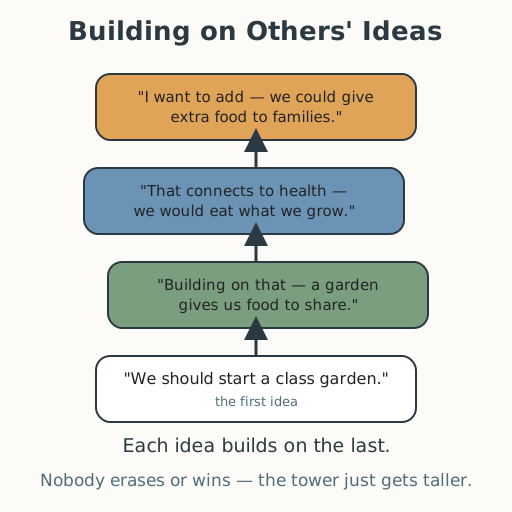
- A 'building blocks' poster · 1 A poster showing a tower of speech bubbles where each bubble rests on the one below it, labeled "each idea builds on the last"
Low-tech / no-cost
- A circle and one question Sit in a circle, ask one real question, and pass a found object as the "talking stone" — each speaker must start by connecting to the idea before theirs; no cards needed
- A 'build or break?' game Say a line aloud and have partners signal whether it builds on the last idea (hands stacked) or breaks away (hands apart)
Enriched / lab & device
- A discussion recorder · 1 per group One learner or a recording device keeps a simple map of who built on whose idea, to see the tower take shape
- A class idea-web wall · 1 A shared wall where learners draw lines from each new idea to the idea it built on, showing the discussion's growth across the unit
Works in different contexts
- large-group Model one build-on chain aloud ("A said…, so B adds…"), then have small groups discuss with the starter cards and report one built idea
- multi-age Older learners model a build-on move and younger learners practice one starter sentence, pairing to build a two-step idea chain
- self-directed A learner writes a short discussion script with three speakers where each visibly builds on the previous idea, then checks each turn connects
- level-grouped Learners ready to extend build a longer chain and note *how* each move builds — by adding, by connecting, by giving a new reason, or by asking a follow-up
- outdoor-only Walk and talk in pairs or a small circle, each person starting their turn by connecting to the last idea, using a found object as the talking stone
Lesson 3 — Building on Others’ Ideas
Summary
Learners practice the heart of good discussion: building on others’ ideas instead of just waiting to speak. They meet sentence starters that connect a new idea to the one before it, watch a worked example of a “build-on” chain, and hold a short discussion where every turn visibly rests on the last idea.
Objectives
- Participate in a group discussion by building on others’ ideas. (D04.S1.06.02)
Connection
Think of a real conversation that went somewhere good — someone said one thing, and the next person’s words made it bigger, not different. “We should start a class garden.” “Building on that — a garden gives us food to share.” “That connects to health — we’d eat what we grow.” Each idea rested on the one before it, like blocks in a tower. The opposite is a conversation where everyone only waits for their turn and nobody’s words touch anyone else’s. Building on others’ ideas is the skill that turns a group of people talking into one mind thinking together — in a classroom, a family, or a community meeting.
Materials
- Build-on sentence starters
- A discussion question card
- A “building blocks” poster
Preparation
- Print or draw the building-blocks poster (a tower of speech bubbles, each resting on the one below).
- Copy the build-on sentence starters for each pair.
- Prepare one discussion question the group genuinely cares about.
Facilitator note
This lesson is written to the learner (“you”). The idea to land is that discussion is a
shared construction, not a sequence of separate speeches — a good turn connects to the last
one. Teach the sentence starters explicitly (a novice skill; model then guide — Kirschner,
Sweller & Clark, 2006), and hold the discussion lightly: the goal is connection, not
coverage or correctness. Honor every home language — learners may build on ideas in their
strongest language, and code-switching between languages in one discussion is welcome, not a
mistake. Watch for quiet learners and invite them with a gentle, genuine question; “build on”
starters give everyone a way in. Cooperation over competition (docs/philosophy.md §8).
Procedure
- Gather (5 min). Think of a time a conversation grew because each person added to the last idea. Today you practice doing that on purpose: building on others’ ideas.
- Meet the tower (10 min). Look at the poster. Four bubbles stack into a tower. The first says, “We should start a class garden.” The next three each build on the one below: “Building on that — a garden gives us food to share.” “That connects to health — we’d eat what we grow.” “I want to add — we could give extra food to families.” Nobody erases or wins; the tower just gets taller.
- Learn the starters (10 min). Read the starter card: “Building on what ___ said…”, “That connects to…”, “I want to add…”, “Another reason is…”. Practice saying one starter aloud once. Notice: each begins by pointing back to the idea before it.
- Hold a discussion (20 min). In a small group, take up your question. The rule: every turn must start by connecting to the last idea — with a starter, or in your own words. If someone forgets, gently pass the talking stone back and ask, “How does that connect?” Build the tallest tower you can in ten minutes, then share one built idea with the whole group.
- Close (5 min). A discussion is not a list of speeches; it is one idea that many hands lift together. When you build on others, you make everyone’s thinking stronger — including your own.
Differentiation
- Support: Provide the starter sentence to copy and a single question with a shared word bank; allow a two-person “build one step” turn before the full circle.
- Extension: After the discussion, map the tower — who built on whose idea, and how (added, connected, gave a new reason, asked a follow-up) — and name which moves made the thinking deepest.
Assessment
- Formative (observation/peer): Does each learner’s turn visibly connect to the previous idea, using a starter or their own link, rather than starting an unrelated point?
- Self-check: The learner asks, “If someone pointed at my sentence, could they draw a line from it to the idea right before it?”
Home connection
In a conversation at home, try one “building on” move — “building on what you said…” — and notice how the other person responds.
Resources
- Cooperative discussion and “building on” talk moves are well-supported structures; see the
“talk moves” of accountable talk (Michaels & O’Connor) and cooperative-learning research
(Johnson & Johnson). On cooperation over competition and explicit instruction for novice
skills, see
docs/philosophy.mdand Kirschner, Sweller & Clark (2006).