Lesson 09 — Writing My Claim and Reasons
Learners begin their own argument by writing a claim and the reasons that support it. They meet a full worked example — one claim joined to three reasons by "because" — learn the "does it support the claim?" test, and draft their own claim and reasons on a real topic. This is step one of three toward a complete argument (evidence and counterargument follow).
Objectives
Objectives
- D04.S3.06.01 Write a well-developed argument with a claim, reasons, evidence, and a response to a counterargument.
Essential question
How do I state a claim and support it with reasons?
Key vocabulary
Materials
Standard materials
- Claim-and-reasons poster · 1 A poster showing one modeled argument — a claim plus its reasons, each reason joined to the claim by "because" — with labels for claim and reason
- Claim-and-reasons frame · 1 per learner A simple frame — "I believe ___ because (reason 1), (reason 2), and (reason 3)."
- Topic chooser cards · 1 set per group Cards naming real, local topics worth arguing for — a school garden, a rest spot, a water tap, a reading corner — to choose from or adapt
Low-tech / no-cost
- Voice and a real want Say aloud something you want changed and give two reasons, each starting with "because"; a partner checks that every reason really supports the claim; no paper needed
- A 'claim or reason?' game Say a sentence aloud and have partners signal "claim" (one fist) or "reason" (open hand); no cards needed
Enriched / lab & device
- A class claim-and-reasons wall · 1 A shared wall where learners post their claims and reasons, growing the argument bank they will draw on in the next two lessons
- A digital writing tool · 1 per group To draft the claim and reasons where devices are available (full formatting comes in a later lesson)
Works in different contexts
- large-group Model the full claim-and-reasons example on the board, then have learners draft their own claim and reasons with the frame and share one
- multi-age Younger learners say a claim and one reason aloud while older learners write the claim and three reasons and check that each supports the claim
- self-directed A learner chooses a topic, drafts a claim and three reasons, and checks each reason against the "does it support the claim?" test
- level-grouped Learners ready to extend order their reasons from strongest to weakest and explain why they would lead with the strongest
- outdoor-only Choose a real change outside — shade, a path, a bench — and say your claim and reasons aloud, a partner checking each reason supports the claim
Lesson 9 — Writing My Claim and Reasons
Summary
Learners begin their own argument by writing a claim and the reasons that support it. They meet a full worked example — one claim joined to three reasons by “because” — learn the “does it support the claim?” test, and draft their own claim and reasons on a real topic. This is step one of three toward a complete argument (evidence and counterargument follow).
Objectives
- Write a claim and support it with reasons. (D04.S3.06.01)
Connection
You want something to change — a garden, a rest spot, a water tap, a reading corner. You could just say “I want it,” but that convinces no one. The moment you say why — “because there is nowhere cool to sit, because children play in the hot sun” — you have begun an argument: a claim (what you believe should happen) plus reasons (why). This is not about winning or talking the loudest. It is about giving another person honest reasons they can weigh — the same move you made when you disagreed respectfully, now written down, in any language.
Materials
- Claim-and-reasons poster
- Claim-and-reasons frame
- Topic chooser cards
Preparation
- Print or draw the claim-and-reasons poster (claim on top, reasons below, joined by “because”).
- Copy the frame for each learner and the topic cards for each group.
Facilitator note
This lesson is written to the learner (“you”). The idea to land is that an argument is a
claim plus reasons — and a reason is only a reason if it supports the claim, not just
restates it or wanders. Use the worked example fully and slowly; this is a foundational
writing skill, so model it step-by-step before independent drafting (Kirschner, Sweller &
Clark, 2006). Retrieval: connect back to Lesson 1’s claim/detail/example tree — writing an
argument is making your own tree. Hold the ethical frame firmly: argument is reasoned claim,
never winning or rhetoric (docs/philosophy.md §4, §7). Honor every home language: draft in
the strongest language. The modeled example — planting shade and fruit trees — is adaptable;
invite learners to argue for what their community actually needs.
Procedure
- Gather (5 min). Think of one change you genuinely want in your school or neighborhood. Today you start an argument for it — not by shouting, but by writing a claim and reasons.
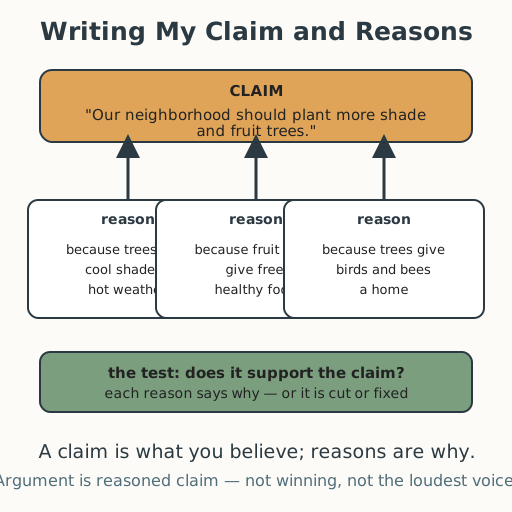
- Meet the worked example (10 min). Look at the poster. The claim: “our neighborhood should plant more shade and fruit trees.” The reasons, each joined by “because”: “because trees give cool shade in hot weather,” “because fruit trees give free, healthy food,” “because trees give birds and bees a home.” Notice: each reason supports the claim. A reason that doesn’t support it — “because I like green” — is not a reason for this claim.
- Learn the test (5 min). For each reason, ask: “Does it support the claim?” If you can say “this is why I believe the claim,” it’s a reason. If not, cut it or fix it.
- Draft your claim and reasons (20 min). Choose a topic from the cards or your own. Write your claim in one clear sentence. Then write three reasons, each starting with “because.” Run each through the test with a partner: does every reason support your claim?
- Close (5 min). You now have the spine of an argument: a claim you believe, and reasons that say why. Next lesson you will strengthen it with evidence — and answer the person who disagrees.
Differentiation
- Support: Provide the claim already written and two reasons to choose between; ask the learner to add one reason of their own and run the test.
- Extension: Write four reasons, then order them strongest to weakest and explain why you would lead with the strongest.
Assessment
- Formative (peer/portfolio): Is the claim a clear, arguable position, and does each reason actually support it (not restate it)?
- Self-check: The learner asks, “For each ‘because’ sentence, could a reader say ‘yes, that’s why you believe this’?”
Home connection
Tell someone at home one change you want, and give them two honest reasons — each starting with “because” — and see how they respond.
Resources
- Argument writing as claim + reasons (Toulmin’s claim/data/warrant) is standard; for classroom
guidance see Graham & Perin, “Writing Next” (Carnegie Corporation, 2007) and the IES
“Teaching Secondary Students to Write Effectively” guide. On explicit instruction and worked
examples for novice writers, see Kirschner, Sweller & Clark (2006). The “reasoned claim, not
winning” stance is a values commitment (
docs/philosophy.md§4, §7).