Lesson 01 — Ratios in Fair Shares
Learners meet the ratio as a way to describe a fair share (for every 2 oranges there are 3 apples) and discover that a share stays fair when both parts are multiplied by the same number. They build shares with counters, write ratios, and extend ratio tables (2:3, 4:6, 6:9) so the same fairness holds for any size of group.
Objectives
Objectives
- D05.S1.06.01 Use ratios and rates to describe and compare real situations such as fair shares, recipes, and unit prices.
Essential question
What is a ratio, and how does it keep a share fair when the group changes size?
Key vocabulary
Materials
Standard materials
- Counters in two kinds · 20 of each per pair Stones, seeds, beans, or two colors of small objects to build ratio shares
- Ratio recording page · 1 per learner A page with ratio tables to fill in and pictures of shares to match
- Ratio table chart · 1 per pair A blank table with two columns to record equivalent ratios
Low-tech / no-cost
- Found objects Use leaves, pebbles, twigs, or seeds of two kinds; build shares on the ground or a cloth
- Voice and body Chant the ratio ("for every 2, there are 3") and have learners group themselves to act out doubling a share
Enriched / lab & device
- A ratio-match game · 1 per group Cards pairing a picture of a share with its ratio and a doubled version, for repeated play
- A simple spreadsheet or slider · 1 per group A tool that doubles or triples both columns of a ratio table together, where devices allow
Works in different contexts
- large-group Build one big share at the front, then have pairs double and triple it and record the table
- multi-age Younger learners count and build a share with objects while older learners write and extend the ratio table
- self-directed A learner works the recording page alone, building shares with counters and checking against the worked example
- level-grouped Learners ready to extend find a missing part of an equivalent ratio and explain why both parts must change together
- outdoor-only Use found objects outdoors (two kinds of leaves or seeds) to build and double fair shares on the ground
Lesson 1 — Ratios in Fair Shares
Summary
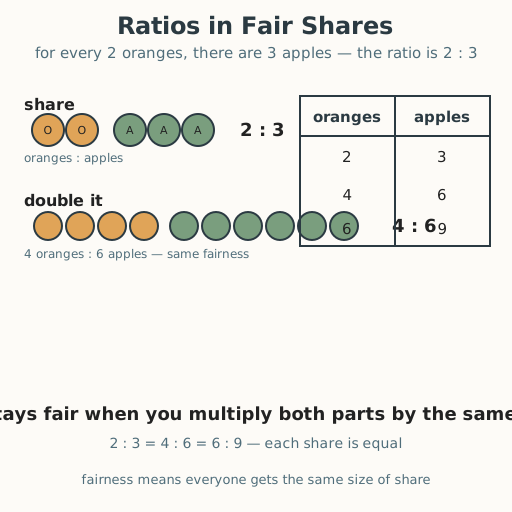
Learners meet the ratio as a way to describe a fair share: “for every 2 oranges there are 3 apples.” They build shares with counters, write the ratio 2 : 3, and discover that a share stays fair when both parts are multiplied by the same number — 4 : 6, 6 : 9. The same fairness holds for any size of group.
Objectives
- Use a ratio to describe and compare a fair share, and find equivalent ratios by scaling both parts together. (D05.S1.06.01)
Connection
Two families share a harvest basket: for every 2 oranges one family takes, the other takes 3 apples — because oranges are bigger and rarer. If a third family joins and the basket doubles, “fair” now means 4 oranges and 6 apples, not 2 and 3. The ratio 2 : 3 is a recipe for fairness that scales to any number of people. From dividing a catch of fish to mixing paint to sharing a sack of grain, people everywhere use “for every” thinking to keep shares equal.
Materials
- Counters in two kinds
- Ratio recording page
- Ratio table chart
Preparation
- Gather two kinds of counters (stones and seeds, two colors of beans) — about 20 of each per pair.
- Copy the ratio recording page and the ratio table chart.
- Have a worked example ready: for every 2 oranges, 3 apples → 2 : 3; doubled → 4 : 6.
Facilitator note
This lesson is written to the learner (“you”). The ideas to land: (1) a ratio compares two
quantities (“for every A there are B”); (2) the order of a ratio matters — 2 : 3 is not 3 : 2;
and (3) a ratio stays equivalent when you multiply or divide both parts by the same number.
Because ratio is a foundational skill, use explicit instruction and worked examples first
(Kirschner, Sweller & Clark, 2006): model building 2 oranges : 3 apples aloud, then guide a second
share before independent work. Watch for the common slip of adding instead of multiplying (2:3 → 4:5
instead of 4:6). Retrieval: ask learners to recall sharing and fractions from earlier grades — a ratio
is a new, clearer way to hold that same fairness. The fairness lens is central (docs/philosophy.md §4):
ratios are how “equal shares” is made exact. Note the global point: ratio and proportion appear in
records from ancient Egypt, Mesopotamia, and India (for example, the Baudhayana rules for scaling a
sacrificial altar by proportion) — “for every” thinking is a human universal, not one culture’s
invention.
Procedure
- Gather (5 min). Think of a time you shared something fairly with others. How did you decide how much each person got? Today you learn the math that makes “fair” exact.
- Meet the ratio (10 min). A ratio compares two quantities. “For every 2 oranges, there are 3 apples” is written 2 : 3 (say “two to three”). The first number matches the first thing you named. Order matters: 2 : 3 is not the same as 3 : 2.
- Worked example (10 min). Build the share with counters: 2 oranges and 3 apples. Write 2 : 3. Now a second family joins and the basket doubles. Double both parts: 4 oranges and 6 apples. Write 4 : 6. Did the share stay fair? Yes — each family still gets the same mix.
- Extend the table (10 min). Fill the ratio table: 2 : 3, then 4 : 6, then 6 : 9 (triple). The rule: multiply both numbers by the same amount. What would a share for 10 families look like? Start from 2 : 3 and multiply by 5 → 10 : 15.
- Practice with a partner (10 min). Take turns inventing a share (for every 3 cups of rice, 2 cups of beans), building it with counters, and doubling and tripling it in a ratio table. Check each other: did both parts change together?
- Close (5 min). A ratio is a recipe for fairness. To keep a share fair for a bigger group, multiply both parts by the same number. That single idea scales from two friends to a whole village.
Differentiation
- Support: Use only small whole-number ratios (2 : 3, 1 : 2) and keep the table to two rows at first. Describe each move aloud and use tactile counters so learners with low vision can follow by touch.
- Extension: Find a missing part of an equivalent ratio (3 : 5 = ? : 20) and explain why both parts must change together; write the rule in words.
Assessment
- Formative (observation/self): Can the learner build a ratio with objects, write it, and find an equivalent ratio by multiplying both parts by the same number?
- Self-check: The learner asks, “Does my doubled share keep the same mix? Did I multiply both numbers by the same amount?”
Home connection
At home, find a recipe or a sharing situation with two amounts (rice and water, flour and sugar, two kinds of fruit) and write its ratio; then double it and write the new ratio.
Resources
- Ratios and equivalent ratios are standard in elementary mathematics; see John A. Van de Walle,
Elementary and Middle School Mathematics (10th ed., 2019). The note that proportional scaling rules
appear in ancient Egyptian, Mesopotamian, and Indian mathematical records is a historical observation
(e.g., the Baudhayana Sulba Sutra on scaling altars); treating all traditions as worthy is a value
(
docs/philosophy.md§4). The claim that fairness means equal shares is a value commitment, not a mathematical fact.