Lesson 02 — Rates: Recipes and Unit Prices
Learners meet the rate as a ratio of two different kinds of quantity (cups of flour per cups of water; coins per kilogram) and the unit rate as the amount "per 1." They scale a recipe, compute unit prices for two package sizes, and choose the better buy by comparing per-1 amounts.
Objectives
Objectives
- D05.S1.06.01 Use ratios and rates to describe and compare real situations such as fair shares, recipes, and unit prices.
Essential question
What is a rate, and how does a unit rate help me compare prices and cook fairly?
Key vocabulary
Materials
Standard materials
- Unit-price cards · 1 set per group Cards showing two package sizes with their amounts and prices, to compare "per 1" rates
- Recipe scaling page · 1 per learner A page to scale a recipe up or down using a rate, and to find unit prices
- A small balance or measuring cups · 1 per group Where available, to feel a rate physically (cups per batch)
Low-tech / no-cost
- Market role-play Use real or drawn "bags" of grain with amounts and coin counts written on them; compare per-unit amounts aloud
- Chant and clap Chant the rate ("three cups for every two") and clap once per unit to hear the "per one" rhythm
Enriched / lab & device
- A unit-rate game · 1 per group A game matching amounts and prices to their unit rate, for repeated play
- A real market or shop visit · 1 trip Read two package labels, find each unit price, and decide which is the better buy
Works in different contexts
- large-group Compare two big package examples at the front together, then have pairs find unit prices for card sets and share one decision
- multi-age Younger learners match amounts to prices while older learners divide to find the unit rate and compare
- self-directed A learner works the recipe-scaling page alone, computing unit prices and checking against the worked example
- level-grouped Learners ready to extend compare three package sizes and explain which is best and why the smallest is not always cheapest
- outdoor-only Use a market stall outdoors with real or drawn goods and coin prices; find the "per one" price by sharing the amount into equal piles
Lesson 2 — Rates: Recipes and Unit Prices
Summary
Learners meet the rate as a ratio of two different kinds of quantity — cups of flour per cups of water, coins per kilogram — and the unit rate as the amount “per 1.” They scale a recipe up and down, compute unit prices for two package sizes, and decide which is the better buy by comparing per-1 amounts.
Objectives
- Use rates and unit rates to describe and compare real situations such as recipes and unit prices. (D05.S1.06.01)
Connection
Two bags of rice sit side by side in a market: one holds 2 kilograms and costs 8 coins, the other holds 3 kilograms and costs 9 coins. Which is the better buy? You cannot tell from the price alone — you must ask “how much for one kilogram?” That “per 1” amount is a unit rate, and it is how shoppers everywhere, from a stall in Accra to a market in Manila to a shop in Lima, compare prices honestly. Cooks use the same idea to scale a recipe: if 2 cups of rice need 3 cups of water, then 4 cups of rice need 6 cups of water.
Materials
- Unit-price cards
- Recipe scaling page
- A small balance or measuring cups (where available)
Preparation
- Copy unit-price cards for groups and the recipe scaling page for each learner.
- Have two worked examples ready: 2 kg → 8 coins means 4 coins per kg; and scaling 2:3 rice:water to 4:6.
Facilitator note
This lesson is written to the learner (“you”). The ideas to land: (1) a rate is a ratio of two
different units (flour per water, coins per kilogram); (2) a unit rate is the amount for one
unit, found by division (8 coins ÷ 2 kg = 4 coins per kg); and (3) comparing unit rates, not sticker
prices, reveals the better buy. Model a worked example first, then guide a second before
independent work (Kirschner, Sweller & Clark, 2006). Two common slips: dividing the wrong way (kg ÷
coins instead of coins ÷ kg) and comparing total prices instead of per-1 prices. Retrieval: ask
learners to recall yesterday’s ratio (2 : 3) — a rate is a ratio with units attached. The
egalitarian lens is sharp here (docs/philosophy.md §4): the skill of finding a unit price protects
buyers from overpaying, which matters most to people with the least to spend. Note the global point:
the idea of a “per one” price is ancient and appears wherever people trade; we use “coins” as a
stand-in so no single currency is treated as the default.
Procedure
- Gather (5 min). Have you ever wondered whether a big package is really cheaper than a small one? Today you learn the “per one” trick that answers it.
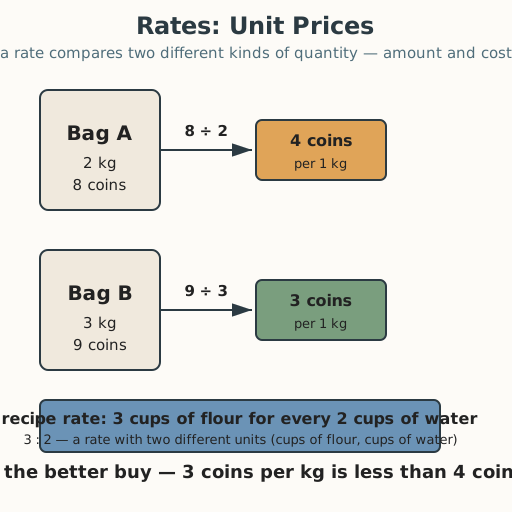
- Meet the rate (10 min). A rate compares two different kinds of quantity. “3 cups of flour for every 2 cups of water” is a rate. A unit rate tells you the amount for just one: if 2 kg cost 8 coins, then 8 ÷ 2 = 4 coins per 1 kg.
- Worked example — recipe (10 min). A porridge recipe needs 2 cups of rice for 3 cups of water. You want to double it. Multiply both: 4 cups rice and 6 cups water. The rate 2 : 3 stays the same. What if you triple it? 6 : 9.
- Worked example — unit price (10 min). Bag A: 2 kg for 8 coins → 8 ÷ 2 = 4 coins per kg. Bag B: 3 kg for 9 coins → 9 ÷ 3 = 3 coins per kg. Compare the per-1 amounts: 3 is less than 4, so Bag B is the better buy.
- Practice with a partner (10 min). Take your unit-price cards. For each pair of packages, find each unit price and decide which is the better buy. Then scale one recipe up and one down. Check each other: did you divide the right way, and compare per-1 amounts?
- Close (5 min). A rate compares two different units; a unit rate is “per 1.” Divide to find it, then compare — that is the honest way to shop and to cook.
Differentiation
- Support: Use whole-number rates with easy division (4 kg → 8 coins; 5 cups → 10 spoons). Read amounts aloud and keep the division visible with shared-out counters.
- Extension: Compare three package sizes, find all three unit prices, and explain that the biggest package is not always the best buy; express the rate in two ways (coins per kg and kg per coin).
Assessment
- Formative (observation/self): Can the learner find a unit rate by dividing, and use unit prices to choose the better buy?
- Self-check: The learner asks, “Did I divide amount-by-amount the right way? Did I compare per-1 amounts, not total prices?”
Home connection
At a shop or market (or using two packages at home), find two sizes of the same item, compute the per-1 price of each, and tell someone which is the better buy.
Resources
- Rates and unit rates are standard in elementary mathematics; see John A. Van de Walle, Elementary
and Middle School Mathematics (10th ed., 2019). The note that “per one” pricing is a long-standing
practice of trade worldwide is a historical observation; the claim that honest unit-price comparison
protects buyers is an egalitarian value (
docs/philosophy.md§4). Using “coins” rather than any one currency is a deliberate choice to avoid a single default currency.