Lesson 05 — Variables and Expressions for Real Situations
Learners use a variable to write an expression for a real situation (t cups of tea at 4 coins each plus a 3-coin pot → 4t + 3) and evaluate it by substituting a number for the variable. They write their own expressions from situations and interpret what each part means.
Objectives
Objectives
- D05.S2.06.01 Use variables to write expressions and equations that represent real situations, and solve one-step equations.
Essential question
How do I use a variable to write an expression for a real situation?
Key vocabulary
Materials
Standard materials
- Expression cards · 1 set per group Cards pairing a real situation (t cups of tea at a price, plus a fixed cost) with its expression
- Substitution chart · 1 per learner A chart to evaluate an expression for several values of the variable
- Recording page · 1 per learner A page to write expressions for situations and evaluate them
Low-tech / no-cost
- Cups and counters Use a cup as the variable (an unknown amount) and stones or seeds as the known amounts; build each expression with real objects
- Voice patterns Chant the situation ("four coins per cup, plus three for the pot") and substitute numbers aloud
Enriched / lab & device
- A simple spreadsheet · 1 per group A spreadsheet with a formula cell that evaluates an expression for different values of a variable, where devices allow
- An expression-match game · 1 per group A game matching situations to expressions and to their values for given amounts
Works in different contexts
- large-group Model writing and evaluating one expression at the front, then have groups match situations to expressions and share one
- multi-age Younger learners substitute numbers into a ready-made expression while older learners write the expression from the situation
- self-directed A learner works the recording page alone, writing and evaluating expressions and checking against the worked example
- level-grouped Learners ready to extend write expressions with two operations and parentheses, and evaluate for a table of values
- outdoor-only Use a cup or basket as the variable and real objects outdoors to build and evaluate each expression
Lesson 5 — Variables and Expressions for Real Situations
Summary
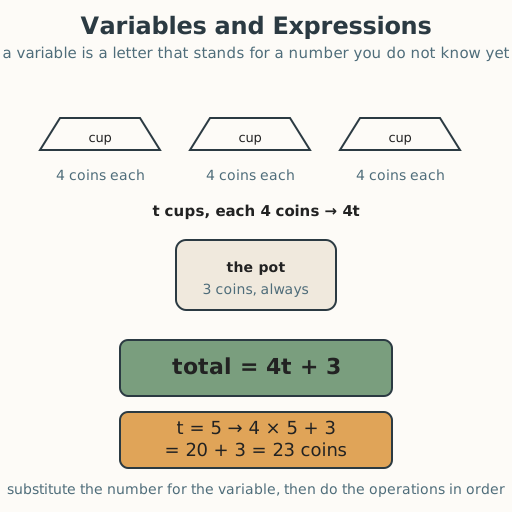
Learners use a variable to write an expression for a real situation: t cups of tea at 4 coins each plus a 3-coin pot becomes 4t + 3. They evaluate the expression by substituting a number for the variable (t = 5 → 4 × 5 + 3 = 23), write their own expressions from situations, and say what each part means.
Objectives
- Use a variable to write an expression for a real situation and evaluate it by substitution. (D05.S2.06.01)
Connection
A tea seller charges 4 coins for each cup and 3 coins for the pot, always. If you do not yet know how many cups a customer will buy, you can still write the rule: 4t + 3, where t stands for the number of cups. The moment the customer says “five cups,” you substitute: 4 × 5 + 3 = 23 coins. A variable is a box that can hold any number, and an expression is the recipe that tells you what to do with it. Sellers, builders, cooks, and bus drivers use such recipes all day, everywhere.
Materials
- Expression cards
- Substitution chart
- Recording page
Preparation
- Copy expression cards for groups, the substitution chart, and the recording page.
- Have a worked example ready: t cups at 4 coins each plus 3 for the pot → 4t + 3; t = 5 → 23.
Facilitator note
This lesson is written to the learner (“you”). The ideas to land: (1) a variable is a letter that
stands for an unknown or changing amount; (2) an expression combines numbers, variables, and
operations — 4t + 3 means “4 times t, then add 3” (the number next to the variable is a
coefficient); and (3) to evaluate, substitute a number for the variable and do the operations in
order. Model a worked example first, then guide a second before independent work (Kirschner, Sweller &
Clark, 2006). Two common slips: reading “4t” as “4 plus t” (it means 4 × t), and doing the operations
out of order. Retrieval: ask learners to recall the rates and unit prices from earlier lessons — “4
coins per cup” is a rate, and now the variable turns it into a reusable recipe. The critical-thinking
lens: writing a rule clearly so anyone can follow it is a shareable, egalitarian value
(docs/philosophy.md §4). Note the global point: variables are a human convention — different
traditions have used different symbols, and algebra grew from the work of al-Khwarizmi and others
across the Persian and Arabic world, building on Indian and Greek number ideas. The letter we choose is
ours; the idea of “a number you do not know yet” is universal.
Procedure
- Gather (5 min). Last time you ordered signed numbers. Now think: a seller charges 4 coins a cup but does not yet know how many cups you want. How can they write the price before knowing? Today you learn the letter that holds the place.
- Meet variables and expressions (10 min). A variable is a letter for a number you do not know yet. Let t stand for cups of tea. Each cup is 4 coins, so t cups cost 4t (which means 4 × t). The pot is 3 coins, always, so the whole cost is 4t + 3. This rule is called an expression.
- Worked example — write (10 min). Write an expression for: “7 coins for each bowl of noodles plus 2 coins for the box.” That is 7b + 2. What about “n cakes shared equally by 4 people”? That is n ÷ 4.
- Worked example — evaluate (10 min). Evaluate 4t + 3 when t = 5. Substitute: 4 × 5 + 3. Multiply first: 20, then add 3: 23. Five cups of tea plus the pot is 23 coins. Try t = 2: 4 × 2 + 3 = 11.
- Practice with a partner (10 min). Take your expression cards: match each situation to its expression, then evaluate it for the value given. Check each other: did you multiply where it says multiply, and do operations in order?
- Close (5 min). A variable holds the place of an unknown number, and an expression is the recipe for what to do with it. Write the recipe first, then substitute — that is the whole skill.
Differentiation
- Support: Use only expressions like n + 3 and 5n (no two operations at first); keep the substitution chart to one clear value. Describe each step aloud and use cups/counters so learners with low vision can follow by touch.
- Extension: Write expressions with parentheses and two operations (2(n + 3)) and evaluate for a table of several values; write a real situation for a partner to match.
Assessment
- Formative (observation/self): Can the learner write an expression for a real situation and evaluate it correctly by substitution?
- Self-check: The learner asks, “Does my expression match the situation word for word, and did I substitute and operate in the right order?”
Home connection
Find a situation at home with an unknown amount (a bag with n things, a recipe for n people) and write an expression for it; then pick a number and evaluate it.
Resources
- Variables and expressions are standard in middle-grades mathematics; see John A. Van de Walle,
Elementary and Middle School Mathematics (10th ed., 2019). The note that algebra grew from the work
of al-Khwarizmi and others across the Persian and Arabic world, building on Indian and Greek ideas, is
documented history; the value that clear rules should be shareable by everyone is a commitment
(
docs/philosophy.md§4).