Lesson 04 — Locating and Ordering Integers on a Number Line
Learners locate integers on a horizontal number line and put them in order, discovering the rule that farther left is smaller and farther right is larger. They place shuffled integer cards, write orderings with less-than and greater-than symbols, and explain why a negative number farther from zero is the smaller one.
Objectives
Objectives
- D05.S1.06.02 Use positive and negative numbers to represent real situations such as temperature and elevation, and locate and order them on a number line.
Essential question
How do I locate integers on a number line and put them in order?
Key vocabulary
Materials
Standard materials
- Horizontal number line · 1 per pair A number line from -5 to 5 with open spots for placing integer cards
- Integer cards · 1 set per group Cards from -5 to 5 to place and order on the line
- Ordering recording page · 1 per learner A page to order sets of integers and write them with less-than and greater-than symbols
Low-tech / no-cost
- A chalk or rope line Draw a line on the ground with 0 in the middle; learners stand on integers to order themselves
- Stones and a drawn line Place stones at integers on a line drawn in the dirt; move them to order the numbers
Enriched / lab & device
- An integer ordering game · 1 per group A game where learners race to place shuffled integer cards in order, for repeated play
- A digital number-line tool · 1 per group A tool that plots and sorts integers and shows comparisons, where devices allow
Works in different contexts
- large-group Have a human number line at the front — learners hold integer cards and sort themselves — then pairs order card sets
- multi-age Younger learners place positive integers while older learners place and compare the negatives and the whole set
- self-directed A learner places the integer cards alone, orders them, and checks against the worked example
- level-grouped Learners ready to extend order integers across a wider range (including -20, -15) and explain "farther left is smaller"
- outdoor-only Draw a long line on the ground with 0 in the middle, mark integers with chalk, and have learners physically order themselves
Lesson 4 — Locating and Ordering Integers on a Number Line
Summary
Learners locate integers on a horizontal number line and put them in order, discovering the rule that farther left is smaller and farther right is larger. They place shuffled integer cards, write orderings with less-than and greater-than symbols, and explain why a negative number farther from zero is the smaller one.
Objectives
- Locate and order integers on a number line and compare them using less-than and greater-than. (D05.S1.06.02)
Connection
A mountain guide checks temperatures along a climb: at the base it is +3°C, at a high camp it is −4°C, and on the way down the valley it drops to −10°C. To say which is warmest and which is coldest, the guide puts them on a line and reads them left to right. The same line orders debts and credits, depths and heights, losses and gains — anywhere “less than zero” meets “more than zero.” Ordering signed numbers is how people everywhere decide what is higher, colder, deeper, or farther behind.
Materials
- Horizontal number line
- Integer cards
- Ordering recording page
Preparation
- Copy horizontal number lines (−5 to 5) for pairs and integer cards for groups.
- Copy the ordering recording page.
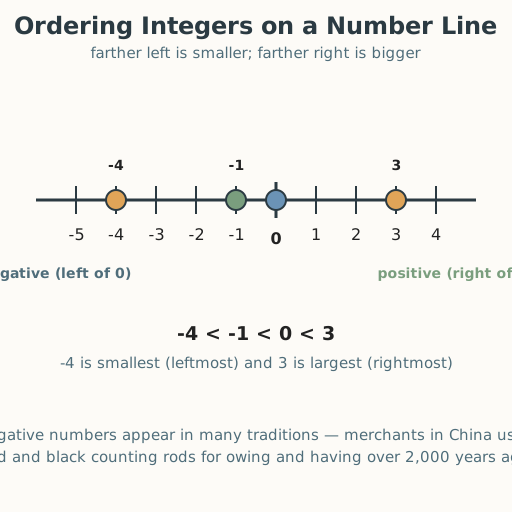
- Have examples ready: order −4, −1, 0, 3 from least to greatest.
Facilitator note
This lesson is written to the learner (“you”). The ideas to land: (1) integers are the whole
numbers plus their negatives and zero; (2) on a horizontal line, left is smaller, right is larger;
and (3) among negatives, the one farther from zero is smaller (−4 < −1, even though 4 > 1). Model a
worked example, then guide a second before independent work (Kirschner, Sweller & Clark, 2006). The
classic slip is saying “−4 is bigger than −1” because 4 > 1 — fix it by always returning to the line.
Retrieval: ask learners to recall yesterday’s vertical line (temperature/elevation) — today the same
integers lie on a horizontal line and get ordered. The global point worth naming: the horizontal number
line with negatives became standard through work across cultures (notably in India and the
Persian/Arabic world), and the idea of “below zero” is older than any single notation. The critical
thinking lens: reading order carefully — not guessing by the size of the digit — is an honest-reasoning
habit (docs/philosophy.md §7).
Procedure
- Gather (5 min). Yesterday you met positive and negative numbers standing above and below zero. Today you lay them out left to right and put them in order.
- Meet the line (10 min). Look at the horizontal number line. Zero is in the middle. Numbers to the left are negative; numbers to the right are positive. The farther left, the smaller; the farther right, the larger.
- Worked example (10 min). Place −4, −1, 0, and 3 on the line. Read them left to right: −4, −1, 0, 3. That is least to greatest. Write it with symbols: −4 < −1 < 0 < 3 (“less than”). Check: −4 is farthest left, so it is smallest.
- Worked example — the negative trap (10 min). Compare −4 and −1. Which is smaller? −4 is farther left, so −4 < −1 — even though 4 > 1. When both numbers are negative, the one farther from zero is smaller. Always look at the line.
- Practice with a partner (10 min). Shuffle your integer cards and place them on the line. Then write the order with < and >. Take turns: one places, one checks against the line.
- Close (5 min). Ordering integers is one rule: farther left is smaller, farther right is larger. With negatives, that means “more negative” is smaller — trust the line, not the digit.
Differentiation
- Support: Use only −3 to 3 at first, with a large tactile line and the words “smaller ← → bigger” written above it. Read each comparison aloud so learners with low vision can follow by listening.
- Extension: Order a wider set (including −20, −15, 5, 0) and explain the rule in writing; find a real situation (temperatures on a climb, depths of lakes) and order them.
Assessment
- Formative (observation/self): Can the learner locate integers on the line and order them correctly, including negative numbers?
- Self-check: The learner asks, “Did I put each number on the line and read left to right? For negatives, did I remember the one farther from zero is smaller?”
Home connection
Write the temperatures (or any signed numbers) from your place over a week and order them from coldest to warmest.
Resources
- Ordering integers on a number line is standard in middle-grades mathematics; see John A. Van de Walle,
Elementary and Middle School Mathematics (10th ed., 2019). The note that negative numbers and their
notation developed across Indian and Persian/Arabic mathematical traditions is documented history; the
habit of reading order carefully rather than guessing is a critical-thinking value (
docs/philosophy.md§7).