Lesson 09 — Balanced and Unbalanced Forces
Learners learn that balanced forces (equal and opposite) mean no change in motion, while unbalanced forces mean the motion changes — an object speeds up, slows down, or changes direction. They lay out force arrows, predict, and test with a book, a ball, and a tug-of-war.
Objectives
Objectives
- D06.S3.06.02 Explain how balanced and unbalanced forces determine whether an object's motion changes.
Essential question
How do balanced and unbalanced forces decide whether an object's motion changes?
Key vocabulary
Materials
Standard materials
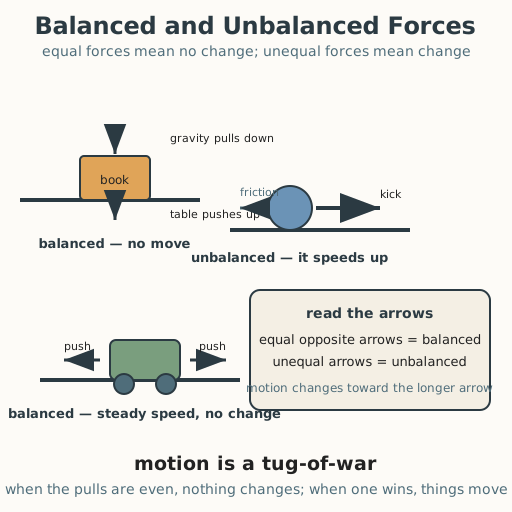
- Force diagram · 1 per pair The graphic showing equal opposite arrows (balanced) and unequal arrows (unbalanced) on a book, a ball, and a cart
- Force arrow cards · 1 set per pair Arrows of two lengths, to lay out balanced and unbalanced pairs
- Force prediction page · 1 per learner A page to predict and test what a push will do, and whether the forces are balanced or not
Low-tech / no-cost
- A book, a ball, and a table A book at rest (balanced) and a pushed ball (unbalanced); no printed page needed
- Voice and body Two learners pull a rope in a tie (balanced, no motion change) and then one pulls harder (unbalanced, motion changes)
Enriched / lab & device
- A spring scale or force meter · 1 per group To measure two forces and see when they are equal (balanced) or not (unbalanced)
- A short video of forces in sports and transport · 1 per group To see balanced and unbalanced forces on a runner, a car, or a rocket
Works in different contexts
- large-group Do the tug-of-war as one shared demonstration and have the group call out "balanced" or "unbalanced" as the motion changes
- multi-age Younger learners act out "equal pulls = no change" and "one harder pull = it moves"; older learners add arrow lengths and the net force
- self-directed A learner lays out arrow pairs, predicts the motion, and tests with a book and ball, recording balanced vs. unbalanced
- level-grouped Learners ready to extend draw arrows to scale and find the net force for a cart pushed two ways at once
- outdoor-only Use a rock, a branch, and a rope outdoors; hold steady (balanced) versus pull harder on one side (unbalanced) and watch the motion change
Lesson 9 — Balanced and Unbalanced Forces
Summary
Learners learn how forces decide motion: balanced forces — equal and opposite — mean the motion does not change, while unbalanced forces mean it does — the object speeds up, slows down, or changes direction. They lay out force arrows, predict, and test with a book, a ball, and a tug-of-war, and they meet the idea of the net force.
Objectives
- Explain how balanced and unbalanced forces determine whether an object’s motion changes. (D06.S3.06.02)
Connection
Why does a book sit still on a table instead of falling through it? Because two forces are exactly even: gravity pulls it down and the table pushes it up. Why does a kicked ball speed away? Because the kick is stronger than the friction that resists it. From a tug-of-war in a schoolyard to a ferry crossing a river to a rocket leaving the ground, the rule is the same: equal forces mean no change; unequal forces mean change. Today you learn to read the arrows.
Materials
- Force diagram
- Force arrow cards
- Force prediction page
Preparation
- Print or draw the force diagram, arrow cards, and prediction page.
- Recall Grade 3: a push or pull (force) changes an object’s motion, and friction resists.
- Have a book, a ball, and a rope ready for the tests.
Facilitator note
Written to the learner (“you”). The one rule to land: balanced forces = no change
in motion; unbalanced forces = motion changes (speed up, slow down, or change
direction). The trick is that “balanced” can mean an object at rest or moving at a
steady speed — no change either way. Use arrow length to carry size: equal arrows
pointing opposite = balanced; unequal = unbalanced, and the net force points the
way the longer arrow points. Model the worked example with the book first (gravity
down, table up, equal — book stays), then the kicked ball (kick bigger than friction
— it speeds up). The tug-of-war is the memorable demonstration. Note that motion at a
steady speed with balanced forces is genuinely counter-intuitive — expect learners to
think “a force is needed to keep moving”; that is where friction (which they met in
Grade 3) explains why things slow down. Keep it concrete. See
docs/facilitation.md.
Procedure
- Gather (5 min). Look at the book on the table. Why does it not move? And why, when you push it, does it slide and then stop? Write two guesses.
- Meet balanced and unbalanced (10 min). A force is a push or pull. When two forces are equal and opposite, they are balanced — the motion does not change. When one is bigger, they are unbalanced — the motion changes, in the direction of the bigger force. Look at the diagram: the book has gravity down and the table up, equal arrows — balanced. The kicked ball has a big kick arrow and a small friction arrow — unbalanced, so it speeds up.
- Lay out the arrows (10 min). With your cards, build three cases: two equal opposite arrows (balanced — no change), a long arrow beside a short one (unbalanced — moves toward the long arrow), and a moving cart with equal arrows (balanced — steady speed, no change). For each, say what the motion will do.
- Predict and test (15 min). On your page, predict: (a) will a book on the table move? (balanced). (b) will a gently pushed ball speed up, slow down, or keep steady? (unbalanced at first, then friction slows it). Test each with your partner and record what happened and whether the forces were balanced or unbalanced.
- Close (5 min). Motion is a tug-of-war: when the pulls are even, nothing changes; when one wins, things move, stop, or turn. Read the arrows and you can predict the motion.
Differentiation
- Support: Act out the tug-of-war first; use two arrow cards and a “move / no move” verdict for each case.
- Extension: Draw arrows to scale for a cart pushed two ways at once and find the net force; predict its motion and explain using balanced/unbalanced.
Assessment
- Formative (observation): Can the learner state the rule (balanced = no change, unbalanced = change) and read a force diagram to predict the motion?
- Self-check: The learner asks, “For any object, can I draw the arrows and say whether they balance — and what that means for its motion?”
Home connection
Find two forces at home (a door held still, a ball rolling, a bag carried). Tell someone whether the forces are balanced or unbalanced and what the motion shows.
Resources
- BBC Bitesize (KS3), “Force diagrams and resultant forces” — balanced and unbalanced forces: https://www.bbc.co.uk/bitesize/topics/z4brd2p/articles/zhnfp4j
- Khan Academy, “Balanced and unbalanced forces”: https://www.khanacademy.org/science/physics/forces-newtons-laws/balanced-unbalanced-forces/v/balanced-and-unbalanced-forces