Lesson 10 — Earth's Place in the Solar System
Learners locate Earth in the solar system — the third planet from the Sun, one of eight, each with its own orbit, and many with moons. They order the planets and grapple with scale: the Sun is enormously bigger than Earth, and the distances between worlds are vast, so real scale cannot fit on one page.
Objectives
Objectives
- D06.S4.06.01 Describe Earth's place in the solar system and the scale of planets, moons, and the Sun.
Essential question
Where is Earth in the solar system, and how big are the Sun, the planets, and their moons compared to one another?
Key vocabulary
Materials
Standard materials
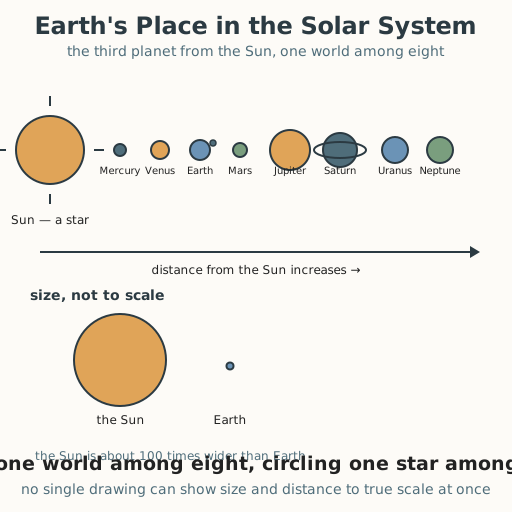
- Solar-system diagram · 1 per pair The graphic showing the planets in order around the Sun, plus a size-comparison inset
- Planet cards · 1 set per pair Cards naming each planet and the Sun, to order by distance and by size
- Scale-model page · 1 per learner A page to build a distance scale model with everyday objects and record the sizes
Low-tech / no-cost
- Stones, seeds, and a long string or chalk line Lay out the planets in order with objects of very different sizes (a big stone for the Sun, a grain of rice for Earth)
- Voice and body Learners stand as the Sun and planets spaced across a field, stepping out the relative distances
Enriched / lab & device
- A planetarium app or a short video of the solar system · 1 per group To see the real distances and sizes and the orbits in motion
- A set of balls of very different sizes (a beach ball and a marble) · 1 per group To feel the scale of the Sun next to the Earth
Works in different contexts
- large-group Build one big scale model across the room or yard, with learners holding the Sun and planets and stepping out the order
- multi-age Younger learners order the planets by distance; older learners explain why the Sun is so much bigger and why the inner and outer planets differ
- self-directed A learner studies the diagram, orders the planet cards, and builds a distance model on the page with recorded sizes
- level-grouped Learners ready to extend compare the size of the Sun to Earth and the distance between them, and explain why a drawing cannot show both to scale
- outdoor-only Lay out the solar system across a long outdoor space with found objects, spacing each planet farther than the last
Lesson 10 — Earth’s Place in the Solar System
Summary
Learners locate Earth in the solar system — the third planet from the Sun, one of eight planets, each orbiting the Sun, many with moons of their own. They order the planets by distance and grapple with scale: the Sun is vastly bigger than Earth, and the distances between worlds are so large that no single drawing can show size and distance to scale at once.
Objectives
- Describe Earth’s place in the solar system and the scale of planets, moons, and the Sun. (D06.S4.06.01)
Connection
Look up at the night sky: the bright dots are other worlds. Our home, Earth, is one planet circling a star — the Sun — along with seven others, and many of those worlds carry moons. People have watched these wanderers from deserts, mountains, islands, and plains for thousands of years: Polynesian wayfinders read the stars to cross the open ocean, and Aboriginal star-lore in Australia encodes seasons and food in the sky — knowledge held beside the astronomy you learn today, not beneath it. Today you learn where Earth sits in that great family and just how small we are in it.
Materials
- Solar-system diagram
- Planet cards
- Scale-model page
Preparation
- Print or draw the solar-system diagram, planet cards, and scale-model page.
- Recall Grade 5: the Earth–Moon–Sun system, day length, moon phases, and eclipses.
- Have a big and a tiny object (a beach ball and a marble, or a big stone and a rice grain) ready for the scale feel.
Facilitator note
Written to the learner (“you”). Two ideas to land: (1) Earth is the third planet
from the Sun, one of eight, each with an orbit, and most planets have moons; (2)
scale — the Sun is enormously bigger than the planets (about 100 times wider than
Earth), and distances are vast. The honest teaching move is to be explicit that no
single page can show size and distance to true scale at once — the diagram shows
order, while the inset shows relative size; a distance model needs a long space.
The Sun is a star, and stars are far bigger than planets. The fact that Earth is a
planet orbiting a star is evidence-based science (observation, measurement, and
spacecraft); the sense of wonder at our smallness can seed a global reflection, but
hold it as a value, not a science claim. Keep “how do we know” alive: we know the
distances by measurement, not by guess. See
docs/facilitation.md.
Procedure
- Gather (5 min). Name everything you can see in the night sky. Which of those is a planet, and which is a star? What do you already know about where Earth fits?
- Meet the solar system (10 min). Look at the diagram. The solar system is the Sun and everything that orbits it. The Sun is a star, huge and bright. Eight planets orbit it in order: Mercury, Venus, Earth, Mars, Jupiter, Saturn, Uranus, Neptune. Earth is the third planet. Many planets have moons that orbit them. Point to Earth and name its neighbors.
- Order the planets (10 min). With your cards, line up the Sun and the eight planets in order of distance. Which are the four inner planets (small and rocky, close to the Sun)? Which are the outer planets (huge and far)? Where does Earth sit on the line?
- Feel the scale (15 min). Look at the size inset: the Sun is about 100 times wider than Earth. Hold a big object (the Sun) and a tiny one (Earth) side by side. On your scale-model page, record: if the Sun were this big, Earth would be this small — and the distance between them would be far larger than this room. Why can’t one drawing show size and distance to scale at once?
- Close (5 min). Earth is one world among eight, circling one star among billions. Knowing our place — small and precious — is the beginning of seeing the universe clearly.
Differentiation
- Support: Order pre-labeled planet cards by distance; focus on “Earth is third” and “the Sun is a star and much bigger.”
- Extension: Compare the Sun’s width to Earth’s (about 100 to 1) and to Jupiter’s, and explain why the outer planets are so different from the inner ones.
Assessment
- Formative (observation): Can the learner place Earth as the third planet, order the eight planets, and state that the Sun is much larger than Earth and the distances are vast?
- Self-check: The learner asks, “Can I name Earth’s place, order the planets, and say why a single drawing cannot show true scale?”
Home connection
On a clear night (or with a star map), find a planet or the Moon. Tell someone where Earth sits among the planets and how the Sun’s size compares to ours.
Resources
- NASA Space Place, “Solar System” — planets, the Sun, and Earth’s place: https://spaceplace.nasa.gov/menu/solar-system/
- NASA Science, “Solar System Exploration” — planet order and the Sun’s scale: https://science.nasa.gov/solar-system/