Lesson 02 — The Same Sun, Shown Differently: Compare Two Cultures and Times
Learners compare how the same subject — the sun — is shown differently across two cultures and time periods, and offer a reason for the difference. A worked example reads an ancient Egyptian winged sun disk (divine protection, gold on temple stone) against a Japanese Edo-period woodblock red sun disc (flat, printed, part of the landscape), then learners compare further suns — an Inca Inti gold face, a modern child's crayon sun — always as living and significant images to honor, never to rank.
Objectives
Objectives
- D07.S1.06.02 Compare how the same subject is shown differently across two cultures or time periods and offer a reason.
Essential question
How is the same subject shown differently across two cultures or time periods, and what reason can I offer for the difference?
Key vocabulary
Materials
Standard materials
- Sun comparison cards · 1 set Cards showing the same subject — the sun — as it appears in different traditions: an ancient Egyptian winged sun disk (divine, protective, gold on temple stone), a Japanese Edo-period woodblock red sun disc (flat, printed, part of a landscape), an Inca Inti gold sun face (the sun god of the Andes), and a modern child's crayon sun (a circle with radiating lines)
- Compare-and-reason chart · 1 per learner A four-column page — "What I observe" → "Place and time" → "Materials and purpose" → "My reason for the difference"
Low-tech / no-cost
- Spoken sun descriptions Describe each sun in words (shape, rays, color, where it appears, what it is made of) so learners can compare without printed cards
- Comparison by voice Complete the chart aloud in pairs, naming one observable feature of each sun and one reason the two differ
Enriched / lab & device
- A world map and timeline · 1 Place each sun card on the map and on a simple timeline, connecting each image to its place and period
- A respectful video or slide of the sun motif · 1 set Brief clips or images (if available) showing the sun in temple relief, woodblock print, goldwork, and children's art today
Works in different contexts
- large-group Model the Egyptian-versus-Japanese worked example on the board, then have small groups each take two more suns, complete the chart, and share one reason aloud
- multi-age Younger learners point to what is different (rays, face, color); older learners connect each difference to place, time, material, or belief in a full sentence
- self-directed A learner chooses two sun cards, completes the chart for each, and writes one sentence offering a reason for the difference
- level-grouped Learners ready to extend bring a fifth sun from a tradition of their choice, add it to the chart with a source note, and offer a reason
- outdoor-only Look at how the sun is pictured in the local environment — a mural, a woven pattern, a drawn sign — and compare it to one card, offering a reason for the difference
Lesson 2 — The Same Sun, Shown Differently: Compare Two Cultures and Times
Summary
Learners compare how the same subject — the sun — is shown differently across two cultures and time periods, and offer a reason for the difference. A worked example reads an ancient Egyptian winged sun disk (divine protection, gold on temple stone) against a Japanese Edo-period woodblock red sun disc (flat, printed, part of the landscape), then learners compare further suns — an Inca Inti gold face, a modern child’s crayon sun — always as living and significant images to honor, never to rank.
Objectives
- Compare how the same subject is shown differently across two cultures or time periods and offer a reason. (D07.S1.06.02)
Connection
The sun rises on everyone, everywhere — over a desert temple, a fishing harbor, a mountain farm, a city street. Yet when people draw it, they draw it differently: one community makes it a god’s face in gold, another a flat red circle over the sea, another a child’s yellow circle with lines for rays. The difference is not a mistake, and not a “better” or “worse” picture. Each image is a choice shaped by where and when it was made — what materials the place gives, what the people believe the sun is and does. Reading those choices is how we meet another time and place with respect and wonder.
Materials
- Sun comparison cards
- Compare-and-reason chart
Preparation
- Prepare the sun cards, each labeled with its place and period.
- Copy a compare-and-reason chart for each learner.
- Recall Grade 5: learners explained how an artwork reflects its culture’s place, materials, or beliefs, citing what they observe; Grade 4: they named subject, materials, and likely purpose, and asked one respectful question.
Facilitator note
This lesson is written to the learner (“you”). The idea to land is non-ranking
comparison with a reason: we look closely at what each image is made of and shows,
connect those observations to a place, time, material, or belief, and offer a reason
for the difference — never to call one “more advanced.” These are living and significant
images; the Egyptian winged disk and the Japanese rising-sun motif are meaningful to
people today, and the Inca Inti belongs to Andean communities — present them with
reverence, not as curiosities. Note for sensitivity: the Japanese rising-sun motif
predates and is distinct from the modern flag’s contested uses; keep the lesson on the
artwork, not the flag. If a learner (or their family) belongs to a tradition shown here,
invite them to be the authority on its meaning and never correct them about their own
culture. See docs/facilitation.md on honoring living traditions and docs/contexts.md
on cultural power dynamics.
Procedure
- Gather (5 min). Last lesson you used line, shape, color, balance, and contrast on purpose. Today you use those same eyes to compare one subject shown many ways: the sun — and offer a reason for each difference.
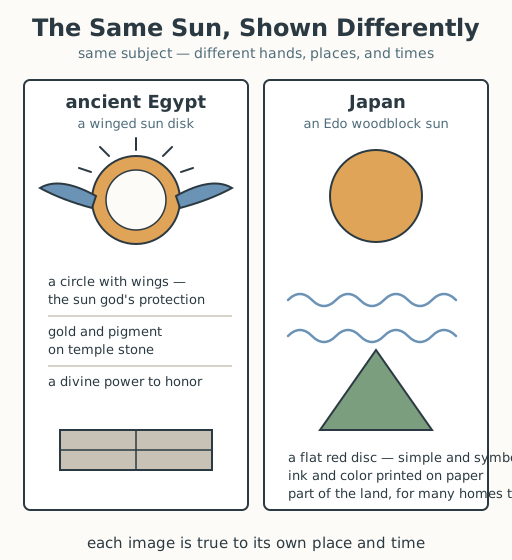
- Meet the comparison (15 min). Look at the first two cards. Ancient Egypt: a winged sun disk — a circle with outstretched wings and rays, carved and painted in gold and pigment on temple stone. What I observe: a circle with wings. What it tells me: the sun is a divine power that protects — gold is the metal that never tarnishes, fitting a god, and it stands on temple stone to be honored. Japan, Edo period: a woodblock print of a flat red disc low over waves and a mountain. What I observe: a plain, flat disc, printed in ink and color on paper. What it tells me: the sun is part of the land — simple and symbolic — and printing lets many homes hold the image. Same subject, two very different pictures. The reason lies in materials (gold on stone vs ink on paper), belief (a god to honor vs a symbol of the land), and purpose (a temple wall vs a printed page for many people).
- Compare two more (15 min). Choose two more suns — an Inca Inti gold sun face (the sun god of the Andes, a face surrounded by rays in worked gold) and a modern child’s crayon sun (a circle with radiating lines, drawn for play). Fill your chart for each: what you observe, its place and time, its materials and purpose, and your reason for the difference.
- Share a reason (10 min). In a small group, share one comparison and your reason. Listen for the difference between what you see (the observation) and why it differs (the reason). Notice that every image makes sense in its own place and time.
- Close (5 min). The same sun has a thousand faces, and every one of them is true to someone, somewhere, sometime. To compare is not to judge; it is to understand. That is how we will meet art, music, and dance from around the world all through this unit.
Differentiation
- Support: Use a sentence frame — “In ___ the sun is ___ (observation), but in ___ it is ___; the reason is ___” — and allow a single observation pair per learner.
- Extension: Bring a fifth sun from a tradition or image of your choice (with a source), complete a chart row, and offer a reason for how it differs from the others.
Assessment
- Formative (observation/self): Can the learner name at least one observable difference between two sun images and offer a reason — connected to place, time, material, belief, or purpose — without ranking one tradition against another?
- Self-check: The learner asks, “Did I name something I actually saw, and did I give a reason for the difference — speaking about living people and their images with respect?”
Home connection
Find two pictures of the same subject (a home, a tree, an animal, a person) from two different times or places, and name one difference and one reason for it.
Resources
- The Metropolitan Museum of Art’s Heilbrunn Timeline of Art History offers classroom-friendly context for the Egyptian winged sun disk and Japanese ukiyo-e woodblock prints: https://www.metmuseum.org/toah/
- UNESCO’s Intangible Cultural Heritage lists frame living traditions (including those behind several of these images) as heritage, not museum pieces: https://ich.unesco.org/