Lesson 03 — Compose and Notate a Melody or Rhythm
Learners compose a short melody or rhythmic composition and notate it so others can follow it. A worked example builds notation step by step — first a beat grid with note symbols (ta, ti-ti), then a pitch ladder (do re mi sol la) that turns the rhythm into a readable melody. Each learner notates their own two-bar piece, then trades with a partner who must perform it exactly — the test of whether the notation works.
Objectives
Objectives
- D07.S2.06.01 Create a melody or rhythmic composition and notate it so others can follow it.
Essential question
How do I create a melody or rhythmic composition and notate it so others can follow it?
Key vocabulary
Materials
Standard materials
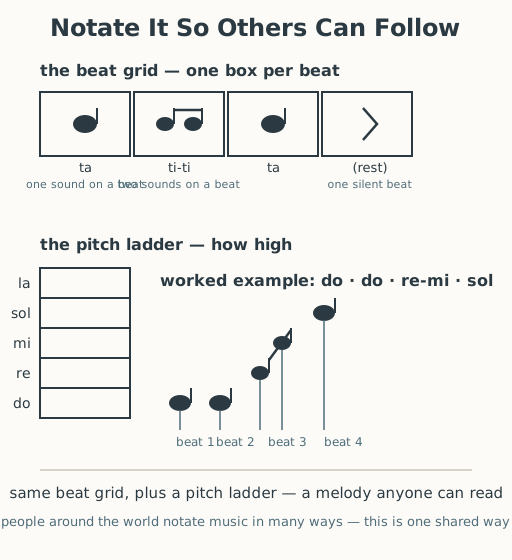
- Notation poster · 1 A poster showing a beat grid (boxes for beats) with note symbols — a filled note for one sound on a beat (ta) and two beamed notes for two sounds on a beat (ti-ti) — plus a pitch ladder (do re mi sol la) with a short worked-example melody notated on it
- Beat-grid and pitch-ladder page · 1 per learner A page with four empty beat-box rows and a five-step pitch ladder, for the learner to notate their own two-bar melody
- Sound makers · per learner Voice (humming, singing, clapping), plus any simple pitched instrument available — chime bars, recorder, keyboard, tuned bottles
Low-tech / no-cost
- Voice and body only Compose with humming, singing, and clapping; notate with drawn shapes, tall/short marks, or letter names on any scrap of paper or the ground
- Found-sound percussion Sticks, stones, cups, and seeds make the rhythm if no pitched instrument exists; pitch can be shown by high and low humming
Enriched / lab & device
- A pitched instrument set · 1 per group Chime bars, recorders, or keyboards tuned to a pentatonic scale (do re mi sol la) so melodies have definite, playable pitches
- A recording device · 1 per group To record the notated melody so a partner can check the notation against the sound and revise
Works in different contexts
- large-group Build one shared notated melody on the board first (call out beats and pitches as a class), then have learners notate their own and trade with a partner to perform
- multi-age Younger learners notate rhythm only (beat boxes with ta/ti-ti); older learners add pitch on the ladder and notate two full bars
- self-directed A learner composes, notates, then performs their own notation back and checks whether another reader could follow it; they record or self-check against the poster's key
- level-grouped Learners ready to extend notate with letter names (C D E G A) or staff notation and add a third bar; others keep the grid and ladder
- outdoor-only Notate in the earth or on stone with a stick, using marks for long and short sounds and high and low pitches; sing the melody back to a partner who follows the marks
Lesson 3 — Compose and Notate a Melody or Rhythm
Summary
Learners compose a short melody or rhythmic composition and notate it so others can follow it. A worked example builds notation step by step — first a beat grid with note symbols (ta, ti-ti), then a pitch ladder (do re mi sol la) that turns the rhythm into a readable melody. Each learner notates their own two-bar piece, then trades with a partner who must perform it exactly — the real test of whether the notation works.
Objectives
- Create a melody or rhythmic composition and notate it so others can follow it. (D07.S2.06.01)
Connection
A recipe written down lets someone you’ve never met cook your dish. A map lets a stranger find the well. A musical score is the same idea in sound: marks on a page that tell another person exactly what to sing or play — which sounds, and how long each one lasts. When you notate, you hand your music to someone else, and it becomes ours instead of only yours. Today you compose a short melody and write it down well enough that a partner can play it back without hearing you first.
Materials
- Notation poster
- Beat-grid and pitch-ladder page
- Sound makers
Preparation
- Print or draw the notation poster, including the worked-example melody.
- Copy a beat-grid and pitch-ladder page for each learner.
- Recall Grade 4: learners read and played simple melodies and rhythms from basic notation; Grade 5: they composed a piece with a beginning, middle, and end.
- Arrange pairs so learners can trade and perform each other’s notation.
Facilitator note
This lesson is written to the learner (“you”). The idea to land is notation as a shared
language: marks must be consistent enough that another person can follow them. Model the
worked example fully before learners compose (explicit instruction for a novice skill —
Kirschner, Sweller & Clark, 2006). Keep the notation concrete and simple: a beat grid
(one box per beat) with “ta” (one sound) and “ti-ti” (two sounds), plus a five-step pitch
ladder (do re mi sol la, the pentatonic scale) so melodies sound pleasant without wrong
notes. Do not demand staff notation; letter names or solfege are welcome for learners
ready to extend. Mention, as a global lens, that cultures notate music in many ways —
staff notation, Indian sargam syllables, Chinese gongche characters, Japanese koto
tablature, and graphic scores — all valid; we use one simple shared system today. The
partner performance is the feedback moment: if a partner cannot follow, that is
information for revision, never a verdict. See docs/facilitation.md and docs/contexts.md.
Procedure
- Gather (5 min). Last lesson you compared how one subject is shown differently across cultures. Today you become the composer: you make a short melody and write it down so someone else can play it.
- Meet the beat grid (10 min). Look at the poster. A beat is a steady pulse — tap it with your foot. We write it in boxes, one box per beat. One sound on a beat is a filled note, said “ta.” Two quick sounds sharing a beat are two joined notes, said “ti-ti.” Worked example: say and clap this four-beat pattern together — ta, ta, ti-ti, ta — and point to each box as you go.
- Add the pitch ladder (10 min). Melody is rhythm plus pitch — high and low. We write pitch on a ladder of five steps: do re mi sol la (a pentatonic scale — no “wrong” notes, everything sounds friendly). Worked example: put your four beats onto the ladder — do, do, re-mi, sol — sing or hum it, then trace the noteheads on the poster as you sing. Now you have a melody anyone can read: which box (when) and which step (how high).
- Compose and notate yours (15 min). On your page, fill two bars — eight beat boxes. Choose your rhythm (ta or ti-ti in each box) and your pitches (which step of the ladder). Make a short melody you like: it could climb, fall, or stay. Notate every sound clearly.
- Trade and perform (10 min). Swap pages with a partner — no singing it first. Read their notation and perform it back. Then switch. Check: did it sound like what they meant? If something was unclear, fix the notation together — that is feedback, not failure.
- Close (5 min). You just did what every composer from every tradition does: turned sound into marks that carry it to another person. Keep your notated melody — later in this unit you will build a performance on top of what you can write down.
Differentiation
- Support: Notate rhythm only (beat boxes with ta/ti-ti) first; add pitches only when rhythm is clear. Provide a pre-made rhythm to place on the ladder.
- Support (non-visual and fine-motor options): Notation need not be drawn or seen. A learner may notate aloud by speaking the sequence (solfege or letter names) while a partner repeats it back or scribes it, or may hum and clap the pattern while a partner writes it. The test is the same: can another person follow it?
- Extension: Notate with letter names (C D E G A) or staff notation, add a third bar, and write one sentence on what your melody expresses.
Assessment
- Formative (performance/peer): Can a partner perform the learner’s notation back accurately, showing the notation is followable — and can the learner fix an unclear mark when a partner stumbles?
- Artifact (portfolio): The notated melody, kept for the unit portfolio.
- Self-check: The learner asks, “Could someone who never heard my melody still play it from my marks — and are my ‘when’ (beat) and ‘how high’ (pitch) both written down?”
Home connection
Write down a short rhythm or melody you hum around the house — even just ta and ti-ti in boxes — and ask someone to clap or sing it back from the page.
Resources
- Elementary music-education practice uses beat grids and solfege (do re mi sol la) as a bridge to notation; Smithsonian Folkways’ “Tools for Teaching” offers classroom-friendly framing for composing with voice and found sound: https://folkways.si.edu/tools-for-teaching
- Kirschner, Sweller & Clark (2006), “Why Minimal Guidance Does Not Work,” on modeling worked examples for novice skills.