Lesson 01 — Puberty Basics: My Body Is Growing and Changing
Learners meet the basic, factual changes of puberty — the growth spurt, body hair, oilier skin, the voice, and the reproductive changes (menstruation for bodies with a uterus; erections and wet dreams for bodies with testes) — and learn that these are driven by hormones and unfold gradually over several years. Every change is taught as normal, with dignity and without shame, and questions are welcomed, never mocked.
Objectives
Objectives
- D03.S1.06.01 Describe the basic changes of puberty and that they happen at different times for different people.
Essential question
What are the basic changes of puberty, and how do I understand my growing body with dignity and care?
Key vocabulary
Materials
Standard materials
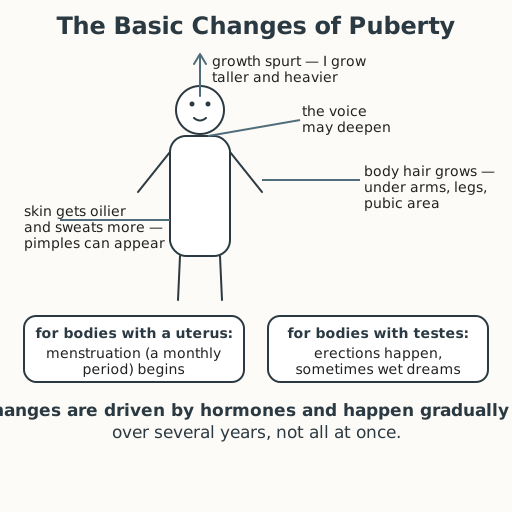
- Puberty changes poster · 1 A poster showing a body with labeled arrows to the basic changes — growth spurt, body hair, oilier skin, voice, and (for different bodies) menstruation or erections — with the caption "changes happen gradually over years"
- What I notice page · 1 per learner A page with two columns — "changes I already know about" and "questions I have" — to gather thinking without pressure
- Pencils · per learner
Low-tech / no-cost
- Body and voice Say each change aloud and describe it in simple words; no poster or page needed — learners can name changes they have observed in growing up
- Chalk or a stick on the ground Draw a body outline and mark each change with a word and an arrow in the dirt or sand
Enriched / lab & device
- A trusted adult guest (nurse, health worker, or elder) · 1 per session An optional invited adult who answers questions calmly and factually, honoring the local community's way of discussing growing up
- An age-appropriate puberty explainer (print or video) · 1 A simple, factual resource reviewed by the facilitator first, to reinforce the basic changes
Works in different contexts
- large-group Walk through the poster as a whole class, then have learners write private questions in the "wonder box" so no one must speak up in front of everyone
- multi-age Older learners explain the changes in their own words as peer guides while younger learners listen and add what they notice; keep all language factual and kind
- self-directed A learner reads the poster, lists the changes they already know, and writes any questions to ask a trusted adult later
- level-grouped Learners ready to extend explain that puberty is driven by hormones and that the same change can begin earlier or later in different people
- outdoor-only Draw the body outline on the ground, mark each change with a stone or a chalk word, and discuss aloud; questions are spoken or drawn rather than written
Lesson 1 — Puberty Basics: My Body Is Growing and Changing
Summary
Learners meet the basic, factual changes of puberty — the growth spurt, body hair, oilier skin, the voice, and the reproductive changes (menstruation for bodies with a uterus; erections and sometimes wet dreams for bodies with testes). They learn that these changes are driven by hormones and unfold gradually, over several years — never all at once. Every change is taught as normal, with dignity and without shame; every body is honored, and questions are welcomed.
Objectives
- Describe the basic changes of puberty and that they happen at different times for different people. (D03.S1.06.01)
Connection
Think of a seed becoming a plant. A seed does not turn into a tall plant in one night; it grows a root, then a stem, then leaves — step by step, over time. Your body is doing something similar right now, in its own way: it is growing from a child’s body into an adult body. This long, gradual change is called puberty. It begins at different ages for different people — for most, somewhere between about 8 and 15 — and it brings a set of changes that prepare the body for adult life. Whether you grow up in a busy city, a village, or on a farm, the same changes come — each body simply arrives at them on its own schedule.
Materials
- Puberty changes poster
- What I notice page
- Pencils
Preparation
- Print or draw the puberty changes poster (a body with labeled arrows to each change, plus the two reproductive-change notes, and the caption “changes happen gradually over years”).
- Copy a “what I notice” page for each learner.
- Prepare a private “wonder box” (a covered box or envelope) where learners can place written, unsigned questions.
- Recall Grade 5: learners learned that bodies grow and change at different rates and that every pace is normal; today they learn what those changes are.
Facilitator note
This lesson is written to the learner (“you”). It is factual, body-positive, and
non-shaming — the tone matters as much as the facts. Present the changes plainly, as
normal biology, with no giggling invitation and no embarrassment; if a learner is
embarrassed, meet it with calm warmth (“every adult you know went through this”). Use
inclusive, accurate language: some bodies have a uterus and ovaries and will
experience menstruation; some bodies have testes and will experience erections
and sometimes wet dreams. Do not sort learners by sex, and never compare or rank
bodies. Emphasize that these changes happen gradually and at different times for
different people (the heart of the next lesson). Keep the reproductive content at the
basic factual level of the standard — no graphic detail, no sexual content — and remind
learners that a growing body is not ready to be a parent; these changes are the body
preparing for a future that is still far off. Where family or community norms differ,
adapt respectfully and encourage learners to take questions to a trusted adult at home.
See docs/facilitation.md on holding sensitive topics safely and docs/contexts.md.
Procedure
- Gather (5 min). You have already learned that bodies grow and change at different rates. Today you learn the name for this big change — puberty — and the basic changes it brings. It is normal, it is gradual, and it happens to everyone.
- Meet the changes (15 min). Look at the poster. Puberty is driven by hormones —
chemical messengers the body makes — that tell the body to grow and change. The main
changes:
- Growth spurt: you grow taller and heavier, faster than before.
- Body hair: hair grows under the arms, on the legs, and in the pubic area.
- Skin: the skin makes more oil and sweat, so it may feel oilier and pimples can appear.
- Voice: for some bodies the voice gets lower and may “crack” while it changes.
- Reproductive changes: for bodies with a uterus, menstruation (a monthly period of blood and fluid) begins; for bodies with testes, erections happen, sometimes with wet dreams during sleep. Notice the caption: none of this happens all at once. It unfolds gradually, over several years, and it begins at a different age for each person.
- Worked example (5 min). Think of one change — say, the growth spurt. One person may shoot up taller at 10; another may not start until 14. Both are normal. The body keeps its own clock; there is no “right” or “wrong” time, only your time.
- What I notice (15 min). On your page, write or draw in the first column the changes you already know about — perhaps from your own body or from an older sibling. In the second column, write any questions you have. No question is silly, and no one must share theirs aloud. If you prefer, place your questions in the wonder box, unsigned.
- Close (5 min). Puberty is not a problem to hide; it is a body growing the way bodies do — with dignity and at its own pace. Next time: why every pace is normal.
Differentiation
- Support: Offer a picture-word bank of the changes and a page with pre-drawn arrows; learners circle instead of write; scribe questions as needed.
- Extension: Explain that hormones are the chemical messengers behind puberty, and name one reason the same change can begin earlier or later in different people (family patterns, nutrition, and many other factors).
Assessment
- Formative (observation): Can the learner name at least three basic changes of puberty and say, in their own words, that they happen gradually and at different times for different people?
- Self-check: The learner reviews their “what I notice” page and asks, “Can I name the changes plainly, without shame, and do I know a trusted adult I could ask?”
Home connection
At home, if it feels comfortable, ask a trusted adult one question from your “what I notice” page — and share one change you now understand better.
Resources
- The basic changes of puberty — the growth spurt, body hair, oilier skin, the voice, and the reproductive changes of menstruation and erections — are standard, well-established adolescent biology, described in the World Health Organization’s adolescent health and development resources (https://www.who.int/health-topics/adolescent-health) and in widely used, age-appropriate puberty guides. These are facts about how bodies work, never judgments about any body, and the curriculum holds the timing of each change as normal across the full human range. For the practice of naming questions safely and managing the feelings that can come with change, see the CASEL framework: https://casel.org/fundamentals-of-sel/.