Lesson 02 — Every Pace Is Normal: Different Times for Different People
Learners turn from what the changes are to when they happen: puberty begins at different times for different people, and every pace is normal. They meet a worked example of the full range, recall the changes from Lesson 1, and write a short, kind reflection about honoring their own pace and everyone else's — never comparing or ranking bodies.
Objectives
Objectives
- D03.S1.06.01 Describe the basic changes of puberty and that they happen at different times for different people.
Essential question
Why do puberty changes happen at different times for different people, and how do I honor every pace — including my own?
Key vocabulary
Materials
Standard materials
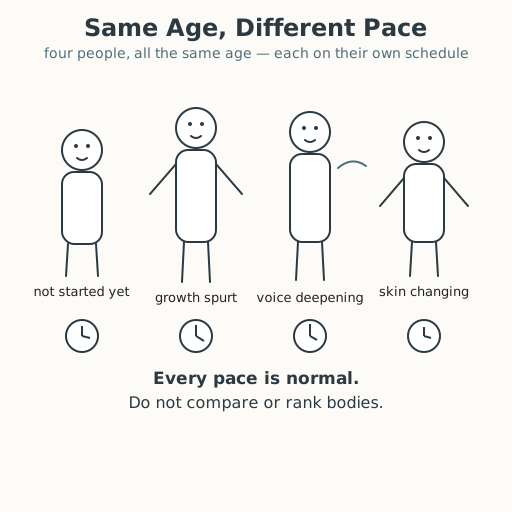
- Every pace is normal poster · 1 A poster showing several figures of the same age at different heights and stages, with the caption "same age, different pace — and every pace is normal"
- Pace reflection page · 1 per learner A page with sentence starters — "one change I have noticed in myself or others is…" and "a kind thing to remember is…" — to write a short reflection
- Pencils · per learner
Low-tech / no-cost
- Standing scale Learners stand in a line ordered by a changeable, private trait like shoe size or height only if comfortable, then discuss how different the line looks — bodies and voices only
- Round-table recall Each learner names one change from last lesson and one reason the timing might differ; no paper needed
Enriched / lab & device
- A class 'range' chart · 1 A shared chart where learners post (anonymously) one change and when they first noticed it, building a visual picture of how wide the range is
- A short, age-appropriate clip on growing at your own pace · 1 A gentle video reinforcing that bodies change on their own schedules
Works in different contexts
- large-group Use the poster to talk about the range of timing as a whole class, then have learners write their reflections privately rather than comparing aloud
- multi-age Older learners share (kindly, without naming anyone) how timing varied among them, modeling that "early" and "late" both turn out fine
- self-directed A learner studies the poster, writes the reflection, and reads it back as a self-check that it is kind and true
- level-grouped Learners ready to extend name several factors that shape timing — family patterns, nutrition, and many others — and explain why ranking bodies is both false and unkind
- outdoor-only Stand or mark a line on the ground by a comfortable trait and discuss how the differences are normal; write the reflection in the dirt or speak it aloud
Lesson 2 — Every Pace Is Normal: Different Times for Different People
Summary
Learners turn from what the changes are to when they happen: puberty begins at different times for different people, and every pace is normal. They meet a worked example of the full range, retrieve the changes from Lesson 1, and write a short, kind reflection about honoring their own pace and everyone else’s — never comparing or ranking bodies.
Objectives
- Describe the basic changes of puberty and that they happen at different times for different people. (D03.S1.06.01)
Connection
Think of a field of the same crop, planted on the same day. Some shoots come up first, tall and green; others come up a week later; a few come up last of all. In the end the whole field stands — the early and the late together. Puberty is like that field. Two friends born in the same month can change at very different times: one may grow taller at ten, the other not until fourteen. Neither is ahead and neither is behind, because there is no race. Every body keeps its own clock, and every pace is normal.
Materials
- Every pace is normal poster
- Pace reflection page
- Pencils
Preparation
- Print or draw the “every pace is normal” poster (several same-age figures at different heights and stages, each with a different clock, and the caption “same age, different pace — and every pace is normal”).
- Copy a pace reflection page for each learner.
- Recall Lesson 1: the basic changes of puberty (growth spurt, body hair, skin, voice, and reproductive changes).
Facilitator note
This lesson is written to the learner (“you”). The one idea to land is that timing
varies and every pace is normal — and that comparing or ranking bodies is both false
and unkind. This is a tender subject at ages 11–14, when self-consciousness spikes, so
guard against any sorting, ranking, or “who is ahead” framing; never ask learners to
reveal or compare their own development. Use the field of crops image and the
worked example of a wide range to make “normal” concrete. Watch for teasing and name
it directly: making fun of someone’s pace is unkind, and it is wrong about the facts,
because every pace is healthy. If a learner is worried about being early or late, respond
with calm reassurance and point them to a trusted adult if the worry feels big. See
docs/facilitation.md and docs/development.md (the 6–8 band on self-consciousness).
Procedure
- Gather (5 min). Last lesson you learned what puberty changes are. Today you learn about when they happen — and the short answer is: at a different time for everyone.
- Retrieve (5 min). Without looking back, name the changes you remember from last time: the growth spurt, body hair, oilier skin, the voice, and the reproductive changes. Say them to a partner or to yourself.
- Meet the range (10 min). Look at the poster — a worked example. Four people, all the same age. One is still shorter, with no body hair yet. Another is tall. Another notices their voice changing. Another notices their skin changing. Each one has a different clock, but all four are normal. Puberty usually begins somewhere between about 8 and 15, so a room of same-age friends is supposed to look different.
- Why timing differs (5 min). Why the differences? Many things shape the timing — family patterns, how the body is nourished, and other factors we are still learning about. It is not a race, and no pace is better than another.
- Write your reflection (15 min). On your page, finish the sentences in your own words: “One change I have noticed in myself or in others is…” and “A kind and true thing to remember is…”. Keep it kind and true: you are describing a normal, shared human change, not ranking anyone.
- Close (5 min). Remember the field: the early shoots and the late shoots all stand. Your body is on its own schedule, and every pace — including yours — is normal, and worthy of respect.
Differentiation
- Support: Offer a sentence bank and picture prompts; scribe as needed; allow one drawing and one word instead of full sentences.
- Extension: Name several factors that can shape timing (family patterns, nutrition, and others) and write one sentence explaining why ranking bodies is both factually wrong and unkind.
Assessment
- Formative (observation): Can the learner explain, in their own words, that puberty happens at different times for different people and that every pace is normal?
- Self-check: The learner reads their reflection and asks, “Is it kind? Is it true? Does it honor every pace, including my own?”
Home connection
Ask a trusted adult at home: “When you were growing up, did you and your friends change at the same time?” and share the idea that every pace is normal.
Resources
- That puberty begins across a wide age range (most often between about 8 and 15) and unfolds at a different pace for each person is standard adolescent health science, as summarized in the World Health Organization’s adolescent health and development resources (https://www.who.int/health-topics/adolescent-health). The lesson holds “every pace is normal” as both a fact (timing varies across the healthy range) and a value (bodies are never to be ranked). The reflection practice draws on the CASEL self-awareness competency: https://casel.org/fundamentals-of-sel/.