Lesson 05 — From Farm to Table: How Food Is Produced and Transported
Learners trace food from where it grows to their table — grow, harvest, transport, and eat — and meet the people at each step and the environment it draws on (soil, water, fuel, packaging). They trace one food's own journey and name one effect on people and one on the environment, carrying the technology-and-environment lens: every plate connects us to the land and to the hands that grew and moved our food.
Objectives
Objectives
- D03.S3.06.02 Explain how food is produced and transported and how this affects people and the environment.
Essential question
How is food produced and transported, and how does that journey affect people and the environment?
Key vocabulary
Materials
Standard materials
- Farm-to-table journey poster · 1 A poster showing the food journey in steps — grow, harvest, transport (truck/boat/train), market or store, table — with the people at each step and the environment inputs (soil, water, fuel, packaging)
- One food's journey page · 1 per learner A page where the learner traces one food from where it grew to their table, naming the steps, the people, and one effect on the environment
- Pencils · per learner
Low-tech / no-cost
- Story round Tell one food's journey aloud as a group — "it grew here, someone harvested it, it traveled by…, it reached us by…" — voices only, no page needed
- Ground map Draw the journey in the dirt — a field, an arrow to a road or river, an arrow to a market — and step along it while naming each stage
Enriched / lab & device
- Food packaging or labels · a small set Real or printed labels from several regions showing where a food was grown or made, to trace real journeys
- A map (paper or digital) · 1 To mark where a few foods grew and how far they traveled, making the journey concrete
Works in different contexts
- large-group Trace one food's journey on the board together, then have learners trace their own food in pairs or small groups
- multi-age Younger learners point to each step in order while older learners name the people and the environmental effects at each step
- self-directed A learner traces one food from farm to table, writes the steps, the people, and one environmental effect, and reads it back to check the order
- level-grouped Learners ready to extend compare a local food to a food that travels far and weigh one cost and one benefit of each
- outdoor-only Step the journey on a drawn ground map, naming each stage aloud; where possible, visit a garden, market, or field nearby
Lesson 5 — From Farm to Table: How Food Is Produced and Transported
Summary
Learners trace food from where it grows to their table — grow, harvest, transport, and eat — and meet the people at each step and the environment it draws on (soil, water, fuel, packaging). They trace one food’s own journey and name one effect on people and one effect on the environment, carrying the technology-and-environment lens: every plate connects us to the land and to the hands that grew and moved our food.
Objectives
- Explain how food is produced and transported and how this affects people and the environment. (D03.S3.06.02)
Connection
Hold up a piece of food — a grain of rice, a slice of bread, a fruit. Before it reached you, it had a whole life and a whole journey. Somewhere, soil and water and sunlight grew it; someone planted and tended it; someone harvested it; and it traveled — by foot, by cart, by truck, by boat, or by train — to the market or garden where your family got it. Whether your food comes from a field you can see from your window or from across an ocean, every plate connects you to the land and to the hands that grew and moved your food. Today you learn to see that hidden journey.
Materials
- Farm-to-table journey poster
- One food’s journey page
- Pencils
Preparation
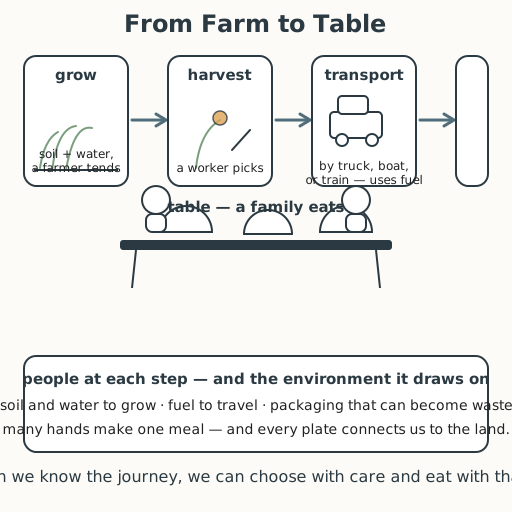
- Print or draw the farm-to-table journey poster (grow → harvest → transport → table, with people and environment labeled at each step).
- Copy a “one food’s journey” page for each learner.
- Recall Grade 5: learners named the nutrients and learned where common foods come from (plants, animals, farms, gardens); today they follow the full production-and-transport chain and its effects.
Facilitator note
This lesson is written to the learner (“you”). The idea to land is that food is
produced and transported by real people using land, water, and fuel — so what we eat
affects both people and the environment. Keep it concrete and hopeful, never
frightening or preachy: the point is awareness and gratitude, not guilt. Honor every
source of food — a family garden, a small farm, a big farm, a market, a shop — and never
rank them. Name the workers with dignity (farmers, harvesters, drivers, sellers) and
note that many hands make one meal. For the environment, keep the effects simple and
true: food needs soil and water to grow and fuel to travel, and packaging can
become waste. This is the unit’s clearest technology-and-environment lesson, so make
the lens explicit, but always attach it to agency — “when we know, we can choose
wisely” — not despair. See docs/facilitation.md and the environment lens in
docs/philosophy.md.
Procedure
- Gather (5 min). Think of one food you ate yesterday. Where did it come from? Before today you might say “the shop” or “the garden.” Today you follow it all the way back — to the soil, the water, and the hands that made it.
- Meet the journey (10 min). Look at the poster — a worked example of the food
journey, in four steps:
- Grow: a farmer plants and tends a crop. It needs soil, water, and sunlight.
- Harvest: a worker picks or gathers it when it is ready.
- Transport: it travels by truck, boat, or train — and that takes fuel.
- Eat: it reaches a table, and a family shares it. Notice the two things running through every step: people (the farmer, the harvester, the driver, the seller) and the environment (soil, water, fuel, and sometimes packaging).
- Trace one food (20 min). Choose one food from your own table. On your page, trace its journey: where might it have grown? Who might have grown and picked it? How did it travel to reach you? Write or draw each step, and then answer two questions: one effect on people (many hands worked to bring it to you) and one effect on the environment (it used soil and water to grow, fuel to travel, and maybe packaging).
- Compare near and far (5 min). Some food grows close to home; some travels far. Food grown nearby may use less fuel to reach you; food from far away may bring tastes no local field can grow. Neither is “bad” — each is a choice with costs and gifts.
- Close (5 min). Every plate is a map: it points to the land that fed it and the people who carried it. Knowing the journey lets you choose with care and eat with thanks. Next time: keeping yourself safe in play, travel, and online life.
Differentiation
- Support: Provide a pre-drawn journey with blanks to fill and picture prompts; scribe the two effects; allow drawing the whole journey.
- Extension: Compare a local food and a far-traveled food, and name one cost and one benefit of each for people and the environment.
Assessment
- Formative (observation): Can the learner name the steps of producing and transporting food and give one effect on people and one on the environment?
- Portfolio (artifact): The “one food’s journey” page, kept as a portfolio artifact.
- Self-check: The learner asks, “Is my journey in the right order, and did I name the people and the environment at each step — without judging any source of food?”
Home connection
At your next meal, ask someone at home where one food on the table came from, and trace its journey together — from soil and hands to your plate.
Resources
- That food is produced and transported by people using land, water, and fuel, and that this affects both people and the environment, is documented by the FAO’s work on sustainable food value chains (https://www.fao.org/sustainable-food-value-chains/en/) and its State of Food and Agriculture reports (https://www.fao.org/publications/home/fao-flagship-publications/the-state-of-food-and-agriculture/en). The lesson frames the journey as a fact to understand and a reason for care and gratitude (a value), keeping evidence and values distinct; it attaches awareness to agency rather than guilt, in line with the curriculum’s technology-and-environment lens.