Lesson 04 — One Change to Better Fuel My Body
Learners move from noticing their day of food and drink to choosing one small, real change that better fuels the body — framed always as additions and swaps, never restrictions, and never a judgment of any body or family. They meet worked examples, choose a change that fits their own life, culture, and means, and write the reason and a first small step as a portfolio artifact.
Objectives
Objectives
- D03.S3.06.01 Analyze a typical day of food and drink and identify one change that would better fuel the body.
Essential question
What one small, real change would better fuel my body — one that fits my life, my culture, and what my family can get?
Key vocabulary
Materials
Standard materials
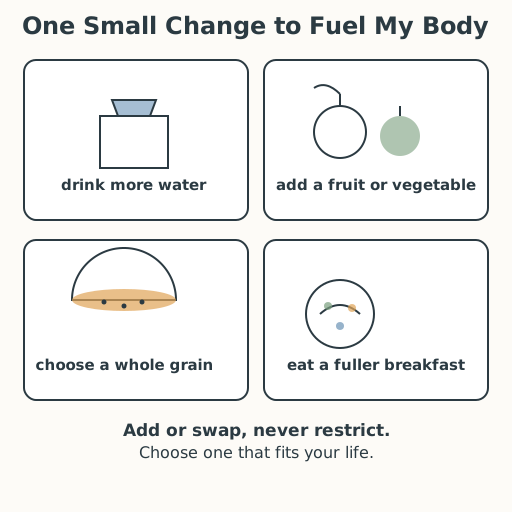
- One small change poster · 1 A poster showing a simple choose-one flow — "drink more water," "add a fruit or vegetable," "choose a whole grain," "eat a fuller breakfast" — each with a small drawing, framed as additions and swaps, never restrictions
- My one change page · 1 per learner A page where the learner writes their one change, why they chose it, and one small step to start — a portfolio artifact
- Pencils · per learner
Low-tech / no-cost
- Voice and body Name the choices aloud and act out the small step (pour a cup of water, add a fruit); no page needed
- Ground diagram Draw a simple choose-one diagram in the dirt and mark the chosen change with a stone
Enriched / lab & device
- A 'fuel tracker' sheet · 1 per learner A simple week tracker to tally the chosen change each day and reflect on how it felt
- A class 'changes wall' · 1 A shared wall where learners post their one change (by name or anonymous) to see the many valid ways to fuel a body
Works in different contexts
- large-group Walk through the choices on the board, then have each learner choose privately and share only if they wish
- multi-age Younger learners choose one picture; older learners write the change, the reason, and the first step and coach a younger partner kindly
- self-directed A learner chooses one change, writes it with a reason and a first step, and reads it back to check it is real, small, and theirs
- level-grouped Learners ready to extend connect their change to a nutrient (water for every cell; a fruit for vitamins; a whole grain for lasting fuel)
- outdoor-only Choose the change by stepping to one of several marked spots, then say the reason and the first step aloud
Lesson 4 — One Change to Better Fuel My Body
Summary
Learners move from noticing their day of food and drink to choosing one small, real change that better fuels the body — framed always as additions and swaps, never restrictions, and never a judgment of any body or family. They meet worked examples, choose a change that fits their own life, culture, and means, and write the reason and a first small step as a portfolio artifact.
Objectives
- Analyze a typical day of food and drink and identify one change that would better fuel the body. (D03.S3.06.01)
Connection
A farmer improving a field does not tear the whole field up and start over. They make one careful change — add a little water here, plant one more useful crop there — and watch how it helps. Your body’s “field” is your everyday eating, and it is already growing well in its own way. So today you do not overhaul anything; you choose one small change that gives your body a little more of what fuels it. Small and steady beats big and short-lived — and a change that fits your life, your food, and your family is the one that will stick.
Materials
- One small change poster
- My one change page
- Pencils
Preparation
- Print or draw the “one small change” poster (four choose-one options with drawings: drink more water, add a fruit or vegetable, choose a whole grain, eat a fuller breakfast).
- Copy a “my one change” page for each learner.
- Have learners bring or recall their “my day” page from Lesson 3.
Facilitator note
This lesson is written to the learner (“you”). The one idea to land is that the best
change is one small, real change that fits the learner’s own life — never a rule from
outside. Frame every option as an addition or a swap, never a restriction: we never
tell a learner to cut out a food, restrict eating, or shrink their body. This is
especially important at ages 11–14, when food and body-image pressures rise; keep the
message body-positive and food-neutral (“more fuel for your growing body,” never “eat
less” or “get thinner”). Let learners choose only what is genuinely available and
affordable in their home and culture, and honor that some learners have little control
over what is on the table — for them, “add water when you can” is a perfectly good
change. Model the choose-one flow as a worked example first. See docs/facilitation.md
and the safety notes on body image in docs/development.md.
Procedure
- Gather (5 min). Last lesson you looked at your day of food and drink with curiosity. Today you choose one small change that better fuels your growing body — and it is yours to choose.
- Meet the choices (10 min). Look at the poster — a worked example of four
choose-one options, all additions or swaps:
- Drink more water — water helps every cell work.
- Add a fruit or vegetable — they carry vitamins and minerals.
- Choose a whole grain — whole grains give lasting fuel.
- Eat a fuller breakfast — morning fuel sets the day. Notice what is not on the list: nothing says “eat less” or “cut out” a food. This is about adding fuel, never taking away.
- Choose yours (5 min). Look back at your “my day” page from last time. Which one change would fit your life best? Maybe you drink little water — choose that. Maybe your table already holds plenty of fruit — choose something else. There is no wrong answer, only your answer.
- Write it (20 min). On your page, write: my one change (what you will do); my reason (how it fuels your body); and my first step (one small, real thing to do this week). Keep it small enough to actually do — that is what makes it real.
- Close (5 min). A body growing through puberty needs good fuel, and you have just chosen one steady way to give it more. Small and steady wins. Next time: where your food comes from, and the people and planet behind every plate.
Differentiation
- Support: Provide a picture-choice page and a sentence bank; scribe the reason and first step; allow one drawing and one word.
- Extension: Connect the chosen change to a nutrient — water for every cell, a fruit for vitamins, a whole grain for lasting fuel — and name the nutrient in one sentence.
Assessment
- Formative (observation): Can the learner choose one small, realistic change and say, in their own words, how it better fuels the body?
- Portfolio (artifact): The “my one change” page (change + reason + first step), kept as a portfolio artifact.
- Self-check: The learner asks, “Is my change real and small enough to do? Does it add fuel, not take away? Does it fit my life and my family’s food?”
Home connection
Share your one change with someone at home — and, if you can, do your first step together this week.
Resources
- Choosing an addition (more water, a fruit or vegetable, a whole grain) rather than a restriction reflects the World Health Organization’s “Healthy diet” guidance (https://www.who.int/news-room/fact-sheets/detail/healthy-diet), which frames healthy eating around what to include (a diversity of foods, water, whole grains) rather than deprivation. The lesson holds “no restriction, no body judgment” as both a health position and a value, in line with the curriculum’s commitment to teach the body with dignity and never shame any body or way of eating.