Lesson 03 — Change and Continuity Over a Hundred Years
Learners meet change and continuity: what becomes different and what stays the same in one society over about a hundred years. A worked example uses the Songhai empire and the city of Timbuktu (about 1464–1591), where an empire rose and learning flourished even as the Niger River and the griots' oral tradition endured.
Objectives
Objectives
- D08.S1.06.02 Describe change and continuity over a period of about a hundred years in one society, giving an example of each.
Essential question
What changed and what stayed the same in one society over about a hundred years?
Key vocabulary
Materials
Standard materials
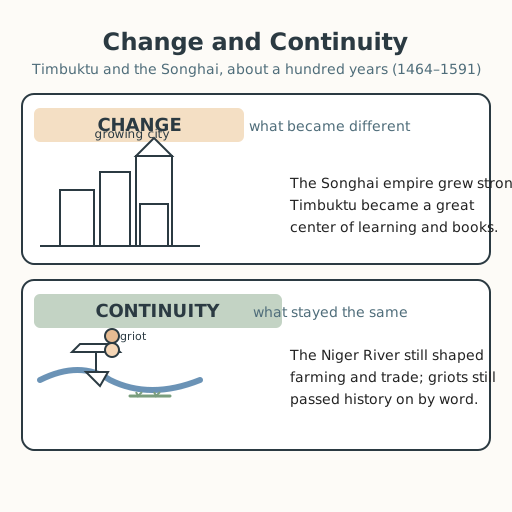
- Change-and-continuity poster · 1 A two-part poster showing change (the Songhai empire grew; Timbuktu became a center of learning) and continuity (the Niger River shaped farming and trade; griots passed history by word), about 1464–1591
- Change or continuity cards · 1 set of 8 Eight short statements about the Songhai/Timbuktu hundred years, to sort into "change" and "continuity" columns
- Change-and-continuity chart · 1 per learner A two-column page (what changed | what stayed the same) for recording the worked example
Low-tech / no-cost
- A read-aloud and hand-drawn chart The facilitator tells the Songhai hundred-year story aloud; learners draw two columns and sort the ideas by speaking them in
- A 'then and now' circle In a circle, each learner names one thing that changed and one that stayed the same in their own community over time
Enriched / lab & device
- A device for images of Timbuktu · 1 per pair Photographs of Timbuktu's mosques and manuscripts viewed and discussed with the change/continuity frame
- A map of West Africa · 1 A map showing the Niger River and Timbuktu to ground the hundred-year story in place
Works in different contexts
- large-group Sort the eight cards together on a big board, then have pairs record the worked example on their charts
- multi-age Younger learners sort cards into two piles while older learners explain why each is change or continuity and write the chart
- self-directed A learner reads the worked example, sorts the cards, and fills the chart for the Songhai hundred years alone
- level-grouped Learners ready to extend name a change that also carried a continuity inside it (for example, learning grew — but the griots kept telling the stories)
- outdoor-only Walk around your own place and name one thing that has changed and one that has stayed the same in living memory; no paper needed
Lesson 3 — Change and Continuity Over a Hundred Years
Summary
Learners meet change and continuity: what becomes different and what stays the same in one society over about a hundred years. A worked example uses the Songhai empire and the city of Timbuktu (about 1464–1591), where an empire rose and learning flourished even as the Niger River and the griots’ oral tradition endured.
Objectives
- Describe change and continuity over a period of about a hundred years in one society, giving an example of each. (D08.S1.06.02)
Connection
Think of your own town, village, or city across the time your grandparents can remember. Some things changed — new buildings, new tools, new people arriving. Some things stayed the same — a river, a market day, a song, the way a festival is kept. History is the same: every society is always changing and always carrying things forward. Change is what became different; continuity is what stayed the same. Today you look at one society across about a hundred years and see both at once.
Materials
- Change-and-continuity poster
- Change or continuity cards (eight items)
- Change-and-continuity chart
Preparation
- Print or draw the change-and-continuity poster.
- Copy the eight cards and a chart for each learner.
- Arrange a circle for the story and a flat space for sorting and writing.
Facilitator note
This lesson is written to the learner (“you”). The skill to build is holding change and
continuity in view at the same time — not listing events. Model the Songhai example fully,
then have learners sort and record. Emphasize that change and continuity are not opposites
to choose between; they happen together. The Songhai example is deliberately West African
and non-European, and it honors oral tradition (the griots) as a real and enduring way of
keeping history — a thread that returns in Lesson 5. Guard against the idea that “continuity
= backward” or “change = progress”: both are simply true, and whether a change is good or
bad is a separate question. See docs/facilitation.md.
Procedure
- Gather (5 min). You have learned to read the past through sources. Now you learn to read it through time: what changed and what stayed the same over about a hundred years.
- Meet the society (10 min). Listen to the story. Around the year 1464, in West Africa, the Songhai grew into a great empire along the Niger River, with the city of Timbuktu at its heart. For about a hundred years, until about 1591, Timbuktu became a famous center of learning, where scholars wrote and copied thousands of books in Arabic and local languages. Meanwhile, all through that time, the Niger River still shaped farming and trade, and griots — storytellers who keep a people’s history by word — still passed the past from one generation to the next.
- Worked example: sort change and continuity (15 min). Change is what became different. Continuity is what stayed the same. Sort the ideas together: “a new empire rose and grew strong” is change; “the Niger River still shaped farming and trade” is continuity; “Timbuktu became a center of learning” is change; “griots still told the people’s history” is continuity. Notice: both were true at the same time.
- Sort your own (10 min). Take the eight cards and sort them into two columns: what changed and what stayed the same. Check with a partner and explain any you disagreed on.
- Record the example (5 min). On your chart, write one example of change and one example of continuity from the Songhai hundred years.
- Close (5 min). A society is not “either changed or the same” — it is always both. That is what makes the human story rich.
Differentiation
- Support: Sort fewer cards with clear, single-idea statements; scribe the learner’s chart and read the story aloud slowly.
- Extension: Name one change that carried a continuity inside it (for example, learning grew with new books — while the griots kept telling the older stories).
Assessment
- Formative (observation): Can the learner sort statements into change and continuity and give one example of each for the Songhai hundred years?
- Self-check: The learner asks, “Can I name what changed and what stayed the same — and explain why each one counts as change or continuity?”
Home connection
Ask someone at home what has changed and what has stayed the same in your community across the years they can remember, and sort their answers into two columns together.
Resources
- The Songhai empire and Timbuktu as a center of learning, including its manuscripts, are documented in African history and by UNESCO; Timbuktu is a UNESCO World Heritage site (https://whc.unesco.org/en/list/119/), and its manuscripts are the subject of ongoing preservation work (see the Timbuktu Manuscripts Project and related scholarship). The griots of West Africa — hereditary keepers of oral history — are documented in West African oral tradition and scholarship (see the work of historians such as Djibril Tamsir Niane). Dates are approximations that scholars revise as new evidence appears.