Lesson 07 — People Shape the Land, the Land Shapes People
Learners see two directions at once: how the environment shapes people and how people shape the environment, through the Andes of South America — where steep mountains and high altitude shaped farming, herding, and travel, and where people carved terraces and canals into the slopes to farm. The two directions are held together, not opposed.
Objectives
Objectives
- D08.S3.06.01 Explain how people shape their environment and how the environment shapes people, using specific examples.
Essential question
How do people shape their environment, and how does the environment shape people?
Key vocabulary
Materials
Standard materials
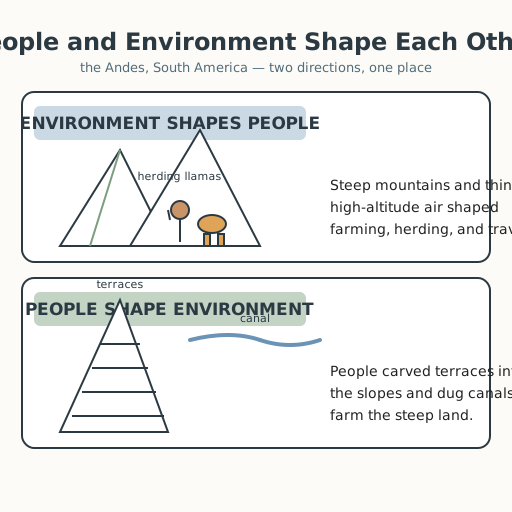
- People-and-environment poster · 1 A two-panel poster of the Andes showing environment shaping people (steep mountains and high altitude shaped farming, herding, travel) and people shaping environment (terraces and canals)
- Shape cards · 1 set of 8 Eight short statements about the Andes — four where the environment shapes people, four where people shape the environment — to sort into two directions
- People-and-environment note · 1 per learner A note page with two boxes (environment shapes people | people shape environment)
Low-tech / no-cost
- A read-aloud and hand-drawn chart The facilitator tells the Andes story aloud; learners draw two boxes and sort the ideas by speaking them in
- A 'shaping the land' walk Walk outside and name one way the land shapes how people live there, and one way people have shaped the land
Enriched / lab & device
- A device with images · 1 per pair Photographs of Andes terraces, canals, llamas, and high-altitude fields, discussed with the two-direction frame
- A relief or physical map · 1 A map showing the Andes' height and steepness to ground the two directions in place
Works in different contexts
- large-group Sort the eight cards together on a big board, then have pairs record one example in each direction
- multi-age Younger learners sort cards into two piles while older learners explain why each is one direction or the other and write the note
- self-directed A learner reads the worked example, sorts the cards, and fills the two-box note alone
- level-grouped Learners ready to extend find a second place (for example, the Nile) and name one way each direction shows up there
- outdoor-only Walk your own place and name, in each direction, one way the land shapes people and one way people shape the land; no paper needed
Lesson 7 — People Shape the Land, the Land Shapes People
Summary
Learners see two directions at once: how the environment shapes people and how people shape the environment, through the Andes of South America — where steep mountains and high altitude shaped farming, herding, and travel, and where people carved terraces and canals into the slopes to farm. The two directions are held together, not opposed.
Objectives
- Explain how people shape their environment and how the environment shapes people, using specific examples. (D08.S3.06.01)
Connection
Look at where you live. The land does things to you — heat, cold, rain, hills, rivers shape what you eat, wear, and how you travel. And you do things to the land — gardens, roads, buildings, ditches. The relationship runs both ways at once. Today you watch it in one place where the land is especially strong: the Andes mountains of South America.
Materials
- People-and-environment poster
- Shape cards (eight items)
- People-and-environment note
Preparation
- Print or draw the people-and-environment poster.
- Copy the eight cards and a note for each learner.
- Arrange a circle for the story and a flat space for sorting and writing.
Facilitator note
This lesson is written to the learner (“you”). The skill to build is holding both
directions at once: environment shapes people, and people shape environment. Model the
Andes example fully, then have learners sort and record. Guard against one-directional
thinking (“nature controls people” or “people conquer nature”): the point is a two-way
relationship. The Andes example honors Andean peoples’ skill and knowledge — terraces and
canals are engineering, not mere “adapting to survive.” A quick retrieval note (the Nile)
spirals back to Grade 5. See docs/facilitation.md.
Procedure
- Gather (5 min). You have seen how knowledge and tools travel. Now you look at a relationship that is always with us: the one between people and the land.
- Meet the Andes (10 min). The Andes are a great mountain range in South America, with steep slopes and thin, high-altitude air. People have lived there for thousands of years. The environment shaped the people: the steep, high land meant they grew hardy crops like potatoes and quinoa, raised llamas and alpacas (there were no large cattle), built from stone, and traveled on foot along mountain roads. And the people shaped the environment: they carved terraces — flat steps — into the steep slopes to farm, and dug canals to carry water to the fields.
- Worked example: sort the two directions (10 min). Sort together: “steep mountains meant people farmed in steps” — that is the environment shaping people. “People cut terraces into the slopes” — that is people shaping the environment. Notice the two sentences point opposite ways, and both are true.
- Sort your own (15 min). Take the eight cards and sort them into two columns: the land shapes people and people shape the land. Check with a partner.
- Record the two directions (5 min). On your note, write one example in each direction from the Andes.
- Close (5 min). People and the land are not enemies and not the same thing — they shape each other, everywhere on Earth.
Differentiation
- Support: Sort fewer cards with clear, single-direction statements; scribe the learner’s note and read the story aloud slowly.
- Extension: Name a second place (for example, the Nile, from last year) and give one example of each direction there.
Assessment
- Formative (observation): Can the learner sort statements into the two directions and give one example of each from the Andes?
- Self-check: The learner asks, “Can I name how the land shaped the people and how the people shaped the land — and explain which direction each one points?”
Home connection
With someone at home, name one way the land where you live shapes how people live there, and one way people have shaped that land — then share both.
Resources
- Andean terrace agriculture and irrigation, including the terraces and canals of the Andes, are documented in Andean archaeology and UNESCO World Heritage listings (for example, Machu Picchu and the Qhapaq Ñan road system, https://whc.unesco.org/). The domestication of potatoes, quinoa, llamas, and alpacas in the Andes is documented in the archaeological record. These are presented as Andean peoples’ achievements, in line with the curriculum’s commitment to honor non-European knowledge and skill. Dates are approximations that scholars revise as new evidence appears.