Lesson 08 — Plants, Animals, and People on the Move
Learners analyze how the movement of plants, animals, and people between the Americas and Afro-Eurasia — the Columbian Exchange, from 1492 — changed environments and societies, using maize, potato, tomato, cacao, chili, horses, cattle, and the forced movement of people as examples. The exchange is told honestly: it transformed diets and landscapes everywhere and was entangled with colonization and slavery, which harmed many peoples.
Objectives
Objectives
- D08.S3.06.02 Analyze how the movement of plants, animals, and people between world regions changed environments and societies, using one historical example.
Essential question
How did the movement of plants, animals, and people between world regions change environments and societies?
Key vocabulary
Materials
Standard materials
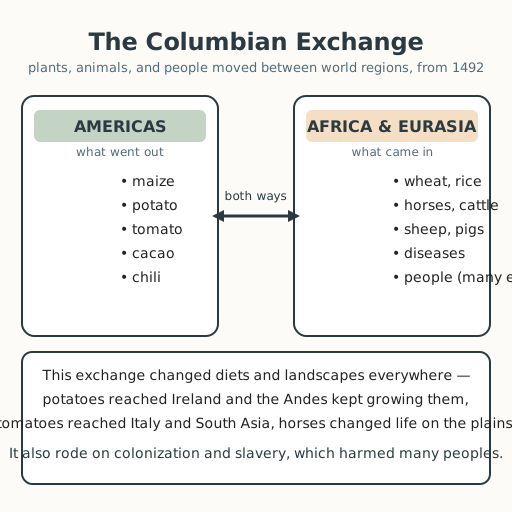
- Columbian Exchange poster · 1 A two-way poster showing what moved from the Americas (maize, potato, tomato, cacao, chili) and what moved in (wheat, rice, horses, cattle, sheep, pigs, and people — many enslaved), with the note that the exchange was entangled with colonization
- What-moved cards · 1 set of 8 Eight cards naming a plant, animal, or group of people, each to sort as moving from the Americas or into the Americas
- Exchange-effects note · 1 per learner A note page to record one thing that moved, where it went, and one change it brought to a place or people
Low-tech / no-cost
- A read-aloud and hand-drawn two-way arrow The facilitator tells the exchange story and draws a two-way arrow; learners name what moved in each direction, voice only
- A 'what moved' circle In a circle, each learner names one plant, animal, or people that moved, and which direction; no cards needed
Enriched / lab & device
- A device with images · 1 per pair Photographs of maize, potatoes, tomatoes, horses, and historical maps, discussed with the movement-and-change frame
- A world map · 1 A map showing the Atlantic between the Americas and Afro-Eurasia to ground the exchange in place
Works in different contexts
- large-group Sort the eight cards together on a big two-way arrow on the board, then have pairs record one thing and one change
- multi-age Younger learners sort cards by direction while older learners explain one change and lead the careful discussion of harm
- self-directed A learner reads the worked example, sorts the cards, and fills the exchange-effects note alone
- level-grouped Learners ready to extend explain how one crop changed two different places (for example, the potato in the Andes and in Ireland)
- outdoor-only Stand on two sides of a line and "send" named plants and animals across, then name one change each brought; no paper needed
Lesson 8 — Plants, Animals, and People on the Move
Summary
Learners analyze how the movement of plants, animals, and people between the Americas and Afro-Eurasia — the Columbian Exchange, from 1492 — changed environments and societies, using maize, potato, tomato, cacao, chili, horses, cattle, and the forced movement of people as examples. The exchange is told honestly: it transformed diets and landscapes everywhere and was entangled with colonization and slavery, which harmed many peoples.
Objectives
- Analyze how the movement of plants, animals, and people between world regions changed environments and societies, using one historical example. (D08.S3.06.02)
Connection
Think of a food you eat that did not grow near where you live — it arrived from somewhere else, long ago. Everywhere on Earth, plants, animals, and people have moved, and each movement changed both the place they left and the place they reached. Sometimes that movement was chosen and welcome; sometimes it was forced and cruel. Today you look at one great movement of plants, animals, and people — and you hold both its gifts and its harms.
Materials
- Columbian Exchange poster
- What-moved cards (eight items)
- Exchange-effects note
Preparation
- Print or draw the Columbian Exchange poster.
- Copy the eight cards and a note for each learner.
- Review the note below on holding the harm of colonization and slavery with honesty, care, and dignity.
Facilitator note
This lesson is written to the learner (“you”). This is a difficult topic, held with
honesty and care. The Columbian Exchange is often taught only as a list of crops “given”
to the world; that telling hides the harm. Teach it whole: (1) what moved, (2) how it
changed environments and societies, and (3) the honest truth that the exchange rode on
colonization and the transatlantic slave trade, which brought disease, dispossession,
and enslavement to Indigenous and African peoples. Spend real time on what moved and
changed, and name the harm clearly but briefly, always centering the dignity, knowledge,
and agency of Indigenous and African peoples — never victimhood. Respect a learner’s right
to pause; connect difficulty to hope (peoples kept their knowledge and adapted). See
docs/facilitation.md on holding difficult topics safely.
Procedure
- Gather (5 min). You have seen how people and land shape each other in one place. Now you see what happens when things move between places — across an ocean.
- Meet the exchange (20 min). From 1492, after European ships reached the Americas, plants, animals, and people began moving both ways across the Atlantic. From the Americas to the rest of the world went maize, potato, tomato, cacao, and chili. Into the Americas came wheat, rice, horses, cattle, sheep, and pigs — and people, many of them enslaved Africans taken by force. These movements changed everything: the potato fed the Andes (where it began) and later Ireland; the tomato became central to cooking in Italy and South Asia; maize spread across Africa; horses transformed how peoples of the plains hunted and traveled.
- Name the harm honestly (5 min). This exchange was not just crops. It rode on colonization — the taking of Indigenous peoples’ land and self-rule — and on the transatlantic slave trade, which stole millions of African people from their homes. New diseases also devastated many Indigenous peoples. Even so, Indigenous and African peoples kept their knowledge, their languages, and their ways, and adapted. The harm is real; so is their strength.
- Sort what moved (10 min). Take the eight cards and sort them: moved from the Americas or moved into the Americas. Check with a partner.
- Record one change (10 min). On your note, write one thing that moved, where it went, and one change it brought to a place or a people.
- Close (5 min). Movement changes the world — for good and for harm. A historian’s job is to see both, honestly, and to honor the peoples who lived through it.
Differentiation
- Support: Sort fewer cards with picture prompts; scribe the learner’s note and keep the tone calm, honest, and hopeful.
- Extension: Trace one crop (for example, the potato) in two places it reached and write one change it brought in each.
Assessment
- Formative (observation): Can the learner name what moved in each direction and one change it brought — while naming the harm of colonization and slavery honestly?
- Self-check: The learner asks, “Did I see both the changes and the harms, and did I hold the peoples involved with dignity and respect?”
Home connection
With someone at home, list three foods on your table that came from far away, and find out where one of them came from and how it got to you.
Resources
- The Columbian Exchange — the movement of plants, animals, and people between the Americas and Afro-Eurasia from 1492 — is a well-documented framework in world history (see Alfred W. Crosby, The Columbian Exchange, and the Smithsonian, https://www.si.edu/). The transatlantic slave trade, in which millions of African people were forcibly taken, is documented by UNESCO’s “Routes of Enslaved Peoples” project (https://www.unesco.org/en/routes-enslaved-peoples) and by historians. Indigenous peoples’ knowledge and agency throughout this period are central to the telling, in line with the curriculum’s commitment to center dignity and liberation, not victimhood. Dates are approximations that scholars revise as new evidence appears.