Lesson 09 — What Is Power, and Who Holds It?
Learners build a working idea of power — the ability to influence or decide, for yourself and others — and distinguish "power over" (one decides for others) from "power with" (people deciding together). They ask who holds power in a community, comparing a monarch, a council of elders, a village assembly, and a confederacy that decides by consensus, then map power in a place they know.
Objectives
Objectives
- D08.S4.06.01 Explain what power is, who holds it in a community or society, and how it can be used fairly or unfairly.
Essential question
What is power, and who holds it in a community or society?
Key vocabulary
Materials
Standard materials
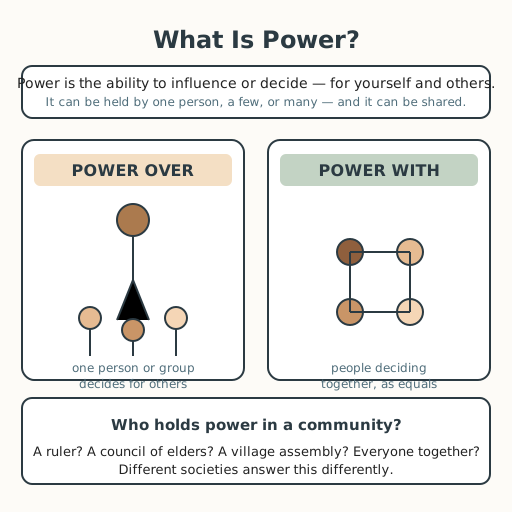
- What-is-power poster · 1 A poster defining power and contrasting "power over" (one decides for others) with "power with" (people deciding together), then asking who holds power in a community
- Who-holds-power cards · 1 set of 6 Six cards showing who holds power in different societies — a monarch, a council of elders, a village assembly, a shared confederacy by consensus, a family, and a school — for discussion
- Power map · 1 per learner A page to map who holds power in one place the learner knows (home, school, or community) and whether it is power over or power with
Low-tech / no-cost
- A read-aloud and circle The facilitator reads the definition and examples aloud; learners discuss who holds power in their own lives, voice only
- A 'who decides' circle In a circle, each learner names one decision made in their day and who made it — and whether it was made over others or with others
Enriched / lab & device
- A device with images · 1 per pair Photographs of a council, an assembly, a palace, and a consensus gathering, discussed with the power-over/power-with frame
- A world map · 1 A map to place examples of who holds power — a confederacy in North America, a village assembly in West Africa, a monarchy — across the globe
Works in different contexts
- large-group Discuss the definition and the six cards together, then have pairs map power in one place they know and share one finding
- multi-age Younger learners match each card to "one person" or "many people" while older learners discuss power over vs. power with and write the map
- self-directed A learner reads the definition, studies the six cards, and fills the power map for one place they know alone
- level-grouped Learners ready to extend name a real decision and trace who has power over it and who has power with others in it
- outdoor-only Stand in a line (one decides for others) and then in a circle (deciding together), and name which feels like power over and which like power with
Lesson 9 — What Is Power, and Who Holds It?
Summary
Learners build a working idea of power — the ability to influence or decide, for yourself and others — and distinguish “power over” (one decides for others) from “power with” (people deciding together). They ask who holds power in a community, comparing a monarch, a council of elders, a village assembly, and a confederacy that decides by consensus, then map power in a place they know.
Objectives
- Explain what power is, who holds it in a community or society, and how it can be used fairly or unfairly. (D08.S4.06.01)
Connection
Think of one decision made in your day — what time to eat, who sits where, what the class studies, who runs your town. Someone decided it. Power is the ability to influence or decide, for yourself and for others. It is everywhere — in families, schools, villages, and whole societies — and it can be held by one person, a few, or many. Today you look at what power is and who holds it, in your world and across the human story.
Materials
- What-is-power poster
- Who-holds-power cards (six examples)
- Power map
Preparation
- Print or draw the what-is-power poster.
- Copy the six cards and a power map for each learner.
- Arrange a circle for discussion and a flat space for writing.
Facilitator note
This lesson is written to the learner (“you”). The skill to build is describing power
without loading it with judgment: power is simply the ability to influence or decide, and
it can be held many ways. Distinguish power over (one decides for others) from power
with (deciding together), but keep both as descriptions, not verdicts — the fairness
question comes in the next lesson. Use examples across societies and honor shared,
consensual forms of power (a council, an assembly, a confederacy) as equal to any other.
Anchor to the learner’s own life so the abstraction lands concretely. See
docs/facilitation.md.
Procedure
- Gather (5 min). You have traced sources, knowledge, movement, and place. Now you look at something that runs through all of them: power.
- Meet the idea (10 min). Read the poster. Power is the ability to influence or decide — for yourself and for others. It comes in two shapes. Power over: one person or group decides for others. Power with: people decide together, as equals. Both are real, and both exist all around you.
- Who holds it? (15 min). Read the six cards. In one society, a monarch holds much power alone. In another, a council of elders decides together. In another, a village assembly lets many voices speak. In still another, a confederacy of nations decides by consensus — everyone talking until they agree. Power can also live in a family and in a school. For each card, ask: is this power over, or power with — or a mix?
- Map power in your world (15 min). On your power map, write one place you know (home, school, or community), then name who holds power there and whether it is mostly power over, power with, or both.
- Share and check (5 min). With a partner, read your map and listen to theirs. Did you both notice that power can be shared, not only held by one?
- Close (5 min). Power is not good or bad by itself — it is a fact of living together. What matters is how it is used. That is the next question.
Differentiation
- Support: Use two cards (a monarch and a village assembly) with picture prompts; scribe the learner’s power map.
- Extension: Name a real decision and trace who has power over it and who has power with others in it.
Assessment
- Formative (observation): Can the learner define power, name who holds it in at least one society, and distinguish power over from power with?
- Self-check: The learner asks, “Can I say what power is, who holds it, and whether it is power over or power with — in a place I know?”
Home connection
With someone at home, list three decisions made in your household and who makes each one — and ask which are made over others and which are made with everyone.
Resources
- The idea of power as the ability to influence or decide is a standard concept in the social sciences (see, for example, the work of the political theorist Steven Lukes, Power: A Radical View). The Haudenosaunee (Iroquois) Confederacy and its Great Law of Peace, with its consensus-based councils and the role of clan mothers, are documented in Haudenosaunee oral tradition and in scholarship and museum collections (see the Smithsonian’s National Museum of the American Indian, https://americanindian.si.edu/). Consensus and assembly forms of decision-making are documented in many societies, including West African village assemblies. These are presented side by side, not ranked.