Lesson 01 — Fact, Belief, or Value?
Learners learn to tell the difference between a **fact** (a claim about how things are, checkable with evidence), a **belief** (a claim a person holds but cannot fully check now), and a **value** (a claim about what ought to be). They sort worked examples, then sort statement cards in pairs and record examples from their own life.
Objectives
Objectives
- D09.S1.06.01 Identify the difference between a fact, a belief, and a value in a short text or conversation.
Essential question
How can I tell the difference between a fact, a belief, and a value in what people say and write?
Key vocabulary
Materials
Standard materials
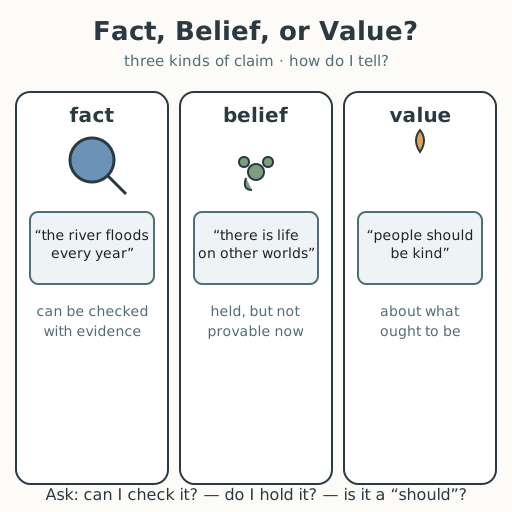
- Fact–belief–value poster · 1 Three labeled columns (fact / belief / value) with one worked example and the 'how do I tell?' question under each
- Statement cards · 1 set per pair Short everyday statements to sort into fact, belief, or value (a plant needs water; there is life on other worlds; people should be kind; a river floods every year)
- Sorting page · 1 per learner A three-column page to record a fact, a belief, and a value from the cards and from the learner's own life
Low-tech / no-cost
- Three chalked columns Draw three columns on the ground or a board — 'can be checked' / 'held but not provable' / 'about what should be' — and stand each spoken statement in the right column
- Spoken statements Say statements aloud; learners move to a corner or raise a hand for fact, belief, or value; no cards or paper needed
Enriched / lab & device
- A shared sorting board or slides · 1 A digital board where learners drag statements into fact, belief, or value columns and see the class's answers
- A short news or social-media snippet · 1 A brief real-world text (a post, a caption, a headline) for the group to sort statements from together
Works in different contexts
- large-group Sort the worked example together on the poster, then have pairs sort a few cards each and share one 'fact, belief, or value' call per pair
- multi-age Younger learners say 'true/false' or 'good/bad' first; older learners name the three kinds and give the 'how do I tell?' reason
- self-directed A learner reads the worked example, sorts the cards alone, and writes one fact, one belief, and one value from their own life with a reason for each
- level-grouped Learners ready to extend take one tricky statement that could be read two ways and explain which reading makes it a fact, a belief, or a value
- outdoor-only Use three marked areas on the ground as the three columns; for each spoken statement, learners stand in the matching area and give their reason aloud
Lesson 1 — Fact, Belief, or Value?
Summary
Learners learn to tell the difference between a fact (a claim about how things are, that evidence can check), a belief (a claim a person holds but cannot fully check now), and a value (a claim about what ought to be). They sort a worked example, then sort statement cards in pairs and record one fact, one belief, and one value from their own life.
Objectives
- Identify the difference between a fact, a belief, and a value in a short text or conversation. (D09.S1.06.01)
Connection
Three sentences, side by side. “The river floods every year.” “There is life on other worlds.” “People should be kind.” They sound similar — but they are three different kinds of claim. The first can be checked with evidence; the second is held but cannot be proven today; the third says what ought to be. Telling them apart is how you know what to ask next: “Is that true? How do you know? Do you mean ‘should’?” — at a market stall, in a comment section, or anywhere people talk.
Materials
- Fact–belief–value poster
- Statement cards
- Sorting page
Preparation
- Print or draw the fact–belief–value poster (three columns, one worked example each, and the “how do I tell?” question under each).
- Copy statement cards for each pair and a sorting page for each learner.
- Prepare three spoken statements (one of each kind) for the opening.
Facilitator note
This lesson is written to the learner (“you”). The idea to land is a precise,
three-way distinction: a fact is a claim about how things are that evidence can
check (true or false); a belief is a claim a person holds but cannot fully check
right now (it might be true or false, but we cannot settle it with what we have); a
value is a claim about what ought to be (it is neither true nor false in the
factual sense — it is about what matters). Teach the sort as a worked example before
independent practice (Kirschner, Sweller & Clark, 2006). Do not rank beliefs or
values against each other — the point is to tell the kinds apart, not to say which is
better. Distinguish evidence from values (docs/philosophy.md §5): a fact is
settled by evidence; a belief is held when evidence is not yet enough; a value is a
“should,” not a “is.” Keep the question open: this lesson teaches classification,
not a verdict on anyone’s beliefs or values. See docs/facilitation.md.
Procedure
- Gather (5 min). You already know what a value is — something you care about that guides your choices. Without looking back, try to recall it in your own words. (Pause — retrieval helps learning stick.) Today you meet its two companions: fact and belief.
- Meet the three kinds (10 min). Look at the poster. A fact is a claim about how things are, and evidence can check it — like “the river floods every year.” A belief is a claim a person holds but cannot fully check now — like “there is life on other worlds.” It might be true or false, but we cannot settle it today. A value is a claim about what ought to be — like “people should be kind.” It is not true or false the way a fact is; it is about what matters.
- Worked example (10 min). Build the sort together. Take a statement card. Ask the three “how do I tell?” questions: Can evidence check it now? (then it is a fact.) Is it held, but not provable now? (then it is a belief.) Is it about what should be? (then it is a value.) Sort three cards together, one of each kind, and say the reason for each.
- Practice with a partner (10 min). Take a set of statement cards. Sort each one into fact, belief, or value, and for each, say the reason aloud: “This is a ___ because ___.” If a card could go two ways, say which reading makes it which — that is the interesting part.
- Record your own (10 min). On your page, write one fact you can check, one belief you hold but cannot prove, and one value you care about — each with a one-line reason for why it belongs in that column.
Differentiation
- Support: Provide a smaller card set with very clear examples and the three “how do I tell?” questions printed as a checklist.
- Extension: Take one tricky statement that could be read two ways and explain which reading makes it a fact, a belief, or a value — and how you would check the fact.
Assessment
- Formative (observation): Can the learner sort a given statement into fact, belief, or value, and give the “how do I tell?” reason?
- Self-check: The learner reads their three examples and asks, “Would evidence settle my fact? Is my belief genuinely not provable now? Is my value really about what ought to be?”
Home connection
Listen for three statements at home or nearby — one fact, one belief, one value — and tell someone how you could tell which was which.
Resources
- On classifying claims and distinguishing “is” from “ought” (the fact–value distinction) in reasoning: see the reasoning and responsible decision-making framing in CASEL, https://casel.org/fundamentals-of-sel/
- On modeling a sort before independent practice: Kirschner, Sweller & Clark (2006), https://doi.org/10.1207/s15326985ep4102_1