Lesson 02 — A Moral Dilemma: Two Right-Seeming Choices
Learners learn what a **moral dilemma** is — two right-seeming choices in conflict, so neither is simply "the good one." They meet a worked dilemma, describe two right-seeming choices in dilemma cards, and write a dilemma of their own.
Objectives
Objectives
- D09.S1.06.02 Describe a moral dilemma (two right-seeming choices in conflict) and weigh the consequences of each.
Essential question
What makes a moral dilemma — and how do I describe its two right-seeming choices?
Key vocabulary
Materials
Standard materials
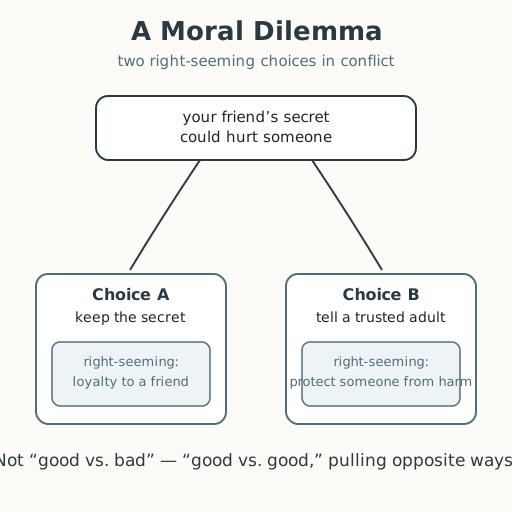
- Dilemma poster · 1 A diagram with one situation at the top and two right-seeming choices branching down, each with a 'why it feels right' note
- Dilemma cards · 1 set per pair Short moral dilemmas (tell the truth vs protect a friend; keep a promise vs help someone in need; share scarce food vs save it for family) with two right-seeming choices each
- Dilemma record page · 1 per learner A page to name a dilemma, its two right-seeming choices, and why each feels right
Low-tech / no-cost
- A told dilemma Tell one dilemma aloud and draw its two branches; learners name why each choice feels right
- Act it out Two learners stand as the two choices; the group names why each choice is right-seeming; no cards or paper needed
- A point-to-the-choice round Name the two choices and hold up a card or object for each; learners point to the choice that feels right, and others nod or point to agree — seated and silent, no speech or standing needed
Enriched / lab & device
- A short film clip or story excerpt · 1 A brief scene or read-aloud where a character faces two right-seeming choices, analyzed as a group
- A class dilemma wall · 1 A shared display where learners post dilemmas they found or invented and read each other's two choices
Works in different contexts
- large-group Build one dilemma together on the poster, then have pairs work a card and share their two right-seeming choices in one sentence each
- multi-age Younger learners name the two choices; older learners name why each choice feels right and what makes it a dilemma
- self-directed A learner reads the worked example, works a dilemma card alone, and writes a dilemma of their own with two right-seeming choices
- level-grouped Learners ready to extend write a dilemma where both choices are equally right-seeming and explain why it is genuinely hard
- outdoor-only Use two stones or branches as the two choices; stand at one and say why it feels right, then the other, before deciding which you would pick
Lesson 2 — A Moral Dilemma: Two Right-Seeming Choices
Summary
Learners learn what a moral dilemma is — two right-seeming choices in conflict, so neither is simply “the good one.” They meet a worked dilemma, describe the two right-seeming choices in dilemma cards, and write a dilemma of their own.
Objectives
- Describe a moral dilemma (two right-seeming choices in conflict). (D09.S1.06.02)
Connection
You promised to keep a friend’s secret — but the secret means someone could get hurt. Keep the promise, or speak up? Both choices look right: loyalty says “keep it,” protection says “tell someone.” A moral dilemma is exactly this — two right-seeming choices pulling in opposite directions. There is no clean “good” button. Learning to see the dilemma clearly — without rushing to pick — is the first step of thinking well about it.
Materials
- Dilemma poster
- Dilemma cards
- Dilemma record page
Preparation
- Print or draw the dilemma poster (one situation, two right-seeming branches, each with a “why it feels right” note).
- Copy dilemma cards for each pair and a record page for each learner.
- Prepare one told dilemma for the opening.
Facilitator note
This lesson is written to the learner (“you”). The idea to land is precise: a moral
dilemma is two right-seeming choices in conflict — neither is obviously “the good
one,” and that is what makes it hard. Model one dilemma as a worked example before
pairs try their own (Kirschner, Sweller & Clark, 2006). Keep it non-shaming and
open: the point is to describe the dilemma, not to settle it — the weighing comes in
the next lesson, and the unit holds questions as questions, never answered as dogma.
Choose dilemmas that are age-appropriate and emotionally safe: keep a promise vs help
someone in need, tell the truth vs protect a friend, share scarce food vs save it for
family. Avoid dilemmas that force a child to choose between loyalties they cannot
safely resolve alone — if a dilemma involves real risk of harm, the move is to bring in
a trusted adult, and that is a right-seeming choice worth naming. Distinguish evidence
from values: that two choices both seem right is observable; which to choose is a
value question for the next lesson. See docs/facilitation.md.
Procedure
- Gather (5 min). Last time you sorted facts, beliefs, and values. Today a new kind of hard thing: a moral dilemma. Try to recall: what does “right” and “wrong” usually mean in a simple choice? (Pause.) A dilemma is when it is not that simple.
- Meet the idea (10 min). Look at the poster. A situation sits at the top. Two choices branch down — Choice A and Choice B. The key: both are right-seeming. Each one has a good reason behind it. A moral dilemma is two right-seeming choices in conflict — not “good vs bad,” but “good vs good,” pulling opposite ways.
- Worked example (10 min). Build one together. Situation: “You promised to keep your friend’s secret, but the secret means someone could get hurt.” Choice A: keep the secret (right-seeming because of loyalty). Choice B: tell a trusted adult (right-seeming because of protecting someone from harm). Name both, and say why each feels right. That tension — both right — is the dilemma.
- Practice with a partner (10 min). Take a dilemma card. Name the situation, then the two right-seeming choices, then why each feels right. Say it in one sentence each: “Choice A feels right because ___; Choice B feels right because ___.” If one choice feels wrong, keep looking — a real dilemma has two that seem right.
- Record your own (10 min). On your page, write a dilemma of your own (real or invented), name its two right-seeming choices, and say why each feels right. Do not decide yet — deciding is the next lesson.
Differentiation
- Support: Provide a dilemma card with both choices already named; the learner adds why each feels right, using a sentence starter.
- Extension: Write a dilemma where the two choices are almost equally right-seeming, and explain in one line what makes it genuinely hard.
Assessment
- Formative (observation): Can the learner name a situation and two right-seeming choices, and say why each feels right?
- Peer check: Partners check each other: “Are both of your choices right-seeming — or is one actually just wrong?”
Home connection
Ask someone at home about a time they faced two right-seeming choices, and name the two reasons that pulled opposite ways.
Resources
- Reasoning about real dilemmas and weighing what is right: responsible decision-making framing in CASEL, https://casel.org/fundamentals-of-sel/
- On modeling a concept before independent practice: Kirschner, Sweller & Clark (2006), https://doi.org/10.1207/s15326985ep4102_1