Lesson 03 — Weighing the Consequences of Each Choice
Learners practice **weighing the consequences of each choice** in a moral dilemma — asking *who is helped* and *who is harmed* by each, and *how big* each consequence is — before reaching a considered decision. They weigh a worked example, then weigh dilemma cards in pairs and record a decision of their own.
Objectives
Objectives
- D09.S1.06.02 Describe a moral dilemma (two right-seeming choices in conflict) and weigh the consequences of each.
Essential question
How do I weigh the consequences of each choice in a moral dilemma?
Key vocabulary
Materials
Standard materials
- Consequence-weighing poster · 1 A two-branch dilemma with a 'who is helped / who is harmed' pair under each choice, and a balance line to compare them
- Weighing cards · 1 set per pair Dilemmas (the same kind met in Lesson 2) with space to list a consequence for each choice — who is helped, who is harmed, and how big each is
- Weighing page · 1 per learner A page with two branches to record consequences of each choice and a line to write a considered decision
Low-tech / no-cost
- A balance in the dirt Draw two pans of a balance on the ground; place a stone for each consequence on each side and watch which side sinks, then talk it through
- Spoken weighing Name a dilemma aloud; learners hold up one hand for each choice and say one consequence for each; no paper needed
Enriched / lab & device
- A shared weighing board or slides · 1 A digital board to build the two branches and list consequences, visible to the whole class
- A short film or story where a character weighs a dilemma · 1 A brief scene where a character names consequences of each choice before deciding, analyzed as a group
Works in different contexts
- large-group Weigh one dilemma together on the poster, then have pairs weigh a card and report the two consequences they compared
- multi-age Younger learners name one consequence per choice; older learners name who is helped and who is harmed and compare which is heavier
- self-directed A learner weighs a dilemma alone, lists consequences of each choice, and writes a considered decision with a reason
- level-grouped Learners ready to extend weigh consequences for several different people (not just one) and explain how that changes the call
- outdoor-only Use a real balance or two stone piles as the two pans; place a stone per consequence and say who is helped and who is harmed before deciding
Lesson 3 — Weighing the Consequences of Each Choice
Summary
Learners practice weighing the consequences of each choice in a moral dilemma — asking who is helped and who is harmed by each choice, and how big each consequence is — before reaching a considered decision. They weigh a worked example, then weigh dilemma cards in pairs and record a decision of their own.
Objectives
- Describe a moral dilemma (two right-seeming choices in conflict) and weigh the consequences of each. (D09.S1.06.02)
Connection
Last time you held a dilemma — two right-seeming choices, pulling opposite ways. Now the next move: before you decide, weigh each choice. What happens to whom if you keep the secret? What happens to whom if you tell? Consequences have weight — some are heavy, some light — and they fall on different people. Weighing them is not finding a perfect answer; it is deciding with your eyes open, aware of who is helped and who is harmed.
Materials
- Consequence-weighing poster
- Weighing cards
- Weighing page
Preparation
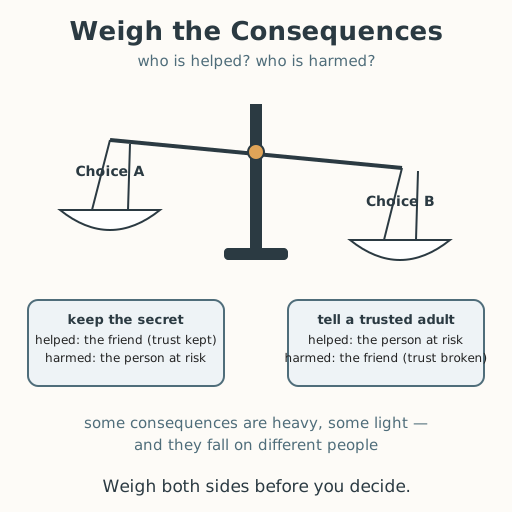
- Print or draw the consequence-weighing poster (two branches, who is helped/harmed under each, and a balance line to compare).
- Copy weighing cards for each pair and a weighing page for each learner.
- Prepare one dilemma (from Lesson 2) to weigh together.
Facilitator note
This lesson is written to the learner (“you”). The skill to land is a consequence
weighing routine: for each choice, name who is helped and who is harmed, then
compare how big each consequence is before deciding. Model it once as a worked example
(Kirschner, Sweller & Clark, 2006). The egalitarian heart is the question who else is
affected? — not only the chooser. Do not mark a learner’s considered decision as
“wrong”; ask instead whether they weighed both choices and noticed who each helped and
harmed. Distinguish evidence from values: what the consequences are and who they
fall on can be reasoned and observed; which consequence matters most is a value
judgment — and different people weigh the same facts differently. Hold it open: the unit
treats these as questions, never settled as dogma. If a dilemma involves real risk of
harm, the lesson’s safety move — bringing in a trusted adult — is always a legitimate
consequence to weigh. See docs/facilitation.md.
Procedure
- Gather (5 min). You can now describe a dilemma: two right-seeming choices in conflict. Try to recall one dilemma from last time and its two choices. (Pause.) Today you weigh them.
- Meet the weighing (10 min). Look at the poster. For each choice, ask two questions: Who is helped? and Who is harmed? Then compare: how big is each consequence, and on whom does it fall? Consequences are not all equal — some are heavy, some light. Weighing means putting them on the balance before you decide.
- Worked example (10 min). Weigh the dilemma together. “Keep the secret, or tell a trusted adult?” Under Choice A write: helped — the friend (trust kept); harmed — the person at risk. Under Choice B: helped — the person at risk; harmed — the friend (trust broken). Now compare: which consequences are heavier, and on whom? Say your considered decision and the reason.
- Practice with a partner (10 min). Take a weighing card. For each choice, name who is helped and who is harmed. Then weigh them — which is heavier, and on whom — and decide together, with a reason: “We chose ___ because, on balance, ___.”
- Record your own (10 min). On your page, take a dilemma of your own, list the consequences of each choice (who is helped, who is harmed), and write your considered decision. There is no single right answer — the point is that you weighed both sides first.
Differentiation
- Support: Provide a pre-drawn two-branch page with one branch’s consequences filled in; the learner completes the other branch and then decides.
- Extension: Weigh consequences for several people, not just one, and explain how considering more people changes the call.
Assessment
- Formative (observation): Can the learner name, for each choice, at least one person helped and one harmed, and state a decision that follows from the weighing?
- Self-check: The learner asks, “Did I weigh both choices before deciding? Did I notice who else was affected, not just myself?”
Home connection
Next time a choice at home affects more than one person, name who is helped and who is harmed by each option — then decide.
Resources
- Weighing consequences for others before deciding: responsible decision-making framing in CASEL, https://casel.org/fundamentals-of-sel/
- On modeling a reasoning routine before independent practice: Kirschner, Sweller & Clark (2006), https://doi.org/10.1207/s15326985ep4102_1