Lesson 09 — Proposing a Fair Resolution
Learners practice **proposing a fair resolution** to a conflict — one that honors both sides' needs and that *both sides accept*. Building on Lesson 8, they name both needs, brainstorm two or three ideas, test each for fairness, and agree on one, then resolve scenarios in pairs and record a resolution of their own.
Objectives
Objectives
- D09.S4.06.01 Analyze a conflict to identify each side's needs and feelings, and propose a fair resolution.
Essential question
How do I propose a fair resolution to a conflict — one both sides can accept?
Key vocabulary
Materials
Standard materials
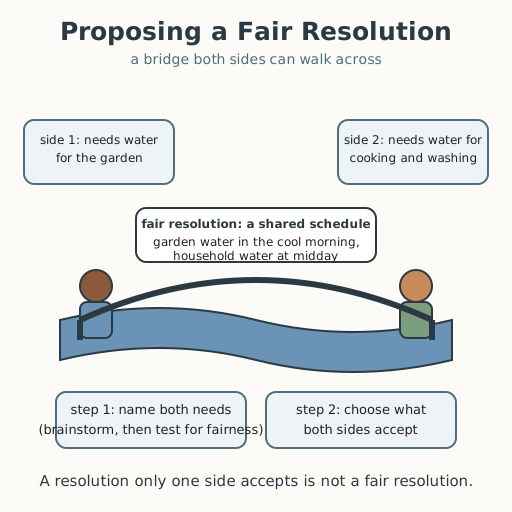
- Fair-resolution poster · 1 A bridge diagram from two sides' needs to a middle resolution, with the steps — name both needs, brainstorm, test for fairness, agree
- Resolution scenarios · 1 set per pair The same conflict cards from Lesson 8, now with a 'propose a fair resolution both sides accept' prompt
- Resolution page · 1 per learner A page to record each side's needs, two or three possible resolutions, and the one both accept
Low-tech / no-cost
- A spoken worked resolution Take a conflict, name both needs aloud, brainstorm two ideas, and pick one both accept — all by voice, no paper
- A talking object and two-idea round Pass a stone so each side names a need, then each side offers one idea, then both point to the resolution they accept
- A thumbs-and-pointing round Sketch or hold up two idea cards; learners point to the resolution both accept and give a thumbs-up for 'fair to both sides' — seated and silent participation, no speech or standing needed
Enriched / lab & device
- A short film or scripted mediation scene · 1 A brief scene where two sides reach a fair resolution, analyzed with the steps
- A class peace-corner with the steps posted · 1 A quiet corner where learners can use the fair-resolution steps themselves, with the poster ready
Works in different contexts
- large-group Build one resolution together on the poster, then have pairs resolve a scenario and share the resolution both accepted
- multi-age Younger learners offer one idea; older learners test each idea for fairness to both sides and name the one both accept
- self-directed A learner reads the worked example, resolves a scenario alone, and writes each side's needs, two ideas, and the one both accept
- level-grouped Learners ready to extend resolve a harder conflict where needs partly conflict, and explain why the chosen resolution is fair to both
- outdoor-only Stand the two sides on either bank of a drawn 'bridge' and walk ideas across it; choose the resolution both step onto together
Lesson 9 — Proposing a Fair Resolution
Summary
Learners practice proposing a fair resolution to a conflict — one that honors both sides’ needs and that both sides accept. Building on Lesson 8, they name both needs, brainstorm two or three ideas, test each for fairness, and agree on one, then resolve scenarios in pairs and record a resolution of their own.
Objectives
- Analyze a conflict to identify each side’s needs and feelings, and propose a fair resolution. (D09.S4.06.01)
Connection
Last time you saw a conflict clearly — two neighbors, one tap, two real needs. Seeing is the first half; the second half is a fair resolution: not one side winning, but a way both sides can accept. A shared schedule — garden water in the cool morning, household water at midday — meets both needs. A fair resolution is a bridge both people can walk across together. Today you build bridges.
Materials
- Fair-resolution poster
- Resolution scenarios
- Resolution page
Preparation
- Print or draw the fair-resolution poster (two sides’ needs → a middle resolution, with the steps: name both needs, brainstorm, test for fairness, agree).
- Copy resolution scenarios for each pair and a resolution page for each learner.
- Prepare one conflict (from Lesson 8) to resolve together.
Facilitator note
This lesson is written to the learner (“you”). The skill to land is a fair-resolution
routine: (1) restate both sides’ needs; (2) brainstorm two or three possible
resolutions; (3) test each for fairness — does it honor both needs, or only one?; (4)
choose the one both sides accept. This is a skill, so model the full routine once
(Kirschner, Sweller & Clark, 2006). Keep it non-shaming and genuinely mutual: a fair
resolution must be accepted by both sides — not imposed, not “majority rules,” and not
the quieter side giving in. The egalitarian move is that a resolution that only the louder
side accepts is not fair, however reasonable it sounds. Distinguish evidence from
values: whether a resolution meets both sides’ stated needs can be checked; that
fairness requires both sides’ acceptance is a value this curriculum holds and names as
such. Draw a clear safety boundary: if a conflict involves harm, threat, or real danger,
the first move is a trusted adult — a peer never resolves serious harm alone. See
docs/facilitation.md.
Procedure
- Gather (5 min). You can now name each side’s feelings and needs in a conflict. Try to recall the two-neighbors conflict: what did each side need? (Pause — retrieval.) Today you turn seeing into a fair resolution.
- Meet the steps (10 min). Look at the poster. Four moves: name both needs (say them aloud, both of them); brainstorm two or three possible resolutions; test each for fairness — does it honor both needs, or only one?; choose the one both sides accept. A resolution only one side accepts is not a fair resolution.
- Worked example (10 min). Build one together. Conflict: the shared tap. Name both needs: garden water; cooking and washing water. Brainstorm: (a) only one side gets it; (b) a shared schedule. Test: (a) honors only one need — not fair; (b) honors both — a shared schedule: garden in the cool morning, household at midday. Choose (b), and check: do both accept? Yes.
- Practice with a partner (10 min). Take a resolution scenario. Name both needs, brainstorm two or three ideas, test each for fairness, and choose the one both sides accept. If the first idea fails the fairness test, brainstorm again. Remember: if there is harm, threat, or danger, bring in a trusted adult — never resolve serious harm alone.
- Record your own (10 min). On your page, write each side’s needs, your two or three ideas, which one you chose, and why both sides accept it. This page pairs with Lesson 8’s analysis as a portfolio piece.
Differentiation
- Support: Provide a scenario with the two needs already named and two ready-made resolutions to test; the learner picks the fair one and says why both accept it.
- Extension: Resolve a conflict where the two needs partly conflict, and explain why your resolution is fair to both — not just a compromise that satisfies neither.
Assessment
- Formative (performance/observation): Can the learner propose a resolution that honors both sides’ stated needs, and can both sides accept it?
- Peer check: Partners check each other: “Does your resolution meet both needs, and would both sides accept it — not just the louder one?”
Home connection
Next time a disagreement comes up at home, name both needs and offer two ideas, then pick the one both accept.
Resources
- Restorative practice frames fair resolution by meeting needs and gaining both sides’ acceptance: International Institute for Restorative Practices, https://www.iirp.edu/
- On modeling a routine before independent practice: Kirschner, Sweller & Clark (2006), https://doi.org/10.1207/s15326985ep4102_1