Lesson 10 — Restorative Justice vs. Punishment
In the unit capstone, learners **explain the aims and limits of restorative justice and compare it with punishment**, and revisit the unit's threads — fact/belief/value, fairness vs justice, and conflict analysis. They compare a worked example, then response cards, and record a considered comparison, holding the question open rather than settling it as dogma.
Objectives
Objectives
- D09.S4.06.02 Explain the aims and limits of restorative justice, and compare it with punishment.
- D09.S1.06.01 Identify the difference between a fact, a belief, and a value in a short text or conversation.
- D09.S2.06.01 Distinguish between fairness (what people deserve) and justice (correcting wrongs and protecting rights), using examples.
- D09.S4.06.01 Analyze a conflict to identify each side's needs and feelings, and propose a fair resolution.
Essential question
What are the aims and limits of restorative justice, and how does it compare with punishment?
Key vocabulary
Materials
Standard materials
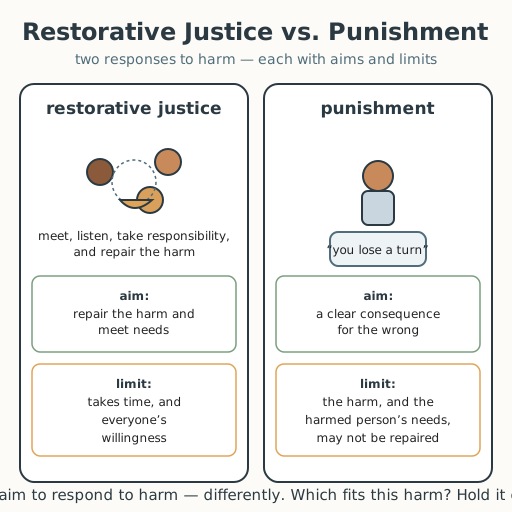
- Restorative-vs-punishment poster · 1 A two-column comparison — restorative justice (repair harm, meet needs, take responsibility) vs punishment (a consequence for the wrong) — each with an 'aim' and a 'limit' line
- Response cards · 1 set per group Scenarios of harm (a broken shared item, a hurtful rumor, a taken goat) with a 'restorative response?' and a 'punishment response?' prompt for each
- Comparison page · 1 per learner A page to record the aims and limits of each approach and a considered view on when each helps
Low-tech / no-cost
- A spoken worked comparison Take one harm, name a restorative response and a punishment response aloud, and list an aim and a limit of each
- Two circles on the ground Draw a 'repair' circle and a 'consequence' circle; for each spoken response, learners stand in the matching circle and name an aim or a limit
Enriched / lab & device
- A short reading or film on restorative circles · 1 A brief age-appropriate account of a restorative circle or conference, analyzed for aims and limits
- A class restorative-and-punishment wall · 1 A shared display where learners post aims and limits they found, building the unit's final comparison
Works in different contexts
- large-group Compare one harm together on the poster, then have groups work a card and share one aim and one limit of each approach
- multi-age Younger learners say 'fix the harm' or 'give a consequence'; older learners name aims and limits of each and a case where one fits better
- self-directed A learner reads the poster, works the response cards, and writes the aims and limits of each approach plus a considered view
- level-grouped Learners ready to extend weigh when restorative justice fits and when it reaches its limits, and defend a reasoned view
- outdoor-only Use two marked circles as 'repair' and 'consequence'; for each spoken response, learners stand in the matching circle and name an aim or a limit
Lesson 10 — Restorative Justice vs. Punishment
Summary
In the unit capstone, learners explain the aims and limits of restorative justice and compare it with punishment, and revisit the unit’s threads — fact/belief/value, fairness vs justice, and conflict analysis. They compare a worked example, then response cards, and record a considered comparison, holding the question open rather than settling it as dogma.
Objectives
- Explain the aims and limits of restorative justice, and compare it with punishment. (D09.S4.06.02)
- Revisit and apply the unit’s threads — fact vs belief vs value, fairness vs justice, and conflict analysis — in one connected capstone task. (D09.S1.06.01, D09.S2.06.01, D09.S4.06.01)
Connection
Someone breaks a shared water jar, and everyone looks at what to do. One answer: a punishment — the person loses a turn or a privilege. Another answer: restorative justice — the person meets the one harmed, hears what the loss meant, takes responsibility, and helps repair it. Both are responses to harm, and both have aims and limits. Neither is magic, and neither is always right. Understanding both — and when each helps — is the last skill of this unit, and it draws on everything before it.
Materials
- Restorative-vs-punishment poster
- Response cards
- Comparison page
Preparation
- Print or draw the restorative-vs-punishment poster (two columns, each with an “aim” and a “limit” line).
- Copy response cards for each group and a comparison page for each learner.
- Prepare one harm scenario to compare together.
Facilitator note
This lesson is written to the learner (“you”). The ideas to land: restorative justice
aims to repair harm, meet the needs of the person harmed, and have the person who harmed
take responsibility — its limits include that it takes time and everyone’s willingness,
and may not fit every harm. Punishment aims at a clear consequence for the wrong and
accountability — its limits include that the harm and the harmed person’s needs may go
unrepaired, and it may not teach how to do better. Compare them non-shamingly and
honestly: neither is “good” and the other “bad”; each has aims and limits, and the unit
holds the question — which response fits this harm? — as a question, never answered as
dogma. This is a capstone, so build in spaced retrieval of the unit’s threads: a
quick recall of fact/belief/value, fairness vs justice, and conflict analysis, interleaved
with the new comparison (see docs/contexts.md; Dunlosky et al. note practice testing and
distributed practice as high-utility). Model the comparison once (Kirschner, Sweller &
Clark, 2006). Distinguish evidence from values: what each approach aims at and where
its limits are is observable in real practices; that repair and dignity matter is a
value this curriculum holds and names as such. Keep restorative examples non-shaming —
the focus is repair and dignity, never humiliation. If a learner brings up serious harm,
hold the boundary: serious harm needs adults and proper systems, and this lesson is about
understanding the ideas, not resolving real cases. See docs/facilitation.md.
Procedure
- Gather — retrieve the unit (5 min). You have come a long way. Without looking back, try to recall: what is the difference between a fact, a belief, and a value? Between fairness and justice? What do you name when you analyze a conflict? (Pause — spaced retrieval across the unit makes these stick.)
- Meet the two responses (10 min). Look at the poster. Restorative justice responds to harm by repairing it: the person harmed is heard, the person who harmed takes responsibility, and the harm is made right as far as it can be. Punishment responds by giving a consequence for the wrong. Each has aims — and each has limits.
- Worked example (10 min). Compare together. Harm: a shared water jar is broken. Restorative response: the person hears what the loss meant, apologizes, and helps mend or replace it. Punishment response: the person loses a turn. Now name an aim and a limit of each: restorative aims to repair harm and heal the relationship, but takes time and willingness; punishment aims at a clear consequence, but the harm — and the harmed person’s needs — may go unrepaired.
- Practice with a partner (10 min). Take a response card. For each harm, name a restorative response and a punishment response, and give one aim and one limit of each. Notice: the same harm can be answered more than one way — the question is which fits, and that question stays open.
- Record your own (10 min). On your comparison page, write the aims and limits of each approach, and a short considered view: for the broken-jar harm, which response would you lean toward, and why? Use the unit’s tools — name facts vs values, check fairness, name both sides’ needs — in your answer. This page is the unit’s capstone portfolio piece.
Differentiation
- Support: Provide a two-column chart with the aims already listed; the learner adds one limit to each and circles the response they would choose, with a sentence starter.
- Extension: Weigh a case where restorative justice reaches its limits (e.g., the harm is denied, or too big for a circle) and explain what a fair response might then require.
Assessment
- Summative (portfolio/observation): Can the learner state at least one aim and one limit of restorative justice and one of punishment, and give a reasoned comparison that uses the unit’s tools (fact/value, fairness, both sides’ needs)?
- Self-check: The learner asks, “Did I name an aim and a limit for both approaches — and did I hold the question open rather than declaring one always right?”
Home connection
Talk with someone at home about how your family or community responds when harm happens — repair or consequence — and name one aim and one limit of the way they usually use.
Resources
- Restorative justice’s aims (repairing harm, meeting needs, taking responsibility) and limits: International Institute for Restorative Practices, https://www.iirp.edu/; and Zehr, Changing Lenses (Herald Press, 1990).
- On spaced, interleaved retrieval in a capstone: Dunlosky et al. (2013), “Improving Students’ Learning With Effective Learning Techniques,” Psychological Science in the Public Interest 14(1), 4–58.
- On modeling a comparison before independent practice: Kirschner, Sweller & Clark (2006), https://doi.org/10.1207/s15326985ep4102_1