Lesson 01 — Who Designs Our Tools? Needs, Wants, and Values
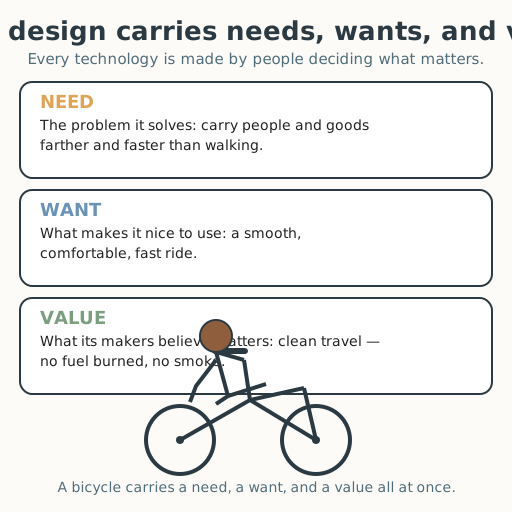
Learners explain that technologies are designed by people with particular needs, wants, and values. A worked example traces the bicycle through its need (travel farther and faster), its want (a smooth, fast ride), and its value (clean travel, no fuel). Learners then read a water filter, a solar lamp, a braille writing slate, or a fishing net the same way, seeing every tool as a person's or community's answer to what they needed and cared about.
Objectives
Objectives
- D10.S1.06.01 Explain that technologies are designed by people with particular needs, wants, and values, and give an example.
Essential question
How do a technology's needs, wants, and values reveal the people who designed it?
Key vocabulary
Materials
Standard materials
- Design triangle poster · 1 A poster tracing one technology (the bicycle) through its need, want, and value, with the labels defined
- Design triangle cards · 1 set per pair Cards for a water filter, a solar lamp, a braille writing slate, and a fishing net, each naming a need, a want, and a value
- Design triangle page · 1 per learner A three-box page (need | want | value) with a line for the people who designed it and what they cared about
Low-tech / no-cost
- A spoken design triangle The facilitator names a tool and learners call out its need, want, and value; voice only
- Act out a need Mime needing to carry water far, then mime the tool that answers the need; no paper needed
Enriched / lab & device
- A short photo set of designed objects from many cultures · 1 set Images of a qanat (water channel), an abacus, a dugout canoe, and a windmill, to ask "who designed this, and what did they care about?"
- A device for a quick image search · 1 per group To find one more designed object and name its need, want, and value, where devices are available
Works in different contexts
- large-group Build the bicycle triangle together on the board, then have pairs each work a different card and report one need, one want, and one value aloud
- multi-age Younger learners name the need a tool answers; older learners add the want and the value, and name the likely designers
- self-directed A learner reads a card, fills the design triangle page, and writes one sentence on who designed the tool and what they valued
- level-grouped Learners ready to extend compare two tools for the same need and explain how different values shaped two different designs
- outdoor-only Find one designed thing outdoors (a fence, a path, a well, a boat) and name its need, want, and value aloud; no paper needed
Lesson 1 — Who Designs Our Tools? Needs, Wants, and Values
Summary
Learners explain that technologies are designed by people with particular needs, wants, and values. A worked example traces the bicycle through its need (travel farther and faster), its want (a smooth, fast ride), and its value (clean travel, no fuel). Learners then read a water filter, a solar lamp, a braille writing slate, or a fishing net the same way, seeing every tool as a person’s or community’s answer to what they needed and cared about — never as a thing that simply appeared.
Objectives
- Explain that technologies are designed by people with particular needs, wants, and values, and give an example. (D10.S1.06.01)
Connection
Hold any object near you — a cup, a shoe, a phone, a broom. Someone, somewhere, decided what problem it would solve, how it should feel to use, and what mattered enough to build into it. A tool is a person’s thinking made solid. Today you learn to read a tool the way you would read a person: what did its makers need, want, and value?
Materials
- Design triangle poster (the bicycle)
- Design triangle cards (water filter, solar lamp, braille slate, fishing net)
- Design triangle page
- Pencils
Preparation
- Print or draw the design triangle poster for the bicycle.
- Copy design triangle cards for each pair and a design triangle page for each learner.
Facilitator note
This lesson is written to the learner (“you”). The idea to land is every technology is
someone’s answer to a need, a want, and a value — not magic, and not “just there.” Model the
bicycle fully as a worked example before learners read their own card (Kirschner, Sweller &
Clark, 2006). Keep it global and egalitarian: choose objects that span cultures and regions (a
qanat, a dugout canoe, a braille slate) so no single place or people appears as the default
“inventor.” Distinguish evidence from values: what a tool does and the problem it solves can
be investigated; that clean travel or fair access matters are values a designer chose to
build in. See docs/philosophy.md §4–5 and docs/facilitation.md.
Procedure
- Gather (5 min). Recall from Grade 5: tools change daily life. Now ask the deeper question — who decided the tool would be this way? A tool is designed by people; it did not make itself.
- Meet the bicycle (12 min). Look at the poster. Every design carries three things. The need — the problem it solves: carrying people and goods farther and faster than walking. The want — what makes it pleasant: a smooth, comfortable, fast ride. The value — what its makers believed mattered: clean travel, no fuel burned, no smoke. Say the triangle together: “need… want… value.”
- Read your own tool (18 min). Take a card. The water filter (need: safe water to drink; want: easy to use every day; value: everyone, even a small child, deserves clean water). The solar lamp (need: light after dark where there is no grid; want: cheap and sturdy; value: light should not depend on costly fuel). The braille writing slate (need: writing for people who are blind; want: small and portable; value: everyone should be able to read and write). The fishing net (need: catch fish to feed a family; want: light to throw and strong to hold; value: taking from the water without taking everything). On your page, write or draw the need, the want, and the value — and one sentence on who likely designed it and what they cared about.
- Check with a partner (10 min). Swap pages. Ask: “Does the triangle make sense? Did you name the need, the want, and the value — and the people behind it?” Fix anything unclear.
- Close (5 min). A tool is not magic; it is a decision. When you ask “who designed this, and what did they care about?”, you begin to see the people inside every object.
Differentiation
- Support: Provide a card with the need already filled in and a sentence starter for the value; work one card aloud first.
- Extension: Compare two tools that answer the same need (a clay pot and a metal pump for water) and explain how different values shaped two different designs.
Assessment
- Formative (observation): Can the learner name a technology’s need, want, and value, and point to the people who designed it?
- Self-check: The learner asks, “Did I name the need, the want, and the value — and did I say who designed it and what they cared about?”
Home connection
Choose one tool at home and ask someone who uses it: what need does it answer, what makes it nice to use, and what value does it carry?
Resources
- The idea that technologies encode their designers’ needs and values is central to technology
studies and is taught across cultures — from the qanat water channels of ancient Persia to the
abacus and the dugout canoe; children’s references (Britannica Kids, DK’s How Things Work)
document these designs and the problems they answer. The framing that design involves need,
want, and value follows the curriculum’s “technology as shaped by people, not magic”
commitment (
docs/philosophy.md§4). On modeling a routine before independent practice, see Kirschner, Sweller & Clark (2006), https://doi.org/10.1207/s15326985ep4102_1.