Lesson 02 — Who Gets to Use It? Technology and Fairness
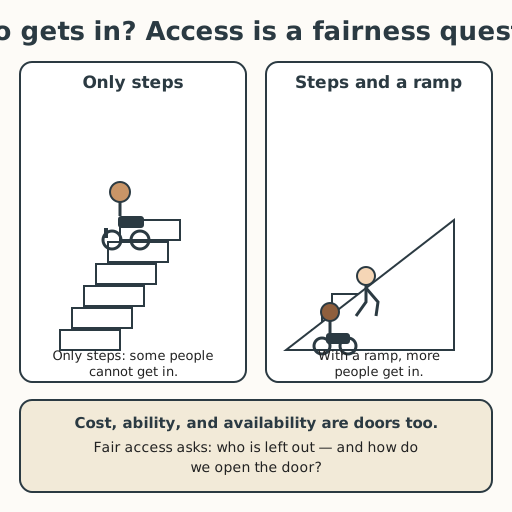
Learners analyze who gets to use a technology and who does not, and why that matters for fairness. A worked example follows one entrance through three doors — cost, ability, and availability — showing how each lets some people through and not others, and how a ramp opens the door for more. Learners then read a school library computer, a water tap, a wheelchair-accessible bus, or a mobile phone signal the same way, framing access as a fairness question people can act on — never as a verdict on any person or place.
Objectives
Objectives
- D10.S1.06.02 Analyze who gets to use a technology and who does not, and why that matters for fairness.
Essential question
Who gets to use a technology, who does not, and why does that matter for fairness?
Key vocabulary
Materials
Standard materials
- Access doors poster · 1 A poster showing one entrance three ways — cost, ability, and availability — each as a door that lets some people through and not others
- Access question cards · 1 set per pair Cards for a school library computer, a water tap, a wheelchair-accessible bus, and a mobile phone signal, each naming who is in and who is out
- Access note page · 1 per learner A page to name a technology, who gets to use it, who does not, and one fairness question it raises
Low-tech / no-cost
- A spoken access question Name a technology aloud and have learners call out who is in and who is out, and why; voice only
- A doorway to think through Look at a real doorway or path and ask who can and cannot use it and what would open it up; no paper needed
Enriched / lab & device
- A short photo set of access designs from many places · 1 set Images of a ramp, a low-cost water kiosk, a shared community phone, and a mobile health van, to discuss who each one lets in
- A device to research one access solution · 1 per group To find one real solution that widened access, where devices are available
Works in different contexts
- large-group Work the three access doors together on the board, then have pairs each take a card and report "who is in, who is out, and one fairness question" in one sentence
- multi-age Younger learners name who can and cannot use a thing; older learners name the barrier (cost, ability, availability) and a fair way to open it
- self-directed A learner works a card alone, fills the access note page, and writes one fairness question and one idea for opening access
- level-grouped Learners ready to extend compare two access solutions and argue which opens the door more fairly, with reasons
- outdoor-only Find one thing people use (a well, a path, a boat, a phone point) and ask who can and cannot reach it; no paper needed
Lesson 2 — Who Gets to Use It? Technology and Fairness
Summary
Learners analyze who gets to use a technology and who does not, and why that matters for fairness. A worked example follows one entrance through three doors — cost, ability, and availability — showing how each lets some people through and not others, and how a ramp opens the door for more. Learners then read a school library computer, a water tap, a wheelchair-accessible bus, or a mobile phone signal the same way, framing access as a fairness question people can act on — never as a verdict on any person or place.
Objectives
- Analyze who gets to use a technology and who does not, and why that matters for fairness. (D10.S1.06.02)
Connection
Think of a technology you use easily — a tap, a phone, a book, a road. Now ask a simple question: who cannot use it? A person who cannot pay, a person whose body does not match the design, a person who lives where it is not available. Who gets left out is not an accident of the tool; it is a choice its design and its price made. Fairness means noticing that question — and asking how to open the door wider.
Materials
- Access doors poster
- Access question cards
- Access note page
- Pencils
Preparation
- Print or draw the access doors poster.
- Copy access question cards for each pair and an access note page for each learner.
Facilitator note
This lesson is written to the learner (“you”). The skill to land is the access analysis:
name a technology, name who is in and who is out, name the barrier (cost, ability,
availability), and ask a fairness question. Model the entrance example fully as a worked
example. Frame access as a fairness question, never a deficit story: do not describe
people or regions as “lacking” or “behind”; describe designs and prices that leave people
out, and the real solutions — ramps, low-cost water kiosks, shared community phones, mobile
clinics — that people everywhere have already built. Distinguish evidence from values: who
can and cannot use a tool is observable; that everyone deserves fair access is a value this
curriculum holds. See docs/philosophy.md §4 (egalitarianism) and docs/facilitation.md.
Procedure
- Gather (5 min). Last lesson: tools are designed by people. Today’s question: when a design is finished, who gets to use it? And who is left standing outside?
- Meet the three doors (12 min). Look at the poster. One entrance, three doors. Cost — if it costs money, only those who can pay get through. Ability — if the entrance has only steps, a person who uses a wheelchair cannot get in. Availability — if it is not built where you live, you cannot reach it. Each door lets some people through and not others. Now the fairness move: add a ramp beside the steps, and more people get in — the design changed, and so did who belongs.
- Read your own card (18 min). Take a card. The school library computer (in: learners with an account and time; out: those with no card, no electricity, or a screen they cannot see or use; fairness question: how does every learner get a turn and an accessible screen?). The water tap (in: people near clean piped water; out: people who carry water from far away; fairness question: how does clean water reach everyone?). The wheelchair-accessible bus (in: people who can reach the stop and board the low floor; out: people far from the route; fairness question: how does the route reach every neighborhood?). The mobile phone signal (in: people in covered areas who can afford a phone; out: people outside the signal or the price; fairness question: how does connection reach rural and remote places?). On your page, name the technology, who is in, who is out, and one fairness question — then one idea for opening the door.
- Check with a partner (10 min). Say it in one breath: “for ___, ___ can use it, ___ is left out, and the fairness question is ___.” Ask: did your partner name a barrier and an idea for opening it?
- Close (5 min). Access is not luck; it is a design choice. When you ask who is left out, you are asking a fairness question — the first step toward opening the door.
Differentiation
- Support: Provide a card with the barrier named and a sentence starter for the fairness question; work one card aloud first.
- Extension: Compare two access solutions (a ramp vs. a fare discount, say) and argue which opens the door more fairly, and for whom.
Assessment
- Formative (observation): Can the learner name who is in and who is out for a technology, identify the barrier, and pose a fairness question?
- Peer check: Partners ask each other, “Did you name a barrier — cost, ability, or availability — and did you suggest a way to open access?”
Home connection
Pick one technology your family uses. Ask: who in our community cannot use it, and what could open it up — a lower price, a different design, or bringing it closer?
Resources
- Access to technology varies by cost, disability, and geography, and design decisions (ramps,
low-cost options, coverage) change who is included — documented by the World Bank’s World
Development Report on technology and by accessibility standards (the Web Content
Accessibility Guidelines and the UN Convention on the Rights of Persons with Disabilities).
The framing of access as a fairness question, not a deficit story, follows
docs/philosophy.md§4 anddocs/facilitation.md.