Lesson 08 — Walk or Ride? Choosing with Trade-offs
Learners evaluate a simple everyday choice — walking versus riding — for its effects on people and the planet, and explain the trade-offs. A worked example weighs the two: walking is healthy, free, and fuel-free but slow and tiring over distance; riding is fast, dry, and carries heavy things but costs money and burns fuel. Learners then weigh carrying water by hand vs. a pump, cooking over wood vs. a clean stove, and buying local food vs. food flown in — and see that the best choice depends on the situation, with no single "right" answer. The lesson revisits the whole unit: design, access, media, biodiversity, and footprint.
Objectives
Objectives
- D10.S4.06.02 Evaluate a simple everyday choice, such as walking versus riding, for its effect on people and the planet, and explain the trade-offs.
- D10.S4.06.01 Explain what a footprint (the resources a person or place uses) is and compare the footprints of two different lifestyles.
Essential question
How do I evaluate a simple everyday choice — walking versus riding — for its effects on people and the planet, and what are the trade-offs?
Key vocabulary
Materials
Standard materials
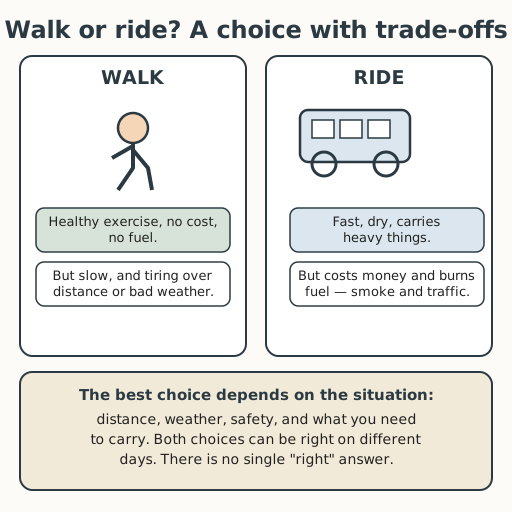
- Trade-off balance poster · 1 A poster listing the effects of walking vs. riding on people and the planet, with a "depends on the situation" band beneath
- Choice cards · 1 set per pair Cards for three everyday choices — carry water by hand vs. a pump, cook over wood vs. a clean stove, buy local food vs. food flown in — each with effects on people and planet to weigh
- Trade-off page · 1 per learner A page with two columns (choice A | choice B) for effects on people and planet, and a line for the learner's own decision and its trade-offs
Low-tech / no-cost
- A spoken trade-off Name a choice aloud and have learners call out its effects on people and on the planet; voice only
- Act out walking and riding Mime walking a short way and riding a long way, then say when each makes sense; no paper needed
Enriched / lab & device
- A short photo set of ways people move · 1 set Images of walking, cycling, a bus, a train, a boat, and a car in different places, to weigh real travel choices
- A device to research one local travel choice · 1 per group To find the real options and their effects near the learner, where devices are available
Works in different contexts
- large-group Weigh walking vs. riding together on the poster, then have pairs weigh a choice card and report "for ___, the trade-off is ___" in one sentence
- multi-age Younger learners name one good and one bad effect; older learners weigh effects on people and planet and defend a decision for a given situation
- self-directed A learner works a choice card alone, fills the trade-off page, and writes a decision with its trade-offs for one situation
- level-grouped Learners ready to extend weigh the same choice for two different situations (short distance vs. long) and explain how the best choice changes
- outdoor-only Actually walk a short way and consider riding a long way, then say which fits which situation and why; no paper needed
Lesson 8 — Walk or Ride? Choosing with Trade-offs
Summary
Learners evaluate a simple everyday choice — walking versus riding — for its effects on people and the planet, and explain the trade-offs. A worked example weighs the two: walking is healthy, free, and fuel-free but slow and tiring over distance; riding is fast, dry, and carries heavy things but costs money and burns fuel. Learners then weigh carrying water by hand vs. a pump, cooking over wood vs. a clean stove, and buying local food vs. food flown in — and see that the best choice depends on the situation, with no single “right” answer. The lesson revisits the whole unit: design, access, media, biodiversity, and footprint.
Objectives
- Evaluate a simple everyday choice, such as walking versus riding, for its effect on people and the planet, and explain the trade-offs. (D10.S4.06.02)
- Revisit: explain what a footprint is and compare the footprints of two different lifestyles. (D10.S4.06.01)
Connection
Every day you make dozens of small choices — walk or ride, buy this or that, use it or save it. Each choice gives something and takes something: that is a trade-off. Walking gives you exercise and clean air and costs nothing, but takes time and tires you on a long road. Riding is fast and dry and carries heavy things, but costs money and burns fuel. A good decision is not the one that has no downsides — no such choice exists. It is the one that fits your situation best.
Materials
- Trade-off balance poster
- Choice cards
- Trade-off page
- Pencils
Preparation
- Print or draw the trade-off balance poster.
- Copy choice cards for each pair and a trade-off page for each learner.
Facilitator note
This lesson is written to the learner (“you”). The skill to land is the trade-off
evaluation: name the choice, list its effects on people and on the planet, weigh them for a
specific situation, and state the decision with its trade-offs. Model walking vs. riding
fully as a worked example. Keep the trade-off balanced and non-moralizing: neither walking
nor riding is universally “good” or “bad” — a long, unsafe, or stormy trip changes the answer,
and people with different bodies, distances, and means face different real options. The
capstone also retrieves the unit’s earlier ideas (design, access, media reading, biodiversity,
footprint) to show the year’s learning as one connected toolkit. Distinguish evidence from
values: what each choice costs and gives is observable; that we should weigh effects on
people and planet is a value this curriculum holds. See docs/philosophy.md §4–5 and
docs/facilitation.md.
Procedure
- Gather (5 min). Today you gather the whole unit into one skill: evaluating an everyday choice for its effects on people and the planet, and naming the trade-offs. No choice is all good or all bad; every choice is a trade.
- Meet walking vs. riding (12 min). Look at the poster. Walking — on people: healthy exercise, no cost, no fuel; on the planet: nothing burned, no smoke. But it is slow and tiring over distance or in bad weather. Riding (a bus, a car, a bike) — on people: fast, dry, carries heavy things; on the planet: burns fuel, adds smoke and traffic, and costs money. Now the key: the best choice depends on the situation. A short, safe trip on a fine day? Walking fits. A long, rainy trip with heavy bags, or a body that cannot walk far? Riding fits. Both can be right on different days.
- Weigh your own choice (18 min). Take a card. Carry water by hand vs. a pump (hand: free and uses no fuel, but heavy and slow; pump: fast and less tiring, but costs money and needs parts — the trade-off depends on how far and how much). Cook over wood vs. a clean stove (wood: free and familiar, but smoky and heavy on trees; clean stove: less smoke and less wood, but costs money — the trade-off depends on what is available and affordable). Buy local food vs. food flown in (local: fresh, supports nearby farmers, less travel; flown-in: available out of season, but more fuel and cost — the trade-off depends on season and access). On your page, list each choice’s effects on people and on the planet, then write your decision for one situation and name its trade-offs.
- Check with a partner (10 min). Say: “in the situation of ___, I would choose ___, because ___, and the trade-off is ___.” Ask: did your partner weigh both people and planet, and name the downside they accepted?
- Close (5 min). This is the year’s last move, and it uses everything: who designs tools, who gets to use them, how to read what messages say, how life holds together, and what your life uses. You can now weigh a choice with your head and your heart — and choose with care.
Differentiation
- Support: Provide a trade-off page with one effect filled in on each side and a sentence starter for the decision; work one card aloud first.
- Extension: Weigh the same choice for two different situations (short vs. long distance) and explain how the best choice changes — with reasons.
Assessment
- Formative (observation): Can the learner name a choice’s effects on people and the planet and explain the trade-off for a given situation?
- Portfolio: The learner’s trade-off page (one decision with its effects and trade-offs) is kept as a year-end artifact of evaluation and stewardship reasoning.
- Self-check: The learner asks, “Did I weigh effects on both people and planet, and did I name the trade-off — the thing I gave up to get what I chose?”
Home connection
Choose one real trip this week — walk or ride — and say out loud why it fits that situation, and what the trade-off is.
Resources
- Weighing the effects of everyday choices (walking vs. riding, wood vs. clean stoves, local
vs. transported food) on health, cost, and the environment is documented by the World Health
Organization (active travel and air pollution), the Global Footprint Network, and the UN Food
and Agriculture Organization; the “depends on the situation, no single right answer” framing
follows
docs/facilitation.mdand the curriculum’s balanced, non-moralizing stance (docs/philosophy.md§5).