Lesson 07 — Footprints: What My Life Uses
Learners explain what a footprint is — the resources a person or place uses — and compare the footprints of two lifestyles as information, not as a ranking. A worked example defines the footprint and lists the resources of two example lives (travel, food, energy, things). Learners then compare a city bus-rider, a rural farm family, a fishing village, and a long-distance commuter, resource by resource, without shaming any life — different lives use different amounts, and knowing that is the first step to choosing.
Objectives
Objectives
- D10.S4.06.01 Explain what a footprint (the resources a person or place uses) is and compare the footprints of two different lifestyles.
Essential question
What is a footprint, and how do the footprints of two different lifestyles compare?
Key vocabulary
Materials
Standard materials
- Footprint poster · 1 A poster defining footprint as the resources a person or place uses, with two example lifestyles listed side by side
- Lifestyle cards · 1 set per pair Cards describing two lifestyles each — a city bus-rider who grows some food, a rural farm family, a fishing village, a long-distance commuter — with the resources each uses listed
- Footprint compare page · 1 per learner A two-column page (lifestyle A | lifestyle B) with rows for food, travel, energy, and things, and a line for what the comparison shows
Low-tech / no-cost
- A spoken footprint compare The facilitator describes two lives aloud and learners call out which uses more of each resource; voice only
- A footprint in the dirt Draw two footprint outlines of different sizes and list each life's resources beside them; no paper needed
Enriched / lab & device
- A footprint calculator · 1 per group A simple child-friendly ecological-footprint calculator, to see how choices change the number, where devices are available
- A short set of photos of different daily lives · 1 set Images of a city flat, a farm, a fishing village, and a suburb, to ground the lifestyle cards in real places
Works in different contexts
- large-group Build the footprint definition and the two example lifestyles together on the poster, then have pairs compare a card set and report "___ uses more of ___ because ___" in one sentence
- multi-age Younger learners match each life to the resources it uses; older learners compare resource by resource and explain why the footprints differ
- self-directed A learner works a card set alone, fills the footprint compare page, and writes what the comparison shows
- level-grouped Learners ready to extend estimate their own day's resources and describe how one change would shrink or grow their footprint
- outdoor-only Compare two ways of doing one task outdoors (carrying water by hand vs. a pump; walking vs. riding) and list what each uses; no paper needed
Lesson 7 — Footprints: What My Life Uses
Summary
Learners explain what a footprint is — the resources a person or place uses — and compare the footprints of two lifestyles as information, not as a ranking. A worked example defines the footprint and lists the resources of two example lives (travel, food, energy, things). Learners then compare a city bus-rider, a rural farm family, a fishing village, and a long-distance commuter, resource by resource, without shaming any life — different lives use different amounts, and knowing that is the first step to choosing.
Objectives
- Explain what a footprint (the resources a person or place uses) is and compare the footprints of two different lifestyles. (D10.S4.06.01)
Connection
Every day your life reaches out to draw on the world: the food you eat, the water and energy you use, the way you travel, the things you own and throw away. Together those draws make up your footprint — the mark your life leaves on the Earth’s resources. Two people can live very different lives and leave very different marks. Today you learn to measure and compare those marks — not to judge anyone, but to understand, so you can choose.
Materials
- Footprint poster
- Lifestyle cards
- Footprint compare page
- Pencils
Preparation
- Print or draw the footprint poster.
- Copy lifestyle cards for each pair and a footprint compare page for each learner.
Facilitator note
This lesson is written to the learner (“you”). The skill to land is the footprint compare:
define the footprint, list each life’s resources (food, travel, energy, things), and compare
resource by resource. Model the two example lives fully as a worked example. This comparison
must never shame any lifestyle or region. A rural family that cooks over wood, a city dweller
who rides the bus, and a commuter who drives all face different realities and constraints —
none is “better” as a person because of the resources they use. The footprint is a measurement
of systems and choices, not a score on character. Distinguish evidence from values: how
much each life uses is measurable; that we should use resources with care for others and the
future is a value this curriculum holds. See docs/philosophy.md §4–5 and
docs/facilitation.md.
Procedure
- Gather (5 min). Ask: what did your life use today — food, water, energy, travel, things? Add them up and you have your footprint.
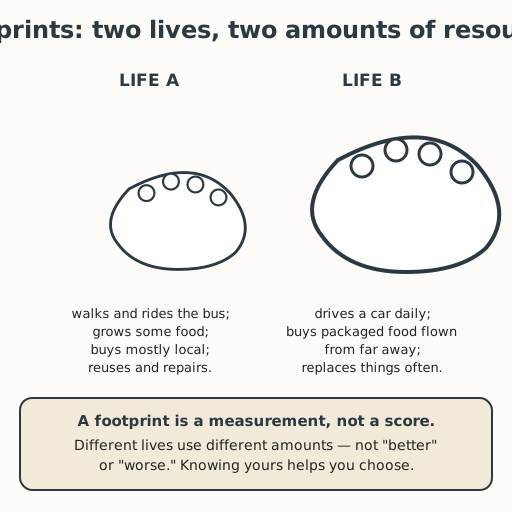
- Meet the footprint (12 min). Look at the poster. A footprint is the resources a person or place uses. It has parts: food (where it comes from), travel (how you move), energy (cooking, light, heat), and things (what you buy and throw away). Compare two example lives. Life A walks and rides the bus, grows some food, buys mostly local, reuses and repairs. Life B drives a car daily, buys packaged food flown from far away, replaces things often. Life B’s footprint is larger — that is a fact to understand, not a reason to shame. Neither life is better as a person.
- Compare your own (18 min). Take a card set. The city bus-rider (travels by bus and foot; buys from nearby markets; lives in a shared flat) vs. the rural farm family (grows much of its food; cooks over wood or gas; travels by cart or motorbike). The fishing village (eats local fish and crops; travels by boat; few bought things) vs. the long-distance commuter (drives far daily; buys packaged food; many electric devices). On your compare page, list each life’s food, travel, energy, and things — then write one sentence on what the comparison shows.
- Check with a partner (10 min). Say: “___ uses more of ___ because ___.” Then ask together: does saying a footprint is larger say anything about who is a better person? (No — it says something about the choices and systems around a life.)
- Close (5 min). A footprint is a measurement, not a score. Understand yours, and you hold the first tool for choosing with care.
Differentiation
- Support: Provide a compare page with one row pre-filled and a sentence starter for the comparison; work one card set aloud first.
- Extension: Estimate your own day’s food, travel, energy, and things, and describe how one change (walking more, wasting less food, reusing a bag) would shrink your footprint.
Assessment
- Formative (observation): Can the learner define a footprint and compare two lifestyles resource by resource — without ranking the people as better or worse?
- Self-check: The learner asks, “Did I compare food, travel, energy, and things — and did I keep the comparison about choices and systems, not about who is a better person?”
Home connection
With your family, list one day’s food, travel, energy, and things. Ask: which part uses the most, and what is one small change we could try?
Resources
- The ecological footprint — the resources a person or place uses — is a standard concept from
the Global Footprint Network and is taught in age-appropriate form by organizations such as
WWF and the UN Environment Programme; the four-part breakdown (food, travel, energy, things)
is a common classroom simplification. The explicit non-shaming framing follows
docs/philosophy.md§4 (egalitarianism) anddocs/facilitation.md.