Lesson 02 — My Goal, My Plan, and What Works
Learners return to the goal loop — set a goal, try it and track, reflect on what worked, adjust and try again — and set one concrete short-term goal for the summer or the start of Grade 7, with a simple tracking plan. They reflect on what has helped them stay on track before, producing a goal-and-plan note for the year-end portfolio.
Objectives
Objectives
- D01.S3.06.01 Set a short-term goal, track their progress, and reflect on what worked.
Essential question
How do I set a short-term goal, track it, and reflect on what worked?
Key vocabulary
Materials
Standard materials
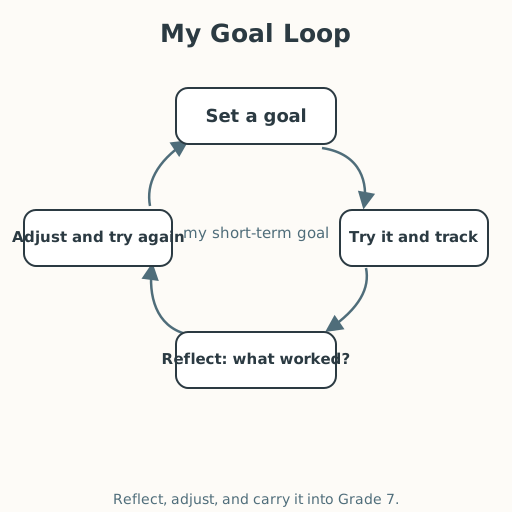
- Goal loop poster · 1 A poster of the four-step cycle — set a goal, try it and track, reflect on what worked, adjust and try again — with "my short-term goal" in the center
- My goal-and-plan note page · 1 per learner A page to write a specific short-term goal for the summer or the start of Grade 7, a simple way to track it, and a reflection on what has worked for them
- Pencils · per learner
Low-tech / no-cost
- A goal drawn in the dirt or sand Draw the loop on the ground with a stick and walk the four steps, naming your goal and how you will track it; no paper needed
- A spoken goal loop Say your goal, your tracking plan, and one thing that has helped you stay on track before; no paper needed
Enriched / lab & device
- A simple tracking chart or sticker chart · 1 per learner A printed week-long chart to mark daily progress toward the goal
- A class goal wall · 1 A wall where learners post one goal and one tracking idea, building a bank of strategies over the week
Works in different contexts
- large-group Model one worked goal loop together, then have learners write their own in small groups and share one tracking idea
- multi-age Older learners explain the loop while younger learners pick one small goal and one way to mark progress
- self-directed A learner works through the loop alone, writing a goal, a tracking plan, and a reflection in their own words
- level-grouped Learners ready to extend make their goal specific and measurable, and plan a mid-point check to adjust
- outdoor-only Walk the loop on the ground, naming each step aloud, and mark a natural object (stones in a row) as your tracking plan; no paper needed
Lesson 2 — My Goal, My Plan, and What Works
Summary
Learners return to the goal loop — set a goal, try it and track, reflect on what worked, adjust and try again — and set one concrete short-term goal for the summer or the start of Grade 7, with a simple tracking plan. They reflect on what has helped them stay on track before, producing a goal-and-plan note for the year-end portfolio.
Objectives
- Set a short-term goal, track their progress, and reflect on what worked. (D01.S3.06.01)
Connection
You decide you want to learn a song on an instrument, ride a bike without wobbling, or bake a bread that rises. Wishing is not enough — a goal turns the wish into a plan: I will practice ten minutes a day; I will try every morning; I will check off each day I try. Then you reflect: which mornings worked best? What made the difference? That is the whole skill, and it is the same for a farm task, a homework plan, a new language, or a summer project. The loop — set, try and track, reflect, adjust — works in a city flat or a village field, and it is yours to carry into Grade 7.
Materials
- Goal loop poster
- My goal-and-plan note page
- Pencils
Preparation
- Print or draw the goal loop poster (four steps around “my short-term goal”).
- Copy a goal-and-plan note page for each learner.
- If possible, prepare a simple week-long tracking chart for the enriched variant.
Facilitator note
This lesson is written to the learner (“you”). It retrieves the goal-setting skill from
earlier in the year (see L.06.001.09) and applies it forward — a spiral, not a repeat. This is a
foundational self-regulation skill, so model it as a worked example first (Kirschner, Sweller
& Clark, 2006): name a goal, make it specific and small, show a tracking plan, then model
reflection. Keep the stance mastery, not ranking — a goal not yet reached is information
(“not yet”), never a verdict. Goals should be the learner’s own, realistic, and about growth, not
comparison. Encourage goals that are doable in a week or a month, and never require any learner
to disclose anything private. See docs/facilitation.md.
Procedure
- Gather and remember (5 min). Earlier this year you set and tracked a short-term goal. Quick recall, no page needed: what was the goal, and what was one thing that worked? (Retrieval practice: recall before you read.)
- Meet the goal loop (10 min). Look at the poster. It is a circle with four moves: Set a goal → Try it and track → Reflect: what worked? → Adjust and try again → and around again. Worked example: goal — “read one chapter every evening for two weeks.” Track — a checkmark each evening. Reflect — “I read best right after dinner, before I get tired.” Adjust — “move reading to right after dinner.” That small reflection is the whole trick.
- Set your goal (10 min). On your page, write one short-term goal for the summer or the start of Grade 7. Make it specific and small: not “get better at everything” but “run a little farther each week” or “learn five new words of a language I want to speak.” Then write how you will track it — checkmarks, a chart, stones in a row, a note in a notebook.
- Reflect on what works (10 min). Think back: when you reached a goal before, what helped? Write one thing that has worked for you (a time of day, a person who reminds you, a small first step). That is your reflection to keep.
- Close (5 min). A goal is a wish with a plan. Track it, reflect, adjust — and if you are not there yet, that is information, not a verdict. You are the author of your next step.
Differentiation
- Support: Offer two ready-made goal choices to pick from, and one tracking idea; ask the learner to say the goal in their own words.
- Extension: Make the goal measurable and time-bound, and plan a mid-point check where the learner will decide what to adjust.
Assessment
- Formative (self): Can the learner state a specific short-term goal, a way to track it, and one reflection on what has worked?
- Portfolio: The goal-and-plan note, kept as a year-end artifact alongside the “who I am becoming” reflection.
Home connection
Share your goal and tracking plan with someone at home and invite them to be your “check-in” person once this week — and offer to be theirs.
Resources
- Goal-setting, self-monitoring, and reflection are core self-regulation skills in CASEL’s self-management competency; explicit modeling of the goal cycle supports novices (Kirschner, Sweller & Clark, 2006): https://casel.org/fundamentals-of-sel/