Lesson 03 — Staying True Under Pressure
Learners consolidate the strategies they have practiced this year for handling stress, distraction, and peer pressure into one personal "values anchor." They work through three short scenarios with the pause–name–choose move, then build a small values-and-strategies card they will carry into Grade 7.
Objectives
Objectives
- D01.S3.06.02 Use strategies to handle stress, distraction, or peer pressure while staying true to their own values.
Essential question
How do I handle stress, distraction, and peer pressure while staying true to my values?
Key vocabulary
Materials
Standard materials
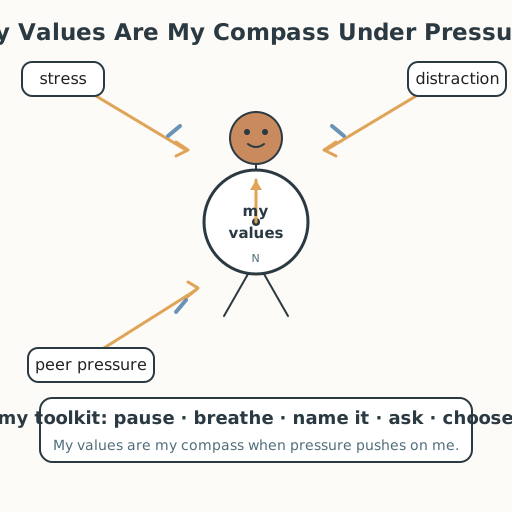
- Values compass poster · 1 A poster of a figure holding a compass labeled "my values" while three arrows — stress, distraction, peer pressure — press in, each meeting a "pause" bar, with a toolkit strip of strategies
- My values anchor card · 1 per learner A small card to write two or three personal values and one strategy for each kind of pressure
- Pencils · per learner
Low-tech / no-cost
- A spoken anchor Name your values aloud and say one strategy for each pressure; no card needed
- A values stone Hold a stone as your "anchor" while you name a value and one way you will stay true to it; no paper needed
Enriched / lab & device
- A laminated values anchor card · 1 per learner A durable card the learner can keep in a pocket or bag and carry into Grade 7
- A class values wall · 1 A shared wall of values and strategies, built by the whole group over the unit
Works in different contexts
- large-group Model one worked scenario for each pressure, then have small groups practice pause–name–choose and share one strategy
- multi-age Older learners model a scenario while younger learners name the pressure and one small response that stays true
- self-directed A learner works through the three scenarios alone, writing a value and a strategy for each pressure in their own words
- level-grouped Learners ready to extend write about a moment their values and a friend's urging were in tension, and how they could respond with assertion
- outdoor-only Stand on a "values" spot and have a partner call out one pressure; step back and name your pause, your value, and your choice aloud; no paper needed
Lesson 3 — Staying True Under Pressure
Summary
Learners consolidate the strategies they have practiced this year for handling stress, distraction, and peer pressure into one personal values anchor. They work through three short scenarios with the pause–name–choose move, then build a small values-and-strategies card they will carry into Grade 7.
Objectives
- Use strategies to handle stress, distraction, or peer pressure while staying true to their own values. (D01.S3.06.02)
Connection
A test is tomorrow and your chest feels tight — that is stress. A phone buzzes while you are trying to focus — that is distraction. Friends urge you to join something you know is wrong for you — that is peer pressure. All three push on the same thing: your values, the ideas about right and wrong you have chosen to live by. When pressure pushes, your values are the compass that tells you which way is your way. The skill is not to feel nothing — it is to pause, name what presses, and choose what stays true. That skill works in a busy city, a quiet village, on a screen, or in a crowded corridor.
Materials
- Values compass poster
- My values anchor card
- Pencils
Preparation
- Print or draw the values compass poster (figure, compass of values, three arrows, pause bars, toolkit strip).
- Copy a values anchor card for each learner.
- Prepare three short scenario prompts to model and practice.
Facilitator note
This lesson is written to the learner (“you”). It retrieves and consolidates the
pressure-handling strategies from earlier in the year (see L.06.001.10 and the self-care work in
Unit 8) into a portable anchor — a spiral, not a repeat. This is a skill, so model each
scenario step-by-step before independent practice (Kirschner, Sweller & Clark, 2006). Name the
technology lens explicitly — distraction is often a device, and the strategy is to choose
when and how to use it, not to shame the tool. Values are personal; invite learners to share only
what they choose, and never rank any value system. Frame peer pressure carefully: peers are not
villains, and “staying true” includes saying no kindly and finding allies. See
docs/facilitation.md and docs/contexts.md.
Procedure
- Gather and remember (5 min). Quick recall, no page needed: name the three pressures we have studied this year — stress, distraction, peer pressure — and one strategy you have already used. (Retrieval practice: recall before you read.)
- Meet the compass (10 min). Look at the poster. You stand in the middle holding a compass labeled my values. Three arrows press in: stress, distraction, peer pressure. Before each arrow reaches you there is a pause bar. The move is always three steps: pause → name what presses → choose what stays true. Worked example: a friend urges you to copy someone’s work. Pause. Name it — “that is peer pressure, and it goes against my value of honesty.” Choose — “no thank you, I will do my own and I can help you with yours.”
- Practice the three pressures (15 min). With a partner or alone, work through three scenarios: (a) stress — a big test tomorrow; (b) distraction — a phone buzzing while you read; (c) peer pressure — friends urging something against your values. For each, say or write: what presses, what value it touches, and one choice that stays true. Use the toolkit strip: pause, breathe, name it, ask for help, choose.
- Build your anchor card (15 min). On your card, write two or three values you hold — honesty, fairness, kindness, courage, family, faith, the Earth — and next to each, one strategy for when pressure pushes. Keep the card small enough to carry.
- Close (5 min). Pressure will come again. Your values are your compass, and the pause is your power. Carry the anchor with you — into the summer, into Grade 7, into the rest of your life.
Differentiation
- Support: Provide one pre-written value and one strategy to choose from for each pressure; ask the learner to say the three-step move in their own words.
- Extension: Write about a moment two pulls were in tension — a friend’s urging against a value — and draft an assertive, kind refusal that keeps the friendship and the value.
Assessment
- Formative (self): Can the learner name the three pressures, apply pause–name–choose to a scenario, and name at least one value and one strategy?
- Portfolio: The values anchor card, kept as a year-end artifact (the “values note”).
Home connection
Ask someone at home what their “values compass” points to and one way they stay true to it when life pushes — and tell them yours.
Resources
- Stress-management and resisting negative peer influence are part of CASEL’s self-management and responsible decision-making competencies; explicit modeling of a strategy supports novice learners (Kirschner, Sweller & Clark, 2006): https://casel.org/fundamentals-of-sel/