Lesson 03 — Feelings Shown, Hidden, and Valued
Learners discover that cultures — and families within them — differ in which feelings are shown, hidden, or valued, and that these are learned "display rules," not universal facts. They sort feelings across the three columns, hear examples from several traditions held side by side and never ranked, and name the norms of their own home or community.
Objectives
Objectives
- D01.S1.07.02 Explain how cultural norms shape which feelings are shown, hidden, or valued.
Essential question
Why do different cultures — and families — differ in which feelings are shown, hidden, or valued?
Key vocabulary
Materials
Standard materials
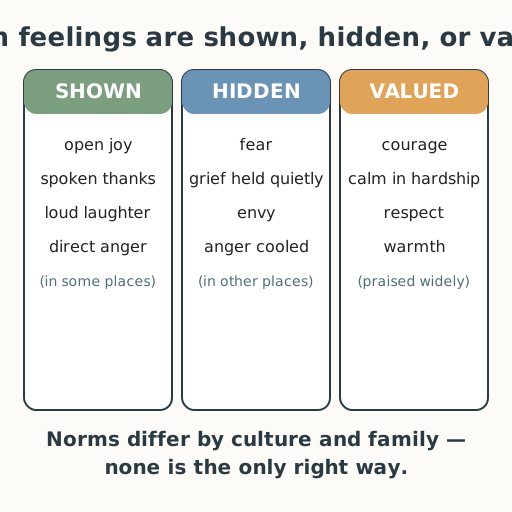
- Shown/hidden/valued chart · 1 A three-column poster — SHOWN, HIDDEN, VALUED — with a few example feelings placed in each and room to add more
- Feeling-rule cards · 1 set per group Cards naming a feeling and a situation (grief at a loss, joy at a win, anger at an injustice, gratitude for a gift) with the prompt "shown, hidden, or valued here — and it depends on the culture"
- Sorting page · 1 per learner A three-column page for the learner to place feelings as shown, hidden, or valued in *their own* family or community
Low-tech / no-cost
- Three zones in the room Mark three spaces (shown, hidden, valued) on the floor; call out a feeling and have learners move to the zone they think their own community would place it, then compare
- Voice and story Tell one short example aloud — "in some places grief is wailed loudly, in others held quietly" — and ask learners to name the norm they see; no cards needed
Enriched / lab & device
- Short video clips of greeting or mourning customs · 2–3 Brief, respectful clips of different communities expressing feeling in different ways, watched and compared without ranking
- A world map with feeling-norm notes · 1 A map where the class can place sticky notes naming how different communities show, hide, or value a feeling, building a non-ranking world picture
Works in different contexts
- large-group Sort one feeling together on the chart, then have groups sort a card and report one "it depends" example
- multi-age Younger learners name the feeling a card describes; older learners name whether their community shows, hides, or values it and why it depends
- self-directed A learner sorts each card into shown, hidden, or valued for their own community and writes one sentence about why it depends on culture
- level-grouped Learners ready to extend explain that norms differ *within* a culture too (by family, region, generation), not only between cultures
- outdoor-only Use voices and bodies — act out a loud grief, a quiet grief, an open joy, a contained joy — and name which a given community would show, hide, or value; no paper needed
Lesson 3 — Feelings Shown, Hidden, and Valued
Summary
Learners discover that cultures — and families within them — differ in which feelings are shown, hidden, or valued, and that these are learned display rules, not universal facts. They sort feelings across the three columns, hear examples from several traditions held side by side and never ranked, and name the norms of their own home or community.
Objectives
- Explain how cultural norms shape which feelings are shown, hidden, or valued. (D01.S1.07.02)
Connection
In one home, grief is wailed loudly so the whole street can hear; in another, it is held quietly behind a calm face. In one community, anger is spoken directly and cleared the same day; in another, it is cooled in silence and repaired through actions later. In one place, gratitude is said with many warm words; in another, it is shown by quietly returning the favor. No one of these is the “right” way to feel or to show — they are different learned habits, passed down like recipes or songs. Every family, village, and city teaches its own.
Materials
- Shown/hidden/valued chart
- Feeling-rule cards
- Sorting page
Preparation
- Print or draw the shown/hidden/valued chart.
- Copy feeling-rule cards for each group and a sorting page for each learner.
- Prepare one worked example to sort together.
Facilitator note
This lesson is written to the learner (“you”). The ideas to land: (1) cultures teach
“display rules” — learned norms about which feelings to show, hide, or value — and these
differ; (2) norms differ within a culture too, by family, region, and generation, so no
culture is a single monolith; and (3) no norm is ranked above another — this is the
unit’s non-ranking, global-anthropological commitment (the display-rules concept traces to
Ekman & Friesen, 1969). Use the “some places / other places” phrasing, and let learners
always return to “it depends.” Be careful never to teach one community’s way as exotic or
superior. Model the sort as a worked example (Kirschner, Sweller & Clark, 2006). Distinguish
evidence from values: that norms differ is a documented fact; that we should honor
every way without ranking is a value this curriculum holds — name it as one. See
docs/facilitation.md and docs/art-style.md.
Procedure
- Gather (5 min). Last time you named the mix precisely. Today a new question: when you feel something, who decides whether you show it, hide it, or hold it up as good? (Pause.) The answer often lives in the culture around you.
- Meet the three columns (10 min). Look at the chart. Shown — feelings a community lets you express openly. Hidden — feelings it teaches you to hold in. Valued — feelings it praises, like courage or calm. These are display rules: learned, not born. Worked example: grief. In some communities people wail aloud together; in others they keep a still, dignified face. The feeling is real in both — the rule about showing it differs.
- Sort with a partner (15 min). Take feeling-rule cards: joy at a win, anger at an injustice, fear before a risk, gratitude for a gift. For each, ask: in my community, is this shown, hidden, or valued? Compare with your partner — if your answers differ, you have found two norms living side by side.
- The big idea (10 min). Discuss together: why do you think cultures teach different rules? (To keep harmony, to survive hardship, to honor elders, to protect the vulnerable.) Notice: every rule makes sense inside its own world — and no world’s rule is “the normal one.”
- Record your own (10 min). On your page, place three feelings your own family shows, hides, or values — one in each column — and write one sentence: In my home, we ___, and that is just one way among many.
- Close (5 min). Feelings are universal; the rules about showing them are local. Learning both is how you read a room — and respect a neighbor.
Differentiation
- Support: Provide a word bank of feelings and a one-line description of each column; sort as a whole group first.
- Extension: Name one feeling your family shows that your wider community hides (or the reverse), and explain the difference.
Assessment
- Formative (observation): Can the learner place a feeling as shown, hidden, or valued for a given culture — and say “it depends on the culture” without ranking one way as correct?
- Self-check: The learner asks, “Did I name a norm for my own community and hold it as one way among many, not the only right way?”
Home connection
Ask someone at home which feelings your family shows openly and which it holds quietly — and why. Notice together that other families do it differently.
Resources
- On “display rules” — learned cultural norms about expressing emotion: Ekman & Friesen (1969), “The Repertoire of Nonverbal Behavior,” https://doi.org/10.1515/semi.1969.1.1.49
- On the universal-and-cultural nature of emotion, for classroom framing: CASEL’s self-awareness and social-awareness competencies, https://casel.org/fundamentals-of-sel/; and the RULER approach, https://www.rulerapproach.org/
- On modeling a new skill before independent practice: Kirschner, Sweller & Clark (2006), https://doi.org/10.1207/s15326985ep4102_1