Lesson 04 — No Culture Is the Default
Learners examine the assumption that any one way of showing feeling is the "normal" one, and replace it with the habit of holding norms side by side and never ranking them. They act and compare two ways for the same feeling, name the ethical and egalitarian danger of treating one's own way as the default, and extend the idea to the display rules of digital spaces.
Objectives
Objectives
- D01.S1.07.02 Explain how cultural norms shape which feelings are shown, hidden, or valued.
Essential question
Whose way of showing feeling counts as "normal" — and what happens when we forget that no culture is the default?
Key vocabulary
Materials
Standard materials
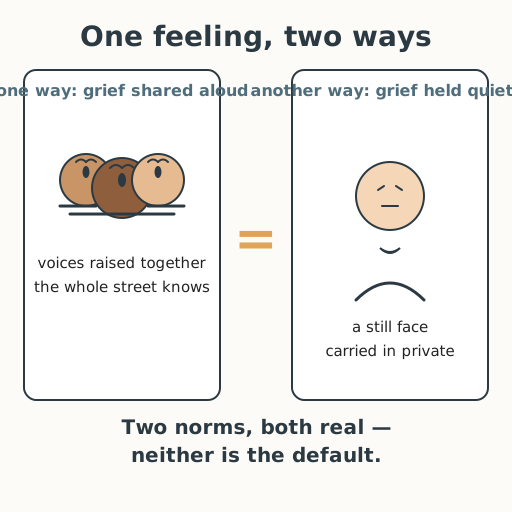
- Two-ways poster · 1 Two panels showing the same feeling expressed two ways (a loud, shared grief beside a quiet, private grief; an open joy beside a contained joy) with an "=" between them and the words "both are real"
- Scenario cards · 1 set per group Short scenes where two people's emotional habits differ (one greets with hugs, one with a bow and words; one thanks aloud, one returns a favor silently) with the prompt "whose way is 'normal'?"
- Both-are-real page · 1 per learner A page for writing two different norms for the same feeling and a sentence about why neither is the default
Low-tech / no-cost
- Two acted ways Act the same feeling two ways — a loud shared grief and a quiet private grief — then place an "=" sign between them; no poster needed
- Voice and body Say two different greetings aloud in two tones and ask "which is the real one?" — both are; no paper needed
Enriched / lab & device
- A discussion of digital norms · 1 A guided talk about how online spaces create their own display rules — emoji, "lol," muted reactions, read receipts, "likes" as approval — and how these differ across apps and communities
- A class 'many norms' gallery · 1 A shared wall of learner examples of two-ways-for-one-feeling, each with an "=" sign, building a non-ranking collection
Works in different contexts
- large-group Compare two ways together on the poster, then have groups act a scenario and ask "whose way is normal?" — collecting every "both are real" answer
- multi-age Younger learners act the two ways; older learners name the *danger* of assuming one is the default and give a real example
- self-directed A learner works a scenario, writes both norms, and adds one sentence about why assuming a default can hurt someone
- level-grouped Learners ready to extend compare *digital* norms across two apps or online communities and name which feelings each one rewards or hides
- outdoor-only Two learners act the same feeling two ways in the open air; the group places an "=" between them and says "both are real"; no paper needed
Lesson 4 — No Culture Is the Default
Summary
Learners examine the assumption that any one way of showing feeling is the “normal” one, and replace it with the habit of holding norms side by side and never ranking them. They act and compare two ways for the same feeling, name the ethical and egalitarian danger of treating one’s own way as the default, and extend the idea to the display rules of digital spaces.
Objectives
- Explain how cultural norms shape which feelings are shown, hidden, or valued — and why no one norm is the “default.” (D01.S1.07.02)
Connection
You meet someone whose way of feeling is different from yours: they grieve loudly where you grieve quietly, or thank with gifts where you thank with words. It is easy, in that moment, to quietly decide that your way is the normal one and theirs is odd. But “normal” is just “what I am used to.” A fish does not know it is wet. Your family’s way is one way, floating in a wide world of ways — in a fishing village by the sea or a farming town in the hills, every home teaches its own, and none is the measuring stick for the rest.
Materials
- Two-ways poster
- Scenario cards
- Both-are-real page
Preparation
- Print or draw the two-ways poster (two ways for one feeling, with an “=” between them).
- Copy scenario cards for each group and a both-are-real page for each learner.
- Prepare one scenario to work together.
Facilitator note
This lesson is written to the learner (“you”). The idea to land: no culture’s way of showing
feeling is the default or the measuring stick — norms are held side by side and never ranked.
This is the unit’s egalitarian commitment made explicit: the ethics lens asks what happens
when we forget it (we misread, exclude, and sometimes punish people whose ways differ), and
the egalitarianism lens asks who gets to decide what counts as “normal” (usually the
majority or the powerful). Extend honestly to digital norms — the technology lens: online
spaces teach their own display rules (emoji, “lol,” muted reactions, read receipts, “likes” as
approval), and these differ across apps and communities, so a learner can now read a digital
culture the way they read a face-to-face one. Model the “whose way is normal?” question as a
worked example (Kirschner, Sweller & Clark, 2006). Distinguish evidence from values: that
norms differ is a fact; that we must not rank them is a value this curriculum holds — name it
as one. See docs/facilitation.md.
Procedure
- Gather (5 min). Last time you sorted feelings into shown, hidden, and valued. Today the sharper question: whose way is “normal”? (Pause.) The honest answer is: no one’s.
- Meet the two ways (10 min). Look at the poster. One way: grief shared aloud, a whole street wailing together. Another way: grief held quietly, a still face, folded hands. Between them an “=” — both are real, neither is the default. The feeling is the same; the rule about showing it differs.
- Worked example (10 min). Take a scenario: two people meet — one greets with a warm hug, the other with a bow and quiet words. Ask the question out loud: “Whose way is normal?” Answer it together: both — they are two learned ways, and the only mistake is deciding one is the measuring stick for the other.
- Act and compare (15 min). In groups, take scenario cards and act each pair of ways, then place an “=” between them and say “both are real.” Notice what the assumption of a default would cost: someone would be told their way is wrong.
- Digital norms (10 min). Turn to screens. Online spaces teach display rules too: an emoji can be loud joy or polite cover; “lol” can hide hurt; a “like” can be approval or habit. Two apps, two communities, two sets of rules — and again, no default.
- Close (5 min). Remember: “normal” is only “what I am used to.” Hold every way side by side, and you stop mistaking your own home for the whole world.
Differentiation
- Support: Provide sentence starters (“One way is ___, another way is ___, and both are real because ___”) and work one scenario as a whole group.
- Extension: Compare the display rules of two different online spaces you know, and name which feeling each one rewards and which it hides.
Assessment
- Formative (observation): Can the learner name two norms for the same feeling and say why neither is the default — without ranking them?
- Self-check: The learner asks, “Did I hold both ways side by side, or did I quietly pick one as the ‘real’ one?”
Home connection
Notice a moment this week when someone’s way of showing feeling differed from yours — at home, at a shop, in a message — and practice saying “two ways, both real” instead of “odd.”
Resources
- On learned cultural rules for expressing emotion: Ekman & Friesen (1969), https://doi.org/10.1515/semi.1969.1.1.49
- On digital norms and emotional expression online, for classroom framing: CASEL’s social-awareness competency, https://casel.org/fundamentals-of-sel/
- On modeling a new skill before independent practice: Kirschner, Sweller & Clark (2006), https://doi.org/10.1207/s15326985ep4102_1