Lesson 05 — My Identity, a Changing Story
Learners reflect on how their identity has changed over time — in interests, abilities, values, and relationships — and name what changed it and what has stayed. They build a "me then / me now" comparison and discover that identity is a changing story, not a fixed label set in childhood.
Objectives
Objectives
- D01.S2.07.01 Reflect on how their identity has changed over time and predict ways it may keep growing.
Essential question
How has my identity changed over time — and what changed it?
Key vocabulary
Materials
Standard materials
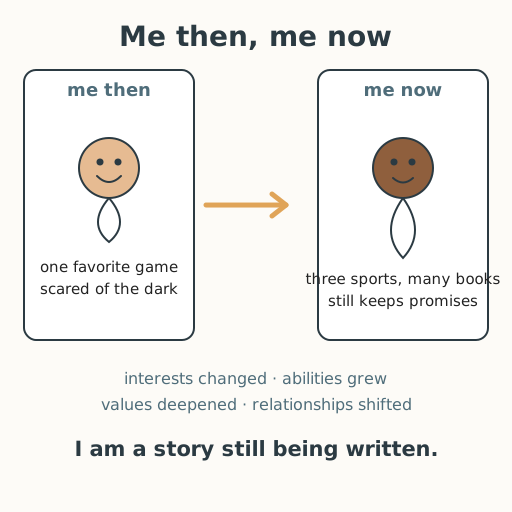
- Then/now poster · 1 A two-panel poster — "me then" (a younger self) and "me now" — each with room for interests, abilities, values, and relationships, joined by an arrow
- Then/now page · 1 per learner A two-column page for the learner to record who they were and who they are now, with a line for what changed each part
- Pencils and crayons · per learner
Low-tech / no-cost
- Two stones or two leaves Hold up one small object for "me then" and another for "me now," and name one way each is different; no paper needed
- Voice and story Tell aloud one thing that changed about you and one thing that stayed; no poster needed
Enriched / lab & device
- A timeline strip · 1 per learner A long paper strip marked by year or age for the learner to plot their own changing self with drawings and words
- A class 'then and now' gallery · 1 A shared wall where learners post one then/now pair each, showing many changing selves side by side
Works in different contexts
- large-group Fill the then/now poster together for a made-up example, then have learners fill their own and share one change in a whip-around
- multi-age Younger learners name one thing that changed; older learners also name *what* changed it and one thing that stayed the same
- self-directed A learner fills the then/now page and writes one sentence for each part about what changed it and what stayed
- level-grouped Learners ready to extend name a *continuity* (something that has stayed the same across the change) and explain why it matters
- outdoor-only Compare yourself to a growing thing — a sapling that is not the seed it was — and name one way you have changed like it; no paper needed
Lesson 5 — My Identity, a Changing Story
Summary
Learners reflect on how their identity has changed over time — in interests, abilities, values, and relationships — and name what changed it and what has stayed. They build a “me then / me now” comparison and discover that identity is a changing story, not a fixed label set in childhood.
Objectives
- Reflect on how their identity has changed over time. (D01.S2.07.01)
Connection
Think of yourself at six, at nine, at eleven. The games you loved, the fears you had, the person you wanted to be — some of it is gone, some of it grew, and some of it is still here, quietly, at the center. You are not the same person who started school; you are the same person, grown. A river is still a river even though the water in it is always new. Your identity is like that: continuous and changing, wherever you live and whatever your family looks like.
Materials
- Then/now poster
- Then/now page
- Pencils and crayons
Preparation
- Print or draw the then/now poster (two panels joined by an arrow).
- Copy a then/now page for each learner.
- Arrange a circle for sharing.
Facilitator note
This lesson is written to the learner (“you”). The idea to land: identity changes over time
and is still continuous — the person I was and the person I am are one story, not two
strangers. This is developmentally real (Erikson describes identity as a lifelong process, not
a finished fact) and it is the opposite of “you were always like this.” Frame change as normal
and good, never as a betrayal of an earlier self. Let learners choose small, safe examples;
identity work can brush against sensitive material (family change, migration, loss), so keep
it low-stakes and voluntary. The four parts — interests, abilities, values, relationships — are
a scaffold, not a cage; learners may name other parts (place, language, faith, body). Model the
then/now comparison as a worked example (Kirschner, Sweller & Clark, 2006). Distinguish
evidence from values: that identity changes is observable; that change should be welcomed
and never used to rank people is a value this curriculum holds — name it as one. See
docs/facilitation.md and docs/art-style.md.
Procedure
- Gather (5 min). You have spent four days on feelings. Now you turn to the self those feelings live in. Try to recall one thing about yourself at age seven that is different now. (Pause.) Today you map that change.
- Meet the two panels (10 min). Look at the poster: “me then” on one side, “me now” on the other, joined by an arrow. Worked example: Then, I was scared of the dark and loved only one game. Now, I read late and play three sports — and I still keep my promises. Four parts to compare: interests, abilities, values, relationships.
- Map your own change (15 min). On your page, write or draw “me then” in one column and “me now” in the other, for each of the four parts — plus any part that matters to you. For each change, add one word about what changed it: a person, a place, an experience, the simple fact of growing.
- What stayed (10 min). Now find the continuity — one thing that has stayed the same across all the change (a value, a love, a habit). Write it under both columns. Change and staying are both true.
- Share and close (10 min). Share one then/now pair with a partner. Close by remembering: you are not the person you were — and that is the point of growing, not a problem with it.
Differentiation
- Support: Provide a partly filled then/now page and a word bank (interests, abilities, values, relationships, changed, stayed).
- Extension: Write a one-paragraph “story so far” connecting one change to what caused it and naming what has stayed.
Assessment
- Formative (observation): Can the learner name at least one way their identity has changed and one thing that stayed, across the four parts?
- Portfolio (artifact): The then/now page, kept for the unit’s “my changing identity” reflection.
Home connection
Ask an older family member how they have changed since they were your age — and what stayed the same. Notice that grown-ups are still changing too.
Resources
- On identity as a lifelong, developing process: Erikson, Childhood and Society (1950) — cited here for the framing that identity forms and reforms across the life, not as a fixed trait.
- On the self as many changing parts, for classroom framing: CASEL’s self-awareness competency, https://casel.org/fundamentals-of-sel/
- On modeling a new skill before independent practice: Kirschner, Sweller & Clark (2006), https://doi.org/10.1207/s15326985ep4102_1