Lesson 06 — The Story Keeps Growing
Learners predict ways their identity may keep growing, and discover that the future is not a single fixed endpoint but a set of open directions they can help author. They sketch several "possible selves," name the values that tie them together, and connect growth to a growth mindset that is honest about both effort and uncertainty.
Objectives
Objectives
- D01.S2.07.01 Reflect on how their identity has changed over time and predict ways it may keep growing.
Essential question
Who might I become next — and how do I stay the author of my own story?
Key vocabulary
Materials
Standard materials
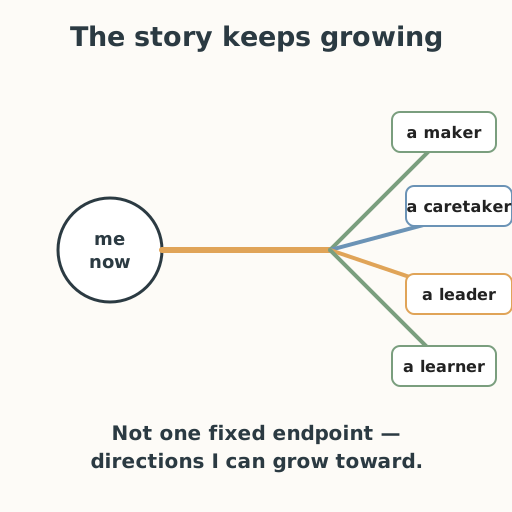
- Growing-arrow poster · 1 An arrow from "me now" into an open horizon that branches into several "possible selves" (a maker, a caretaker, a leader, a learner) — not a single fixed endpoint
- Possible-selves page · 1 per learner A page with "me now" on the left, an open space in the middle, and several empty branches to the right for the learner to sketch possible selves
- Pencils and crayons · per learner
Low-tech / no-cost
- An open hand Hold up a closed fist ("me now") and open the fingers one by one ("possible selves branching out"); no paper needed
- Voice and story Say aloud one thing you might become and one reason it is a direction, not a verdict; no poster needed
Enriched / lab & device
- A short profile of someone who changed direction · 1 A brief account of a real person whose path changed (an athlete who became a teacher, a farmer who became an engineer), read and discussed as proof that the story stays open
- A class 'future selves' wall · 1 A shared display where learners post their possible selves, showing many open futures side by side
Works in different contexts
- large-group Build the growing-arrow poster together, then have learners sketch their own branches and share one possible self each
- multi-age Younger learners name one thing they hope to become; older learners also name a *direction* (a value or skill) that stays the same across every branch
- self-directed A learner sketches three possible selves and writes one sentence for each about what direction (value) ties them together
- level-grouped Learners ready to extend write one "next chapter" paragraph naming a possible self, a first small step, and a value that would guide it
- outdoor-only Look at a path or trail that branches ahead and compare yourself to it — many ways forward, one walker choosing; no paper needed
Lesson 6 — The Story Keeps Growing
Summary
Learners predict ways their identity may keep growing, and discover that the future is not a single fixed endpoint but a set of open directions they can help author. They sketch several “possible selves,” name the values that tie them together, and connect growth to a growth mindset that is honest about both effort and uncertainty.
Objectives
- Predict ways their identity may keep growing. (D01.S2.07.01)
Connection
The person you are at thirteen is not the person you will be at twenty or forty — but you are not a passenger either. You are the author. You can name the directions you hope to grow toward: the maker, the caretaker, the leader, the lifelong learner. These are not boxes to be sorted into; they are branches of a path that stays open. A seed does not know its exact shape, but it grows toward the light it is given. So do you — in a fishing port, a mountain farm, or anywhere people dream.
Materials
- Growing-arrow poster
- Possible-selves page
- Pencils and crayons
Preparation
- Print or draw the growing-arrow poster (one “me now” arrow branching into several open directions).
- Copy a possible-selves page for each learner.
- Arrange a circle for sharing.
Facilitator note
This lesson is written to the learner (“you”). The idea to land: the future self is open,
not fixed — and the learner is its author, not its audience. This builds directly on Lesson
5’s “identity changes” to reach the objective’s second half (“predict ways it may keep
growing”). Frame prediction as direction (values and skills to grow toward), never as a
single destiny that would pressure or narrow a learner — a learner’s possible selves are many,
and none is a verdict. The growth-mindset framing (Dweck, 2006) is real but should be held
honestly: the research shows modest effects, and effort alone is not a guarantee, so do not
teach “you can be anything if you just try” as a promise. Say instead: your self can keep
growing, and what you practice shapes the direction of that growth. Model the growing-arrow
as a worked example (Kirschner, Sweller & Clark, 2006). Distinguish evidence from values:
that identity can keep developing is observable; that every learner’s open future deserves to
be honored equally is a value this curriculum holds — name it as one. See docs/facilitation.md
and docs/art-style.md.
Procedure
- Gather (5 min). Last time you mapped how you have already changed. Now look the other way: who might you become next? (Pause.) The future is not one fixed box.
- Meet the growing arrow (10 min). Look at the poster: an arrow starts at “me now” and branches into several possible selves — a maker, a caretaker, a leader, a learner. Worked example: I am becoming a person who writes things that help people think — and also a person who can fix a machine, and a person who keeps learning new languages. These are directions, not a single destiny.
- Sketch your branches (15 min). On your page, write “me now” on the left. Then draw three or four branches — possible selves you can imagine growing toward. They can be practical (a mechanic, a nurse, a farmer) or qualities (kinder, braver, more curious). There is no wrong branch.
- Find the through-line (10 min). Look at your branches. What value ties them together — helping others? making things? understanding the world? Write it under the arrow. This is the direction that stays the same no matter which branch grows.
- Share and close (10 min). Share one branch and the value under it with a partner. Close by remembering: your story is not finished, and you hold the pen.
Differentiation
- Support: Provide branch starters (“a person who helps ___, a person who makes ___, a person who learns ___”) and a list of values to choose from.
- Extension: Write a short “next chapter” naming one possible self, a first small step toward it, and the value that would guide the choices along the way.
Assessment
- Formative (observation): Can the learner name at least one way their identity may keep growing, as a direction rather than a fixed fate?
- Portfolio (artifact): The possible-selves page, kept for the unit’s “my changing identity” reflection.
Home connection
Ask someone at home what they once thought they would become and what they actually became — and notice together that the story stayed open.
Resources
- On identity as a developing, lifelong process: Erikson, Childhood and Society (1950) — cited for the framing that identity keeps forming across the life.
- On the growth-mindset idea that the self can keep developing (held with the research’s own cautions about modest effects): Dweck, Mindset: The New Psychology of Success (2006).
- On modeling a new skill before independent practice: Kirschner, Sweller & Clark (2006), https://doi.org/10.1207/s15326985ep4102_1