Lesson 03 — Space and Time: The Grammar of Movement
Learners meet spacing and timing — the "grammar" that makes movement and games work. They practice finding open space, and moving at the right moment, through simple drills and a small game, then name where they used each one.
Objectives
Objectives
- D03.S2.07.01 Apply strategies such as spacing, timing, and teamwork in a game or sport.
Essential question
How do spacing and timing make movement and games work better?
Key vocabulary
Materials
Standard materials
- Space and time diagram · 1 A simple playing-area diagram showing players spread into open space (spacing) and an arrow showing the right moment to move or pass (timing)
- Cones or markers · 1 set To mark open spaces and boundaries in a movement game
- A soft ball or rolled-paper ball · 1
Low-tech / no-cost
- Body and space only Mark space with footsteps and shadows; no cones or ball needed — practice spreading out and moving "on the beat" with the voice counting time
- Hands as the object A clap or a "pass" of an imaginary ball carries the timing concept with no equipment at all
Enriched / lab & device
- Whistle or timer · 1 To mark timed intervals so learners can feel "too early / on time / too late"
- A phone camera (optional) · 1 per group To record a 10-second spacing-and-timing drill and watch it back to spot open space and timing
Works in different contexts
- large-group Run the spacing drill as a whole group first (everyone finds open space, then freezes on a count), then split into smaller practice groups
- multi-age Younger learners practice spacing (finding open space); older learners add timing (moving at the exact moment) and coach the younger ones
- self-directed A learner uses the diagram to set up a solo drill — find open space, then time a self-pass or a movement against a counted beat
- level-grouped Learners ready to extend add *anticipation* — reading where space will open before it does, and moving a beat early
- outdoor-only Use the whole open ground as the field; a tree, rock, or shadow marks the boundaries — practice spacing across a wide space and timing a run to a landmark
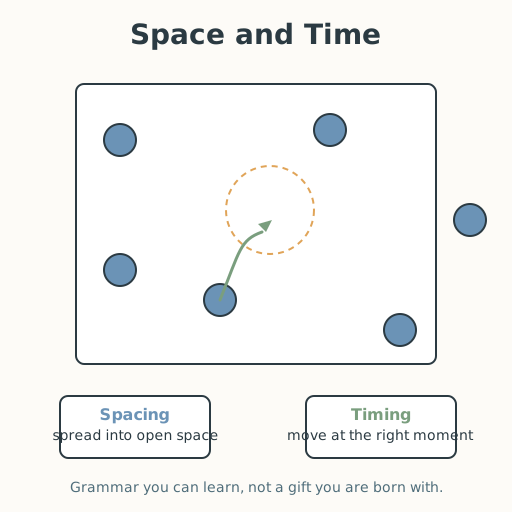
Lesson 3 — Space and Time: The Grammar of Movement
Summary
Learners meet spacing and timing — the “grammar” that makes movement and games work. They practice finding open space, and moving at the right moment, through simple drills and a small game, then name where they used each one.
Objectives
- Apply strategies such as spacing, timing, and teamwork in a game or sport. (D03.S2.07.01)
Connection
Watch any good game — a football match in Brazil, a cricket field in India, a game of tag in a schoolyard anywhere — and you will see the same two hidden rules at work. Players who are clumped together get in each other’s way; players who spread out find room to move. And the best pass is not the fastest one but the one thrown at the right moment — a second too early and it is wasted, a second too late and the opening is gone. Spacing and timing are not talent you are born with; they are grammar you can learn, and they work in every game on Earth.
Materials
- Space and time diagram
- Cones or markers
- A soft ball (or rolled-paper ball)
Preparation
- Mark out a playing area with cones or natural boundaries.
- Print or draw the space and time diagram.
- Clear a safe space to move in.
Facilitator note
This lesson is written to the learner (“you”). The idea to land is that spacing and timing
are learnable strategies, not inborn gifts — and that everyone, of every body and ability,
uses them. Model each drill as a worked example (find the open space yourself; freeze on the
count; show “too early / on time / too late”) before learners try it (Kirschner, Sweller &
Clark, 2006). Adapt every activity so all bodies can join: spacing can be done by walking,
rolling, wheeling, or pointing; timing can be marked by a nod or a hand signal as well as a
run. Keep it cooperative — the goal is to help the group find space and time, never to
eliminate anyone. See docs/contexts.md.
Procedure
- Gather and recall (5 min). You have been reading your body’s internal signals. Now your body gets to move. Think of a game you love: where do players stand — bunched up or spread out? That is spacing.
- Meet spacing (10 min). Look at the diagram. Spacing is spreading out so every player has room and no one crowds another. Drill: with a partner or a small group, walk around the marked area. On “freeze,” check — are you all spread out, or bunched? Move again until everyone is in open space.
- Meet timing (10 min). Timing is moving or passing at the exact right moment, not before and not after. Drill: stand in a circle and pass a soft ball. The catch works only if the pass comes when the receiver is ready — not too early, not too late. Try it at a slow tempo, then a faster one. Feel “on time.”
- Put them together (15 min). Play a short, cooperative game: the whole group’s job is to keep a ball moving to everyone in the area, using open space and well-timed passes, with nobody left out. Count how many clean passes you can make together.
- Close (5 min). Name it: where did you use spacing today? Where did you use timing? You will add the third piece — teamwork — next time.
Differentiation
- Support: Practice spacing first (just spread out), then add timing only after spacing feels steady; allow walking pace throughout.
- Extension: Add anticipation: read where the space will open before it does, and move a beat early. Explain how that changes the game.
Assessment
- Formative (observation): Can the learner name and demonstrate spacing (finding open space) and timing (moving or passing at the right moment) in the drill or game?
- Performance (peer): A partner watches one round and reports one moment of good spacing and one moment of good timing they saw.
Home connection
Watch any game — on a screen, at a park, or in a neighbor’s yard — and name one moment of good spacing and one moment of good timing. Say why each one worked.
Resources
- On fair-play and inclusive-game framing in physical education: SHAPE America, https://www.shapeamerica.org/
- On modeling a skill before independent practice: Kirschner, Sweller & Clark (2006), https://doi.org/10.1207/s15326985ep4102_1