Lesson 04 — Teamwork: Games from Around the World
Learners meet teamwork through three team games from different world regions — kabaddi and kho-kho from South Asia, and sepak takraw from Southeast Asia. They learn each game as a living tradition, play simple adapted versions that include every body, and name the teamwork — shared roles, communication, helping each other — that makes each one work.
Objectives
Objectives
- D03.S2.07.01 Apply strategies such as spacing, timing, and teamwork in a game or sport.
Essential question
How do people everywhere use teamwork — sharing roles and helping each other — in the games they play?
Key vocabulary
Materials
Standard materials
- Games-of-the-world cards · 1 set Cards naming three team games from different regions — kabaddi (South Asia), kho-kho (South Asia), and sepak takraw (Southeast Asia) — each with a one-line description and a simple picture of the idea
- Cones, a soft ball, a small ring or tied cloth · 1 set For adapted, low-contact versions of the games
Low-tech / no-cost
- Body and voice only Tag-and-chase versions need nothing but a boundary and a chant; use a clap or call instead of a ball
- Found objects A stick, stone, or rolled cloth stands in for any ball or marker
Enriched / lab & device
- A short, respectful video clip of each game · 1 per game To see the real game played and its community context before trying an adapted version (verify the clip is appropriate and current)
- A world map · 1 To locate each game's home region together
Works in different contexts
- large-group Teach one game at a time to the whole group in simple adapted form; rotate which game each small group plays so everyone meets all three
- multi-age Older learners read a game card aloud and lead; younger learners join the adapted version and name the teamwork they saw
- self-directed A learner reads the three game cards, chooses one, and teaches or practices an adapted solo-or-pair version, then names the teamwork it needs
- outdoor-only All three games adapt to open ground; mark boundaries with natural objects and play the tag-and-chase versions that need no equipment
Lesson 4 — Teamwork: Games from Around the World
Summary
Learners meet teamwork through three team games from different world regions — kabaddi and kho-kho from South Asia, and sepak takraw from Southeast Asia. They learn each game as a living tradition, play simple adapted versions that include every body, and name the teamwork — shared roles, communication, helping each other — that makes each one work.
Objectives
- Apply strategies such as spacing, timing, and teamwork in a game or sport. (D03.S2.07.01)
Connection
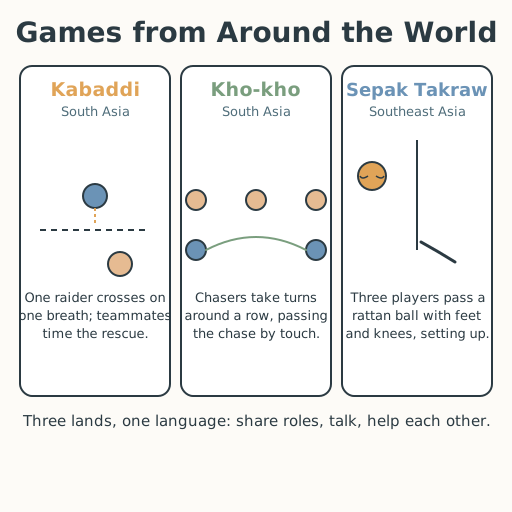
People everywhere have invented games, and almost all of them are about teamwork — not one hero, but a group that shares roles and helps each other. In kabaddi, a game played across South Asia, one raider crosses into the other side chanting “kabaddi, kabaddi” on a single breath, trying to tag defenders and get back before the defending side — working together — can catch them. In sepak takraw, played across Southeast Asia, three players pass a rattan ball over a net using feet and knees, so no one person can win alone. These are not “simple” games — they are living knowledge passed from one generation to the next, and every one of them runs on the same teamwork you use in your own neighborhood. Each game also grew up in a particular place — a dusty field, a courtyard, a cleared beach — so the game fits the land, and the land shapes the game.
Materials
- Games-of-the-world cards
- Cones, a soft ball, a small ring or tied cloth
Preparation
- Print or draw the games-of-the-world cards.
- Set up three simple playing areas, one per game.
- Read the adapted, low-contact rules below and pick which versions fit your space and group.
Facilitator note
This lesson is written to the learner (“you”). The idea to land is that teamwork is a
universal human skill — sharing roles, communicating, and helping each other — and games from
many cultures are one living proof of it. Present each game as a real tradition with
respect, never as a curiosity or a ranking: name its home region, and note that rules vary
from place to place and are best learned from people who play it (the cards are a starting
point, not the last word). The three games here are a sample, not the whole map: to span
more continents, add one from Africa, Oceania, or the Americas — for example, lacrosse of the
Indigenous nations of North America, kilikiti of Samoa, or genna of Ethiopia — and present it
with the same respect: name its home, note that rules vary, and learn from people who play
it. Adapt every game so all bodies and abilities join — tag can be a
touch, a tap, or a call; kicking can be a pass with any part of the body; no one is forced
into contact. Play cooperatively: the aim is for the whole group to experience each game,
not to win. See docs/contexts.md and docs/art-style.md.
Procedure
- Gather and recall (5 min). You have learned spacing and timing. Now add the third piece: teamwork — sharing roles and helping each other. Name a team you have been part of. What made it work?
- Meet three games (10 min). Look at the games-of-the-world cards. Kabaddi (South Asia): a raider crosses the line chanting on one breath, must touch a defender and get back before being caught; the defending side works together to catch the raider. Kho-kho (South Asia): chasers take turns chasing runners around a row, passing the chase by touch — pure timing and teamwork. Sepak takraw (Southeast Asia): three players keep a rattan ball up over a net with feet and knees, passing to set each other up. Each game needs roles, talk, and help.
- Play adapted versions (20 min). In small groups, try each game in a simple, safe form: a gentle tag-and-return for kabaddi, a take-turns chase for kho-kho, and keep-the-ball-up passes for sepak takraw (no contact, no one left out). Rotate so everyone tries all three.
- Name the teamwork (10 min). After each game, stop and name it: what role did each person play? How did you communicate? Where did one person help another? Write one word or sentence for each game.
- Close (5 min). The rules differ on every continent, but the teamwork is the same language. You will now use spacing, timing, and teamwork together in a game of your own.
Differentiation
- Support: Play one game at a time with simplified roles; allow a walking pace and a “tag by calling the name” option for anyone who prefers no contact.
- Extension: Invent one small rule change to a game that makes it more inclusive, and explain how it changes the teamwork needed.
Assessment
- Formative (observation): Does the learner take a role, communicate with teammates, and help another player during the adapted games?
- Peer check: In pairs, name one moment a partner used teamwork — a role, a call, or an act of help — and say how it helped the group.
Home connection
Ask someone at home about a game they played as a child — what region it came from and how players helped each other. Share the three games you met today.
Resources
- On traditional sports and games as living cultural heritage: UNESCO — Traditional Sports and Games, https://www.unesco.org/en/sport-and-anti-doping/traditional-sports-and-games (the games here are living traditions; verify local rules with people who play them)
- On fair-play and inclusive games: SHAPE America, https://www.shapeamerica.org/