Lesson 05 — Strategies in Play: Putting It Together
Learners choose a game or sport and write a simple team plan that names spacing, timing, and teamwork. They play one round, pause to check the plan against what happened, adjust, and reflect — closing the movement-and-strategy arc with the whole trio used together.
Objectives
Objectives
- D03.S2.07.01 Apply strategies such as spacing, timing, and teamwork in a game or sport.
Essential question
How do I choose and apply spacing, timing, and teamwork together in a real game or sport?
Key vocabulary
Materials
Standard materials
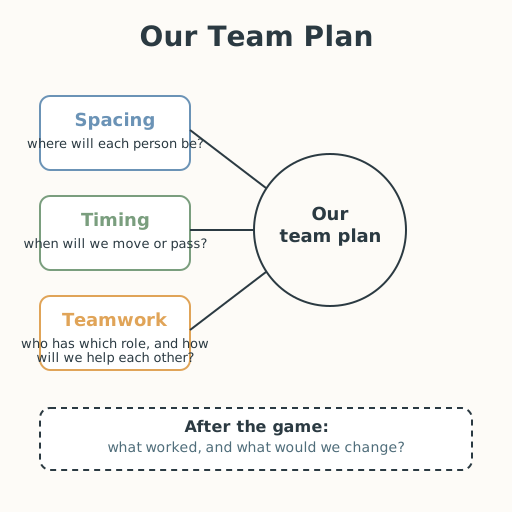
- Team plan page · 1 per team A page with three boxes — Spacing, Timing, Teamwork — where a team writes its plan for a game, then one line for a reflection afterward
- Cones, a ball or object · 1 set For the chosen game or sport
Low-tech / no-cost
- Voice and body The plan can be spoken and remembered; the game can be a tag or relay that needs no equipment
- Sticks and stones as markers · as needed To mark boundaries and goals with found objects
Enriched / lab & device
- A stopwatch · 1 To time a round and see how the plan changed the result
- A phone camera (optional) · 1 per team To record one round and review the plan against what actually happened
Works in different contexts
- large-group Have teams plan, play one short round, and share one strategy aloud in a whip-around; rotate the facilitator's focus so every team is observed
- multi-age Older learners write the plan; younger learners carry out one role and report what worked — the plan is made together
- self-directed A learner writes a solo plan (spacing, timing, and a teammate's role), plays one round with a friend or by adapting a drill, and writes the reflection alone
- level-grouped Learners ready to extend adjust the plan *mid-game* after one round and explain why they changed it
- outdoor-only Choose a game that fits the open ground — a relay, a tag, or a keep-away — and plan spacing, timing, and teamwork for that space
Lesson 5 — Strategies in Play: Putting It Together
Summary
Learners choose a game or sport and write a simple team plan that names spacing, timing, and teamwork. They play one round, pause to check the plan against what happened, adjust, and reflect — closing the movement-and-strategy arc with the whole trio used together.
Objectives
- Apply strategies such as spacing, timing, and teamwork in a game or sport. (D03.S2.07.01)
Connection
A strategy is just a plan you make before you move, so you do not have to decide everything in the heat of the moment. The same three tools you have been practicing — spread out, move at the right time, help each other — are the whole toolkit. A relay team plans who runs which leg; a group crossing a busy market plans who leads and who watches; a crew hauling a fishing net plans who pulls and when. The plan is not about being the best athlete; it is about thinking together, and it works in every game and every place.
Materials
- Team plan page
- Cones, a ball or object
Preparation
- Copy a team plan page for each team.
- Set up the playing area and any equipment for the chosen game.
- Have a short list of low-equipment games ready (relay, tag, keep-away, an adapted version of one of the games from the last lesson) so teams can choose quickly.
Facilitator note
This lesson is written to the learner (“you”). The idea to land is that a strategy is a
plan you can name, test, and improve — not a mystery talent. Model the worked example: write
a tiny plan aloud (“spacing — spread wide; timing — pass on the third count; teamwork — one
caller, one helper”) before teams write their own (Kirschner, Sweller & Clark, 2006). Keep
teams mixed and the game cooperative wherever possible; ensure every body and ability has a
role (planner, caller, timer, mover, helper), so no one is on the sidelines. The reflection
(“what worked, what would we change”) is the mastery moment — feedback, not ranking. See
docs/facilitation.md and docs/assessment.md.
Procedure
- Gather and recall (5 min). You now hold three tools: spacing, timing, and teamwork. Today you use all three at once, on purpose. Name a game or sport your group could play with what you have.
- Write the plan (10 min). On your team plan page, fill the three boxes. Spacing: where will each person stand or move to keep open space? Timing: when will you move or pass? Teamwork: who has which role, and how will you help each other? Keep it to one short sentence each.
- Play one round (15 min). Play a short round, sticking to your plan as best you can.
- Check and adjust (10 min). Huddle. What worked? What surprised you? Change one thing in the plan — one spacing, one timing, or one teamwork idea — and play one more short round to test it.
- Reflect (10 min). Write one line: We planned ___. What worked was ___. We changed ___ and it ___. Share your team’s one biggest discovery with the group.
Differentiation
- Support: Use the sentence starters on the plan page; keep the game simple (a relay or tag) and change only one part of the plan.
- Extension: Change the plan twice, and explain which change mattered most and why — using what you saw, not just what you felt.
Assessment
- Formative (peer): Each team reads its plan aloud; a second team checks that the plan names all three — spacing, timing, and teamwork.
- Portfolio: The completed team plan page and the one-line reflection, kept in the learner’s portfolio as evidence of applying strategies in a game.
Home connection
Explain your team’s plan to someone at home in one sentence each: what you planned, what worked, and what you changed. Ask if they have ever used the same three ideas — spacing, timing, teamwork — in something they do.
Resources
- On fair-play and inclusive-game framing: SHAPE America, https://www.shapeamerica.org/
- On modeling a skill and using feedback to improve: Kirschner, Sweller & Clark (2006), https://doi.org/10.1207/s15326985ep4102_1