Lesson 06 — My Changing Body in Motion
Learners describe how movement changes during puberty — lengthening limbs, a shifting center of gravity, and changing strength and coordination — and, crucially, how to adapt activities to their own changing body. Growth is named as normal, uneven, and never shameful, and every body is honored.
Objectives
Objectives
- D03.S2.07.02 Describe how movement changes during puberty and adapt activities to their own changing body.
Essential question
How does movement change as my body grows during puberty, and how do I adapt activities to my own changing body?
Key vocabulary
Materials
Standard materials
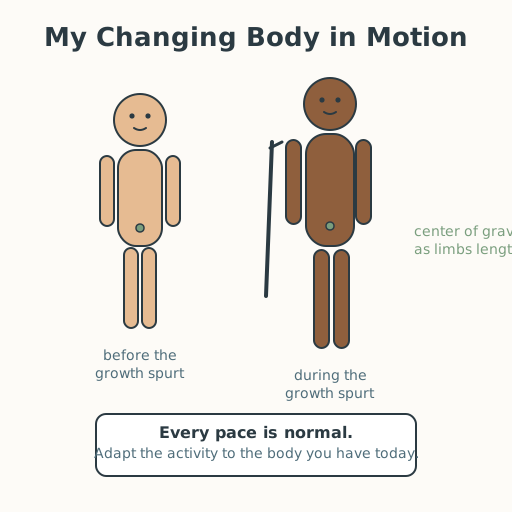
- Changing-body diagram · 1 Two figures side by side — a shorter younger body and a taller body mid-growth-spurt — with labels showing lengthening limbs, a shifting center of gravity, and a note that every pace is normal
- Movement adaptation cards · 1 set Cards pairing a change (longer limbs, a lower or higher center of gravity, changing strength, shifting coordination) with an adaptation (adjust spacing, practice a skill, slow the tempo, change the reach)
Low-tech / no-cost
- Voice and body Describe each change and act out the adaptation; a learner can feel their own reach and balance shift without any cards
- Drawn growth figures Draw two simple stick figures of different heights (or reuse the lesson's SVG) to show different paces of growth, always naming both as normal — never use live learners' bodies as the comparison
Enriched / lab & device
- A short, respectful video on the adolescent growth spurt · 1 A science clip on how bones lengthen and coordination re-adjusts during the growth spurt (verify it is accurate and shame-free)
- A measuring tape or marked wall (optional) · 1 To notice height change over the year as one of many normal signs of growth — only if learners choose to look
Works in different contexts
- large-group Discuss the diagram together; have learners practice one adaptation in pairs rather than measuring anyone publicly (measurement is optional and private)
- multi-age Older learners model an adaptation for a changing body; younger learners try it — everyone names growth as normal
- self-directed A learner reads the diagram and cards alone, chooses one change they notice in their own body, and writes one adaptation they will try
- level-grouped Learners ready to extend design an adaptation for a *specific* activity (a dance step, a throw, a reach) and explain the body change it responds to
- outdoor-only On open ground, try the same movement at two reaches or two tempos and feel the difference; name the adaptation with no paper needed
Lesson 6 — My Changing Body in Motion
Summary
Learners describe how movement changes during puberty — lengthening limbs, a shifting center of gravity, and changing strength and coordination — and, crucially, how to adapt activities to their own changing body. Growth is named as normal, uneven, and never shameful, and every body is honored.
Objectives
- Describe how movement changes during puberty and adapt activities to my own changing body. (D03.S2.07.02)
Connection
During these years your body is not just getting taller — it is rearranging itself, and that changes how it moves. Your arms and legs lengthen faster than you are used to, so a reach you once knew now overshoots; your center of gravity shifts as you grow, so balance feels different for a while; strength and coordination come at their own uneven pace. This is not something going wrong — it is the ordinary work of growth, and it happens at a different time and speed for every person. The skill is not to stop growing; it is to adapt the activity to the body you have today — the same way every athlete, dancer, and worker does all their life.
Materials
- Changing-body diagram
- Movement adaptation cards
Preparation
- Print or draw the changing-body diagram.
- Copy and cut the movement adaptation cards.
- Arrange a space with room to try a few simple movements at different reaches and tempos.
Facilitator note
This lesson is written to the learner (“you”). Hold it with care: growth during puberty is
normal, uneven, and never shameful — and no learner’s body should be singled out or compared.
The science to land: during the adolescent growth spurt the long bones lengthen, which shifts
the body’s center of gravity and temporarily changes coordination, while strength catches up
at its own pace (WHO, 2024; WHO, 2006). Name every pace as normal — growth begins at different
times and speeds for different people, and a wide range of heights and shapes is normal, not a
ranking. Frame adaptation as skill, never limitation: adapting is what skilled movers do.
Avoid measuring anyone publicly or commenting on any individual’s body; keep all examples
general. See docs/facilitation.md and docs/development.md.
Procedure
- Gather and recall (5 min). You have been moving with strategy. Today you notice something that changes how you move: your own growing body. Think: has a movement you used to do easily felt a little different lately? (No need to say it aloud.)
- Meet the changes (10 min). Look at the changing-body diagram. During puberty the body goes through a growth spurt: arms and legs lengthen, so your reach changes; your center of gravity — the point the body balances around — shifts as you grow taller, so balance feels different; strength and coordination catch up at their own pace. All of this is normal, and it happens at a different time for every person.
- Match changes to adaptations (15 min). Sort the adaptation cards: longer limbs → adjust your spacing and reach; shifting balance → widen your stance and slow the tempo while you relearn; changing strength → pick the load and pace that fit today; shifting coordination → practice a skill a few times rather than expecting it to feel instantly familiar. Try one of these adaptations with a partner — a reach, a balance, or a throw.
- Adapt an activity of your own (10 min). Choose one movement or game you like. Name one change you have noticed in your body, and write one adaptation you will try. Example: My reach has changed, so I will adjust my spacing and take one extra practice before I aim.
- Close (5 min). Growing is not a problem to fix; it is the body doing its job. Adapting to the body you have today is a skill every good mover uses — and it will serve you for life.
Differentiation
- Support: Use the sentence frame “My body has changed in ___ , so I will ___ .” and match one change to one adaptation at a time.
- Extension: Design an adaptation for a specific activity (a dance step, a throw, a climb) and explain the body change it responds to and why it helps.
Assessment
- Formative (observation): Can the learner name one way movement changes during puberty and describe one adaptation to their own body?
- Portfolio: The written “movement-adaptation reflection” (one change + one adaptation), kept as a portfolio artifact.
Home connection
Ask a trusted adult or older sibling about a time their own body changed and a movement felt different — what did they adapt, and how did it turn out? Share one adaptation you wrote today.
Resources
- On adolescence as a time of rapid physical growth: WHO — Adolescent health, https://www.who.int/health-topics/adolescent-health
- On growth as a range of normal, measured against percentile curves: WHO — Child Growth Standards, https://www.who.int/toolkits/child-growth-standards
- On movement supporting healthy growth (bone and muscle development): WHO — Physical activity fact sheet, https://www.who.int/news-room/fact-sheets/detail/physical-activity