Lesson 10 — One Idea, Many Genres
Learners shape one idea into three genres — narrative, argument, and informational — keeping the language precise in each and adapting to each genre's audience and purpose. They see that genre is a choice of shape, not a box that changes the truth of the idea.
Objectives
Objectives
- D04.S3.07.01 Develop ideas with relevant, well-chosen details and precise language across a range of genres.
Essential question
How does the same idea take different shapes — narrative, argument, and information — and stay precise in each?
Key vocabulary
Materials
Standard materials
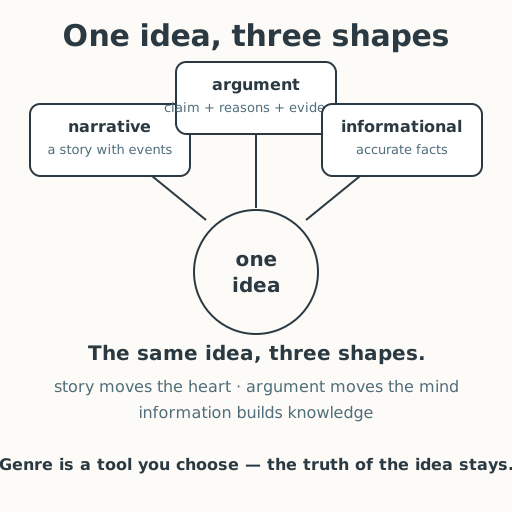
- Genre-shapes poster · 1 One central idea with three shapes branching from it — narrative (story), argument (claim + reasons), informational (facts)
- Genre page · 1 per learner A page with one idea and three empty boxes to write a story version, an argument version, and an informational version
- Example set · 1 set A model showing one idea (saving water) written in all three genres
Low-tech / no-cost
- Voice Tell the same idea three ways aloud — as a story, as a plea with reasons, as facts; no page needed
- Three stones labeled story, argument, facts Place a stone for each genre and move the same idea onto each
Enriched / lab & device
- Three short published examples · 1 set Optional: one short story, one short opinion piece, and one short article on the same theme, from different regions
- Digital document with three templates · 1 per pair Three starter frames to draft the genres in a shared file
Works in different contexts
- large-group Model all three genres on the board for one idea, then have pairs write their own three versions
- self-directed A learner writes the same idea in three genres and checks each against the genre's shape (story / claim+reasons / facts)
- multi-age Younger learners write two genres; older learners write all three and name the audience and purpose of each
- outdoor-only Speak the three versions aloud in a circle, passing a stone to mark each genre; no paper needed
Lesson 10 — One Idea, Many Genres
Summary
Learners write the same idea in three genres — narrative, argument, and informational — keeping the language precise in each and adapting to each genre’s audience and purpose. They learn that genre is a choice of shape, not a change to the truth of the idea.
Objectives
- Develop ideas with relevant details and precise language across a range of genres. (D04.S3.07.01)
Connection
The same true thing can be told many ways. That the river floods every rainy season can be a story (“the year the water reached our door”), an argument (“we should move the seed store to higher ground, because…”), or information (“in this region, heavy rains arrive between June and September”). Each shape fits a different audience and purpose — a story moves the heart, an argument moves the mind, information builds knowledge — and each needs precise language to do its job. Genre is not a cage; it is a tool you choose.
Materials
- Genre-shapes poster
- Genre page
- Example set
Preparation
- Copy the genre page and the example set for each learner.
- Prepare the genre-shapes poster with one central idea and three branches.
Facilitator note
This lesson is written to the learner (“you”). The idea to land is that genre is a
choice of shape — narrative tells, argument persuades, information explains — and precise
language serves each differently. Model all three genres for one idea as a worked
example before learners write their own (Kirschner, Sweller & Clark, 2006; Graham &
Perin, 2007). Let the idea be small and safe; learners may choose their own. The four
lenses: ethics (the truth of the idea stays the same across genres — no exaggerating to
persuade); egalitarianism (every culture has these three ways of speaking — story,
plea, account — in its own language); global (example ideas from many regions);
critical-thinking (choosing a genre is matching shape to audience and purpose). See
docs/facilitation.md.
Procedure
- Gather (5 min). Think of one idea you believe: “we should save water,” “everyone deserves rest,” “the market opens early.” How many different ways could you tell it?
- Meet the three shapes (10 min). Look at the poster and the example set — one idea, three versions. Narrative tells a story with characters and events. Argument makes a claim and gives reasons and evidence. Informational gives accurate facts. Read each example and name its audience and purpose.
- Write your three (20 min). On your genre page, choose one idea and write it three ways: a short story (a few sentences), a short argument (claim + two reasons), and a short informational note (two facts). Keep the language precise in each.
- Check the shape fits (10 min). With a partner, read your three versions. Does the story actually tell? Does the argument actually persuade? Does the information stay factual? Revise one version that does not yet fit its shape.
- Close (5 min). You can now bend one idea into many shapes without breaking its truth. Next lesson you will trade writing with a partner and make each other’s work better.
Differentiation
- Support: Provide the idea and the three starter frames; allow two genres instead of three.
- Extension: Add a fourth shape — a poem — and explain how poetry’s audience and purpose differ from the other three.
Assessment
- Formative (observation): Can the learner write one idea in three genres, each matching its shape and staying precise?
- Portfolio: The genre page, kept as a draft for revision in the next lesson.
Home connection
Tell someone at home one idea three ways — as a story, as a reason to agree, and as a fact — and ask which way convinced or moved them most.
Resources
- On writing in multiple forms with explicit instruction: Graham & Perin (2007), “Writing Next,” https://all4ed.org/reports-factsheets/writing-next/; and IES/What Works Clearinghouse, “Teaching Secondary Students to Write Effectively” (2016), https://ies.ed.gov/ncee/wwc/practiceguide/22
- On modeling before practice: Kirschner, Sweller & Clark (2006), https://doi.org/10.1207/s15326985ep4102_1