Lesson 03 — What the Feeling Tells Me: Emotion as Information
Learners explore the informing half of emotion: how a feeling can carry useful information for judgment. They map feelings onto the signals they send, use a worked example, and write a personal example of a time a feeling told them something true.
Objectives
Objectives
- D01.S1.08.02 Explain how emotion can both inform and distort judgment, using a personal example.
Essential question
How can a feeling inform my judgment — tell me something true I should listen to?
Key vocabulary
Materials
Standard materials
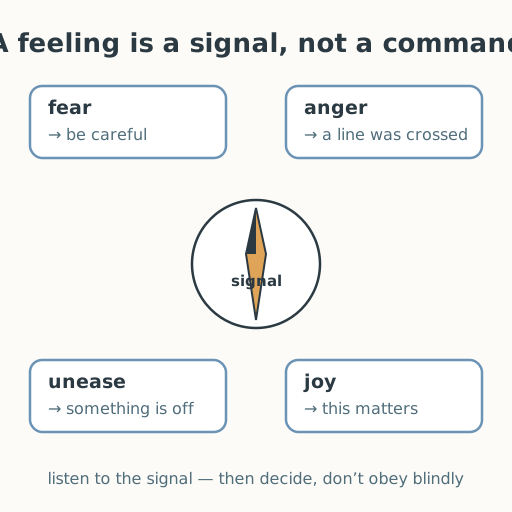
- Emotion-as-signal card · 1 per learner A compass with four signals — fear means careful, anger means a line was crossed, unease means something is off, joy means this matters
- Signal scenarios · 1 set per pair Short situations where a feeling carried useful information (a dark shortcut, an unfair rule, a friend who looks unwell, a choice that felt right)
Low-tech / no-cost
- Voice and a shared board Draw the four signals and talk the scenarios aloud; no cards needed
- A remembered feeling that helped Each learner recalls one time a feeling warned or guided them well
Enriched / lab & device
- A projected signal compass · 1 Display the four signals large, and add learners' own signals to it
- A short true story · 1 A brief account of someone whose feeling carried important information (a rescuer, an athlete, a grandparent), read and mapped to a signal
Works in different contexts
- large-group Discuss one scenario together, then pairs map a second and share one finding
- multi-age Younger learners match a feeling to a signal; older learners explain *why* the signal was useful in the situation
- self-directed A learner reads the four signals, then writes one personal example where a feeling informed a good judgment
- level-grouped Learners ready to extend distinguish when a signal was trustworthy from when the same signal would mislead
- outdoor-only Use outdoor signals — unease near a crumbling bank, care around a fire, the joy of a found path — and name the feeling and its message
Lesson 3 — What the Feeling Tells Me: Emotion as Information
Summary
Learners explore the informing half of emotion: how a feeling can carry useful information for judgment. They map feelings onto the signals they send, work through a modeled example, and write a personal example of a time a feeling told them something true — one half of the “informs and distorts” standard.
Objectives
- Explain how emotion can inform judgment, using a personal example. (D01.S1.08.02)
Connection
A feeling is not always a problem to be fixed. Sometimes it is a signal — a message from the part of you that noticed something before your thinking caught up. The unease on a dark, empty road; the anger when a rule is plainly unfair; the quiet “yes” when a choice feels right. These are not errors; they are information. Today you learn to listen for the message a feeling is carrying.
Materials
- Emotion-as-signal card
- Signal scenarios
Preparation
- Copy the emotion-as-signal card and signal scenarios.
- Retrieval: from Lesson 2, recall the three parts — event, thought, feeling — and where the thought sits. Today the feeling gets a job: carrying information.
Facilitator note
This lesson is written to the learner (“you”). The idea to land: emotion can inform judgment — a feeling is a signal carrying information, not a command to obey. Research on emotion and decision-making shows emotion is not the opposite of good judgment; it is often an input to it (Lerner et al. 2015, S-333). Teach the signal-mapping as a worked example (Kirschner, Sweller & Clark 2006, S-011) before independent work. The ethics lens: a feeling can alert me to a wrong being done — anger at unfairness is moral information. The egalitarian lens: whose feelings are listened to and whose are dismissed is not equal everywhere; honoring a feeling as information is part of honoring a person. The global lens: the messages feelings carry (danger, injustice, unease, care) travel across cultures, even though the expressions differ — what is shown in one place may be hidden in another. The critical-thinking lens: a signal can be wrong — next lesson we learn to check it. Distinguish evidence from values: that emotion can carry information is a scientific claim (S-333); that every learner’s feeling deserves to be heard is a value this curriculum holds — name it as one.
Procedure
- Recall (5 min). From Lesson 2: what are the three parts of a reaction, and which part is the hinge? Say it. Today we give the feeling a job.
- Meet the signals (10 min). Look at the signal card. A feeling can be a signal: fear → “be careful”; anger → “a line was crossed”; unease → “something is off”; joy → “this matters.” A signal informs — it tells you something — it does not command you to act.
- Watch it modeled (10 min). Worked example: You feel uneasy about a shortcut home after dark. The unease is information: it says “this route feels unsafe.” Good judgment listens — you take the lit street or go with a friend — without letting the feeling boss you into panic. The feeling informed the choice; you still chose.
- Practice with a partner (15 min). Choose a signal scenario. Name the feeling, name the message it carries, and say how it could inform a good judgment. Then share one of your own: a time a feeling told you something true.
- Write your personal example (10 min). Write one short paragraph: the feeling, the message it carried, and the judgment it informed. This is the “informs” half of your reaction analysis — keep it.
Differentiation
- Support: Provide sentence starters (“I felt ___, and it told me ___”) and a single signal to focus on.
- Extension: For one signal, say when it would be trustworthy and when the same signal would mislead — a bridge to the next lesson on distortion.
Assessment
- Formative (observation): Can the learner name a feeling and the information it carried, and connect it to a judgment it informed?
- Portfolio artifact: The written personal example, kept for the unit’s informs-and-distorts analysis.
Home connection
Ask someone at home about a time a feeling warned or guided them well — and share your own example.
Resources
- On emotion as an input to (not the enemy of) decision-making: Lerner, Li, Valdesolo & Kassam (2015), “Emotion and Decision Making,” Annual Review of Psychology (S-333).
- On modeling a new skill before independent practice: Kirschner, Sweller & Clark (2006), https://doi.org/10.1207/s15326985ep4102_1 (S-011).