Lesson 04 — When the Feeling Misleads: Checking the Thought
Learners explore the distorting half of emotion: how a feeling can skew judgment, and how to check the thought behind it. They learn three common thought errors, work through a modeled example, and write a personal example of a time a feeling misled them — completing the "informs and distorts" standard.
Objectives
Objectives
- D01.S1.08.02 Explain how emotion can both inform and distort judgment, using a personal example.
Essential question
How can a feeling distort my judgment, and how do I check the thought behind it?
Key vocabulary
Materials
Standard materials
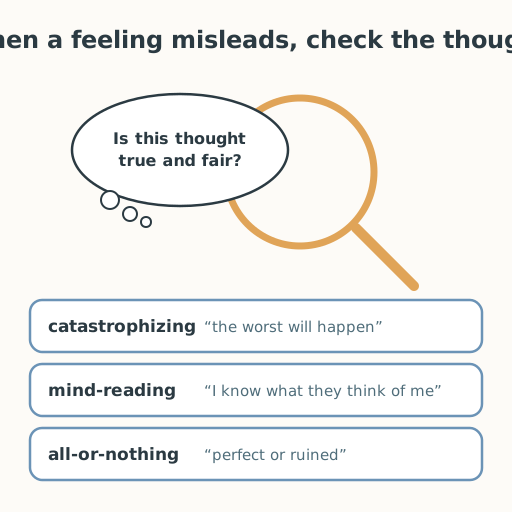
- Check-the-thought card · 1 per learner A magnifying-glass prompt — "Is this thought true and fair?" — with three named thought errors
- Thought-error scenarios · 1 set per pair Short situations where a thought is likely distorted (one low test score, an unanswered message, a friend talking with someone else)
Low-tech / no-cost
- Paper and voice Write the check question and the three errors on a page or board; no cards needed
- A distorted thought the learner caught Use a real, safe moment where a first thought turned out to be wrong
Enriched / lab & device
- A projected check-the-thought prompt · 1 Display the check question and errors large; add the group's own examples to it
- A short video clip · 1 A brief scene where a character overreacts on a misread thought, then re-checks it
Works in different contexts
- large-group Model one scenario on the board, then pairs check a second and share the corrected thought
- multi-age Younger learners name the feeling and the thought; older learners name the error and a fairer thought
- self-directed A learner checks one distorted thought, writes the error it made, and writes a fairer thought
- level-grouped Learners ready to extend weigh when a thought is *worth* distrusting versus when the feeling was right all along
- outdoor-only Recall an outdoor overreaction (a rustle you feared was worse than it was) and check its thought aloud
Lesson 4 — When the Feeling Misleads: Checking the Thought
Summary
Learners explore the distorting half of emotion: how a feeling can skew judgment, and how to check the thought behind it. They learn three common thought errors, work through a modeled example, and write a personal example of a time a feeling misled them — completing the “informs and distorts” standard begun in Lesson 3.
Objectives
- Explain how emotion can distort judgment, using a personal example. (D01.S1.08.02)
Connection
A feeling can carry truth, but it can also distort — like a magnifying glass that makes a small thing look enormous, or a colored lens that tints everything one shade. You get one low mark and the feeling says “I am a failure at everything”; a friend does not reply and the feeling says “she hates me.” The feeling feels like fact, but it is partly a story. Today you learn to check the story before you believe it.
Materials
- Check-the-thought card
- Thought-error scenarios
Preparation
- Copy the check-the-thought card and thought-error scenarios.
- Retrieval: from Lesson 3, recall how a feeling can inform judgment. Today’s question is the other half — how it can distort it — and what to do about it.
Facilitator note
This lesson is written to the learner (“you”). The idea to land: emotion can distort judgment, and the remedy is to check the thought behind the feeling. Emotion shapes judgment in both directions — it informs and it biases (Lerner et al. 2015, S-333); fast, emotionally charged first reactions can be vivid and wrong, which is why a slower check matters (Kahneman’s System 1/System 2 distinction, S-337). Teach the check as a worked example (Kirschner, Sweller & Clark 2006, S-011) before independent practice. The ethics lens: an unchecked thought can hurt other people — I accuse a friend of something she never did. The egalitarian lens: no learner’s thought error is a character flaw; distortion is a normal human habit, and everyone gets to practice catching it. The global lens: what a silence or a glance “means” differs by culture, so the check question — is this thought true and fair here? — protects us from misreading people across difference. The technology lens: feeds, likes, and edited images are built to trigger exactly these distortions — comparison and catastrophizing — so the check is a shield against a designed pressure, not only against our own minds. The critical-thinking lens: checking a thought is questioning one’s own first take — the same habit we apply to any claim. Keep examples small and safe; never require disclosure of painful material, and hold that a learner is never judged for a thought.
Procedure
- Recall (5 min). From Lesson 3: how can a feeling inform judgment? Give one example. Now the flip side: can a feeling ever mislead you? Say a time you have seen it happen.
- Meet the check (10 min). Look at the card. A distorted thought is one that is vivid but not true or fair. Three common thought errors: catastrophizing (“the worst will happen”), mind-reading (“I know what they think of me”), all-or-nothing (“perfect or ruined”). The check is one question: Is this thought true and fair?
- Watch it modeled (10 min). Worked example: You get one low mark on a test. Thought: “I am terrible at everything and always will be.” Which error? Catastrophizing + all-or-nothing. The check: is it true (one mark, one test — not everything) and fair (you have other strengths)? Fairer thought: “This one was hard; I can study differently and improve.” The feeling softened once the thought was checked.
- Guided practice (15 min). With a partner, take a scenario. Name the thought, name the error, and write a fairer thought that is true and fair. Then try one of your own: a time a feeling misled you, and what a fairer thought would have been.
- Write your personal example (10 min). Write one short paragraph: the feeling, the distorted thought, the error it made, and the fairer thought. Keep it beside your “informs” example from Lesson 3.
- Close (5 min). A feeling can tell the truth and it can lie. You are not at its mercy: the check question is yours to ask.
Differentiation
- Support: Give a two-option check (“Is this thought true? Is it fair?”) and sentence starters (“The thought was ___, which is an error because ___; a fairer thought is ___”).
- Extension: Take one scenario and argue both sides — a case for trusting the feeling and a case for checking it — then say which you find stronger and why.
Assessment
- Formative (observation): Can the learner name a thought error and produce a fairer thought that is both true and fair?
- Portfolio artifact: The written personal example, completing the unit’s informs-and-distorts analysis.
- Peer check: A partner confirms the “fairer thought” is genuinely fair, not just kinder to oneself.
Home connection
This week, catch one distorted thought of your own, run the check question on it, and tell someone at home the fairer thought you found.
Resources
- On emotion as both an input to and a bias in decision-making: Lerner, Li, Valdesolo & Kassam (2015), “Emotion and Decision Making,” Annual Review of Psychology (S-333).
- On fast, emotional first reactions versus slower, deliberate checking: Kahneman, Thinking, Fast and Slow (S-337).
- On modeling a new skill before independent practice: Kirschner, Sweller & Clark (2006), https://doi.org/10.1207/s15326985ep4102_1 (S-011).