Lesson 05 — Many Parts, One Me: Intersecting Identities
Learners explain how multiple and intersecting identities — culture, gender, ability, language, and more — shape a whole self. They build an overlapping-circle self-map and discover that no single label is the whole story.
Objectives
Objectives
- D01.S2.08.01 Explain how multiple and intersecting identities, such as culture, gender, ability, and language, shape a whole self.
Essential question
How do my multiple, intersecting identities shape the whole person I am?
Key vocabulary
Materials
Standard materials
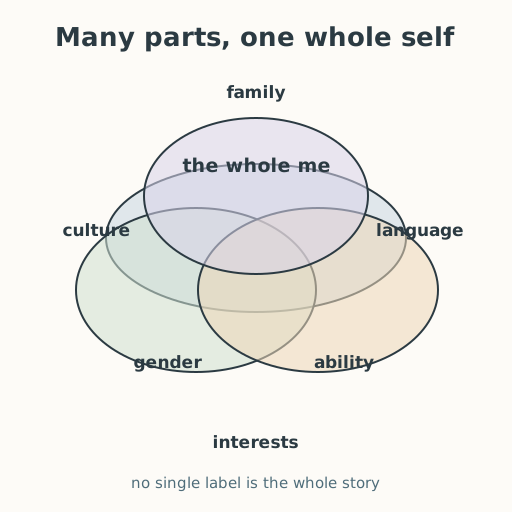
- Intersecting-identities self-map · 1 per learner Overlapping circles — culture, gender, ability, language, family, interests — around a center labeled "the whole me"
- Identity example cards · 1 set per pair Short vignettes of real-feeling people whose identities meet and blend (a Deaf signer who farms, a Quechua-speaking weaver who is also a herder, a bilingual artist who is also an athlete)
Low-tech / no-cost
- A page and overlapping circles drawn by hand Draw your own circles and label them; no printed map needed
- Voice and the group's own identities Name your identities aloud and point to where they overlap in you
Enriched / lab & device
- A digital self-map · 1 Build the overlapping-circle map on a device, sized and colored to reflect which identities feel largest in each setting
- A short profile of a real person · 1 Read a brief true account of a person whose identities intersect, and map them
Works in different contexts
- large-group Build one example map together, then each learner makes their own and shares only what they choose
- multi-age Younger learners name two identities; older learners explain how the two meet and shape each other in them
- self-directed A learner fills the self-map and writes one sentence about how two of their identities shape each other
- level-grouped Learners ready to extend compare which identity feels largest in different places (home, school, a team) and why
- outdoor-only Draw the map in the dust and stand in the overlap of your own identities as you name them; no paper needed
Lesson 5 — Many Parts, One Me: Intersecting Identities
Summary
Learners explain how multiple and intersecting identities — culture, gender, ability, language, and more — shape a whole self. They build an overlapping-circle self-map and discover that no single label is the whole story: identities meet, blend, and change with context.
Objectives
- Explain how multiple and intersecting identities, such as culture, gender, ability, and language, shape a whole self. (D01.S2.08.01)
Connection
No one is a single label. You are not just a student, or just a speaker of one language, or just one gender or one ability — you are all of these at once, and they shape each other. A person who farms and signs and paints is not three people; they are one person whose parts lean on and change each other. Today you map the parts that meet in you.
Materials
- Intersecting-identities self-map
- Identity example cards
Preparation
- Copy the self-map and example cards.
- Retrieval: from Grade 7, recall identity as a changing story and the lesson on labels that narrow a person. Today’s question is how the many parts hold together as one.
Facilitator note
This lesson is written to the learner (“you”). The idea to land: identity is made of many intersecting parts — culture, gender, ability, language, and more — that meet in one whole self, and no single part is the whole story. The concept of intersectionality — that overlapping identities shape a person’s experience together, not separately — is named and sharpened in Kimberlé Crenshaw’s work (S-334), used here descriptively and age-appropriately. The recognition itself — that a person is many parts at once, never a single label — is far older and appears across many cultures, so it is no single tradition’s property; Crenshaw’s term names it for careful social and legal analysis. Teach the self-map as a worked example (Kirschner, Sweller & Clark 2006, S-011) before independent work. The ethics lens: seeing a whole person, not a label, is how we avoid reducing someone to a single trait — a matter of respect and fairness. The egalitarian lens: no identity is above another; the lesson deliberately names ability and language alongside culture and gender so every learner’s parts count. The global lens: which identity feels largest changes by place — a language that is dominant at home may be minor at school, and a person may be read differently in different countries; identity is shaped by where we stand. The technology lens: platforms sort us into categories and boxes that can flatten a whole person into one label; the self-map is a reminder of the fuller self behind the profile. The critical-thinking lens: hold the self-map as a living picture, not a fixed answer — it will keep changing. Be sensitive: let learners share only what they choose, never require disclosure of identity or ability, and frame every identity as equal in worth.
Procedure
- Recall (5 min). From Grade 7: what did you learn about identity as a changing story, and about labels that narrow a person? Say it to a partner.
- Meet the idea (10 min). Look at the map. Your identity is made of many parts — culture, gender, ability, language, family, interests — and they intersect: they overlap and shape each other. You are not a stack of separate labels; you are one whole made where they meet.
- Watch it modeled (10 min). Worked example: A person who farms, signs, and paints. Farming shapes the hands; signing shapes how they tell stories; painting shapes how they see. None of the three is “the real one” — the whole self lives where they overlap.
- Map yourself (15 min). On your self-map, fill your own circles — the identities that matter to you. In the center, write or draw the whole me. Then, for two of your parts, write one sentence about how they shape each other in you.
- Share (10 min). With a partner, share only what you choose: one identity and how it meets another in you. Listen for how your partner is a whole, not a label.
- Close (5 min). No single label is the whole story — of you, or of anyone.
Differentiation
- Support: Start with two circles (“I am ___ and ___”) and a sentence starter (“These two meet in me when ___”).
- Extension: Compare where the same identity feels large or small in different places (home, school, a team), and say what changes it.
Assessment
- Formative (observation): Can the learner name several identities and explain how at least two of them meet and shape each other in them?
- Portfolio artifact: The completed self-map, kept for the unit’s identity portfolio.
Home connection
Ask someone at home about two parts of their identity that meet in them — and share how two of yours meet in you.
Resources
- On intersecting identities and how overlapping parts shape experience together: Kimberlé Crenshaw, “Demarginalizing the Intersection of Race and Sex” (1989) (S-334).
- On modeling a new skill before independent practice: Kirschner, Sweller & Clark (2006), https://doi.org/10.1207/s15326985ep4102_1 (S-011).