Lesson 03 — When Stress Stays: The Cost and the Way Back to Calm
Learners describe how stress affects the body over time — a short burst is a useful alarm, but stress that never turns off wears on the body — and name healthy ways to help the body return to calm: slow breathing, movement, sleep, connection, nature, and talking to someone.
Objectives
Objectives
- D03.S1.08.02 Describe how stress affects the body over time and name healthy ways to help the body return to calm.
Essential question
How does stress affect my body over time, and what healthy ways help it return to calm?
Key vocabulary
Materials
Standard materials
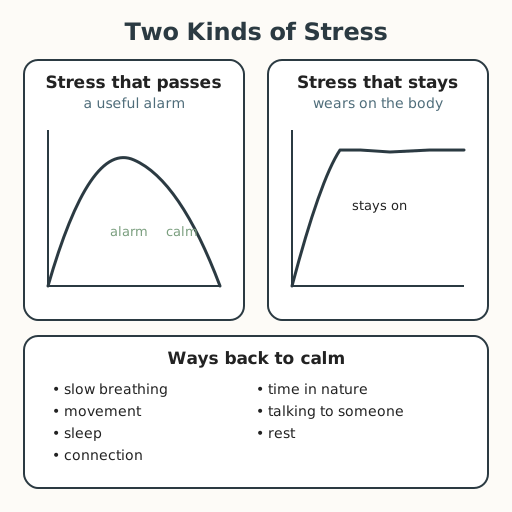
- Two-panel stress sheet · 1 per learner A two-panel sheet — "a short burst (useful alarm)" vs "stress that never turns off (wear on the body)" — with a calm-practice list to complete
- Calm-practice cards · 1 set per group Cards naming ways to unwind (slow breathing, movement, sleep, connection, nature, talking to someone) to discuss and sort
Low-tech / no-cost
- Voice and a shared board Build the two panels together and act out the calm practices; no cards needed
- Your own breath and a quiet corner Practice slow breathing anywhere; no equipment needed
Enriched / lab & device
- A guided breathing audio · 1 A short, age-appropriate guided slow-breathing track to practice together
- A "calm menu" poster · 1 A poster where learners add their own tested ways to unwind, kept in the room all unit
Works in different contexts
- large-group Do the breathing practice as a whole class, then pairs each pick one calm practice and say when they would use it
- multi-age Younger learners name one way to calm down; older learners also name a time stress helped them and a time it lingered
- self-directed A learner completes the two-panel sheet and practices one calm technique, noting how their body feels before and after
- level-grouped Learners ready to extend explain why a short burst of stress is helpful but a long one is not, in their own words
- outdoor-only Practice slow breathing outdoors and name one place in nature (or a calm spot) that helps your body settle
Lesson 3 — When Stress Stays: The Cost and the Way Back to Calm
Summary
Learners describe how stress affects the body over time — a short burst is a useful alarm that rises and falls, while stress that never turns off wears on the body — and name healthy ways to help the body return to calm, practicing one slow-breathing technique.
Objectives
- Describe how stress affects the body over time and name healthy ways to help the body return to calm. (D03.S1.08.02)
Connection
Some stress is a gift — it sharpens you before a performance, wakes you to a real danger, then fades. But some stress does not fade: a worry that follows you to bed, a pressure that sits in your shoulders for weeks. That kind of stress is like an alarm that never stops ringing, and a body holding that alarm for too long pays a real price. Today you learn the difference — and how to help your body come back to calm.
Materials
- Two-panel stress sheet
- Calm-practice cards
Preparation
- Copy the two-panel stress sheet and calm-practice cards.
- Retrieval: from Lesson 2, recall the two branches — fight-or-flight (sympathetic) and rest-and-digest (parasympathetic). Today we ask what happens when the alarm branch stays on.
Facilitator note
This lesson is written to the learner (“you”). The ideas to land: (1) acute stress — a short burst — is normal and useful: it sharpens attention and readies the body, then passes; (2) chronic stress — stress that does not pass — wears on the body over time: tense muscles, a racing heart, upset digestion, broken sleep, and low mood (S-338); (3) the body can be helped back to calm with healthy practices — slow breathing, movement, sleep, connection with others, time in nature, and talking to someone — and these are skills, not weaknesses. Model the slow-breathing technique once (worked example, S-011), then practice together. The scientific account of chronic stress (S-338) is held alongside cultural breathing practices from many peoples (pranayama, qigong, and others) without ranking them (philosophy §11). The ethics lens: caring for a stressed body is a form of responsibility toward oneself. The egalitarian lens: stress does not fall evenly — poverty, violence, discrimination, and unsafe places add stress that is not anyone’s fault, and no one should be blamed for being stressed. The global lens: every culture has its own ways of settling the body — breath, prayer, song, water, tea, rest — all worth honoring. The technology & environment lens: constant alerts, screens before sleep, and a lack of green or safe space can keep the alarm on; naming these is the first step to choosing differently. Safeguarding: some learners carry heavy stress; do not require disclosure — invite optional sharing, and remind learners a trusted adult is always a resource. Keep hope central: the lesson ends on agency, not on the weight of stress.
Procedure
- Recall (5 min). From Lesson 2: what are the two branches of the automatic response? Today we ask what happens when the alarm branch stays on.
- Meet the two kinds of stress (10 min). Acute stress is a short burst — it rises to meet a challenge and then fades. That is the alarm working as it should. Chronic stress is stress that does not turn off. Over time it wears on the body: muscles stay tight, the heart works harder, digestion and sleep are disturbed, and mood dips. The same alarm that saves you in a moment costs you when it never stops.
- Name the ways back to calm (15 min). With a group, go through the calm-practice cards: slow breathing, movement, sleep, connection (a friend, a trusted adult), nature, and talking to someone. For each, say one reason it helps the body settle.
- Practice slow breathing (15 min). Sit comfortably. Breathe in slowly for a count of four, and out slowly for a count of six — the long, slow exhale tells the body it is safe. Breathe through your nose or mouth, whichever is comfortable. Repeat four times. A leader may count with a slowly rising and falling hand so learners who are deaf or hard of hearing follow the pace visually, and learners may keep their eyes open and simply follow the hand. Notice your shoulders, your jaw, your hands.
- Close (5 min). Remember: stress that passes is an ally; stress that stays needs tending — and you know ways to tend it.
Differentiation
- Support: Offer a single calm practice to try and a sentence starter (“When I feel stressed, one thing I can do is ___”).
- Extension: Write a short “calm menu” for yourself, pairing a stress signal you notice (racing heart, tight jaw) with a practice that helps it settle.
Assessment
- Formative (observation): Can the learner tell acute stress from chronic stress and name at least two healthy ways to return to calm?
- Portfolio artifact: The completed two-panel stress sheet, kept in the portfolio.
Home connection
Try one slow-breathing round with someone at home before bed. Ask them what they do to settle when life feels loud, and add it to your own list.
Resources
- On stress’s effect on the body over time: American Psychological Association, “Stress effects on the body,” https://www.apa.org/topics/stress/body (S-338).
- On slow breathing as a way back to calm: Harvard Health Publishing, “Relaxation techniques: Breath control helps quell errant stress response,” https://www.health.harvard.edu/mind-and-mood/relaxation-techniques-breath-control-helps-quell-errant-stress-response (S-340).
- On sleep as part of wellness: American Academy of Sleep Medicine, recommended sleep durations, https://aasm.org/resources/pdf/pediatricsleepdurationconsensus.pdf (S-050).
- On explicit instruction and worked examples: Kirschner, Sweller & Clark (2006), https://doi.org/10.1207/s15326985ep4102_1 (S-011).