Lesson 04 — Three Ways Movement Builds Me: Strength, Endurance, Flexibility
Learners distinguish three qualities movement builds — strength (muscles working against a load), endurance (heart, lungs, and muscles working over time), and flexibility (range of motion at the joints) — and sort everyday movements into the three kinds, working at their own level.
Objectives
Objectives
- D03.S2.08.01 Design a short movement routine and explain how each part builds strength, endurance, or flexibility.
Essential question
What are strength, endurance, and flexibility, and how does each kind of movement build my body?
Key vocabulary
Materials
Standard materials
- Movement-kind cards · 1 set per group Cards naming everyday movements (carrying, walking, reaching, pushing, holding a stretch) to sort into strength, endurance, or flexibility
- Three-kinds sheet · 1 per learner A three-panel sheet defining strength, endurance, and flexibility, with room to add examples
Low-tech / no-cost
- Voice and your own body Act out and sort the movements together; no cards needed
- Found objects Use a wall for a push, a step for a calf stretch, a water container to carry — no equipment needed
Enriched / lab & device
- Resistance bands or light weights · 1 set per group Optional, for feeling strength work (used at each person's own level, never competitively)
- A short demonstration video · 1 An age-appropriate video showing seated and standing versions of strength, endurance, and flexibility work
Works in different contexts
- large-group Sort the cards as a class, then pairs each demonstrate one movement and name its kind
- multi-age Younger learners sort two cards; older learners also name the body part each movement builds
- self-directed A learner sorts the cards, does one of each kind of movement, and writes which kind each one was
- level-grouped Learners ready to extend explain why one movement (like walking uphill) can build more than one quality at once
- outdoor-only Find three real movements outdoors — one that needs strength (carrying, climbing), one for endurance (walking, cycling), one for flexibility (reaching, stretching)
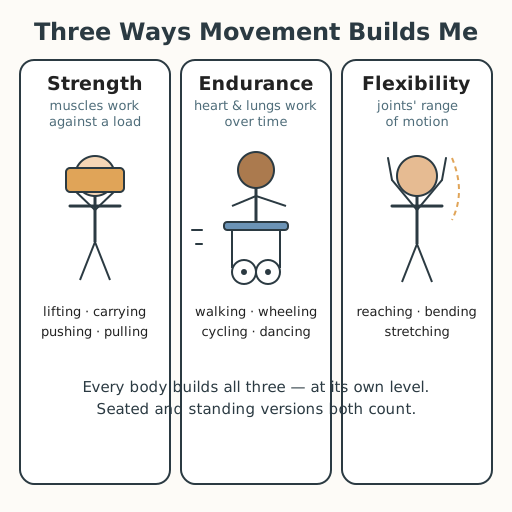
Lesson 4 — Three Ways Movement Builds Me: Strength, Endurance, Flexibility
Summary
Learners distinguish the three qualities movement builds — strength, endurance, and flexibility — and sort everyday movements into the three kinds. They practice one of each at their own level, always with a seated or adapted version available.
Objectives
- Explain the difference between strength, endurance, and flexibility, and name an example of each kind of movement. (D03.S2.08.01)
Connection
Every time you move, your body is quietly getting better at something. Carrying a heavy bag builds strength. Walking or wheeling for a long stretch builds endurance. Reaching, bending, and stretching build flexibility. You do not need a gym to grow these three — they are built by ordinary, everyday movement, done at whatever level is right for your own body. Today you learn to see the difference.
Materials
- Movement-kind cards
- Three-kinds sheet
Preparation
- Copy the movement-kind cards and three-kinds sheet.
- Retrieval: from Grade 7, recall how movement changes during puberty and how to adapt activities to your own changing body (D03.S2.07.02). Today we add the “why” — what each kind of movement actually builds.
Facilitator note
This lesson is written to the learner (“you”). The ideas to land: (1) strength = muscles working against a load; endurance = heart, lungs, and muscles working over a longer time; flexibility = range of motion at the joints; (2) each is built by movement you already do, at your own level; (3) no movement quality is “better” — a balanced body uses all three, and every body starts where it starts. Model each kind once (worked example, S-011), then guide practice. The WHO frames regular physical activity and a mix of aerobic and muscle-strengthening work (S-341); hold it as a health guideline, not a ranking. This is a body lesson — teach it with dignity: never comment on any learner’s body size or shape, never time learners against each other, never rank speed or strength. “Your level is the right level.” Always offer a seated or adapted version alongside the standing one, and treat assistive devices (wheelchairs, prosthetics, canes) as ordinary parts of a body in motion. The ethics lens: how we speak about bodies — our own and others’ — is an ethical choice; we choose respect. The egalitarian lens: everyone can build strength, endurance, and flexibility, whatever their body or ability — the movements look different, the qualities are the same. The global lens: people everywhere build these three through the movements of daily life — carrying water, farming, dancing, cycling, swimming — not only through sport. The technology & environment lens: a body that mostly sits at screens misses the movement it is built for, and safe, welcoming places to move are not equally available to everyone. The critical-thinking lens: “movement builds the body” is a checkable scientific fact; “some bodies are better than others” is a false value we refuse.
Procedure
- Recall (5 min). From Grade 7: how did movement change during puberty, and how did you adapt activities to your own body? Today we ask what movement actually builds.
- Meet the three qualities (12 min). Strength is your muscles working against a load — lifting, carrying, pushing. Endurance is your heart, lungs, and muscles working over a longer time — walking, wheeling, cycling, dancing. Flexibility is your joints’ range of motion — reaching, bending, stretching. Notice: no one quality is “best”; a healthy body uses all three.
- Sort the movements (15 min). With a group, sort the movement-kind cards into strength, endurance, or flexibility. For each, say what the body is building and why. Some movements (like walking uphill) build more than one — put those between the columns.
- Try one of each (13 min). Do one strength movement (a wall push or a lift), one endurance movement (a steady walk, wheel, or march in place), and one flexibility movement (a gentle reach or stretch) — each at your own level, with a seated or adapted version if you prefer. Move gently and stop if anything hurts.
- Close (5 min). Remember: your body grows stronger, longer-lasting, and freer with every kind of movement — and your level is the right level.
Differentiation
- Support: Provide two pre-sorted cards and ask learners to match the movement to its quality.
- Extension: Find one movement that builds two qualities at once and explain how (e.g., walking uphill builds both endurance and strength).
Assessment
- Formative (observation): Can the learner sort a movement into strength, endurance, or flexibility and say why?
- Portfolio artifact: The completed three-kinds sheet, kept in the portfolio.
Home connection
At home, find one everyday movement for each quality — one that needs strength, one for endurance, one for flexibility — and name them to someone.
Resources
- On physical activity and a balanced mix of movement: World Health Organization, “Physical activity” fact sheet, https://www.who.int/news-room/fact-sheets/detail/physical-activity (S-341).
- On explicit instruction and worked examples: Kirschner, Sweller & Clark (2006), https://doi.org/10.1207/s15326985ep4102_1 (S-011).