Lesson 05 — Designing My Movement Routine
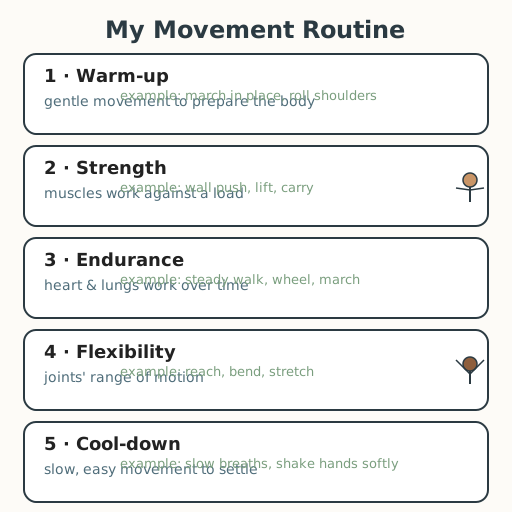
Learners design a short movement routine and explain how each part builds strength, endurance, or flexibility. They build a warm-up, a strength part, an endurance part, a flexibility part, and a cool-down, labeling each and offering a seated or adapted version.
Objectives
Objectives
- D03.S2.08.01 Design a short movement routine and explain how each part builds strength, endurance, or flexibility.
Essential question
How do I design a short movement routine and explain how each part builds strength, endurance, or flexibility?
Key vocabulary
Materials
Standard materials
- Routine-builder card · 1 per learner A template with warm-up, three labeled parts (strength, endurance, flexibility), and cool-down, to fill in
- Movement menu · 1 per learner A list of low-equipment strength, endurance, and flexibility movements, each with a seated or adapted version
Low-tech / no-cost
- Voice and your own body Build the routine from body-only movements; no paper or equipment needed
- Found objects and space Use a wall, a step, and open space; nothing to buy
Enriched / lab & device
- A movement-menu poster · 1 A large posted menu of movements with illustrations and seated versions for the room
- A timer or music · 1 A simple timer or beat to pace the routine's endurance part
Works in different contexts
- large-group Build one sample routine together on the board, then each learner designs their own
- multi-age Younger learners design a two-part routine; older learners design the full four-part routine with labels and reasons
- self-directed A learner fills the routine-builder card, labels each part, and does the routine once
- level-grouped Learners ready to extend add a note on how to adapt each part for a friend who needs a seated version
- outdoor-only Design the routine using the space and objects around you — a bench for a step, a path for endurance, a tree for a gentle stretch
Lesson 5 — Designing My Movement Routine
Summary
Learners design a short movement routine and explain how each part builds strength, endurance, or flexibility. They assemble a warm-up, a strength part, an endurance part, a flexibility part, and a cool-down, label each, and include a seated or adapted version.
Objectives
- Design a short movement routine and explain how each part builds strength, endurance, or flexibility. (D03.S2.08.01)
Connection
Athletes, dancers, and people who simply care for their bodies do the same quiet thing: they design their movement on purpose, choosing each part for what it builds. You can too, with no gym and no coach — just a clear plan and your own body. Today you build a routine you could do anywhere, and you will be able to say exactly why each part helps.
Materials
- Routine-builder card
- Movement menu
Preparation
- Copy the routine-builder card and movement menu.
- Retrieval: from Lesson 4, recall the three qualities — strength, endurance, flexibility — and one example of each. Today we put them together into one routine.
Facilitator note
This lesson is written to the learner (“you”). The ideas to land: (1) a routine has a shape — warm-up, a strength part, an endurance part, a flexibility part, and a cool-down; (2) each part has a job — strength works muscles against a load, endurance works heart and lungs over time, flexibility works range of motion; (3) a good routine is safe, gentle to start, and adaptable to any body. Design is a skill — model one full routine as a worked example, then guide learners through building their own, then let them do it (explicit instruction → guided → independent, S-011). The WHO frames a balanced mix of movement (S-341). Body dignity is non-negotiable: never rank routines against each other, never comment on a body’s shape, never push anyone past comfort. “Your level is the right level.” Ensure every movement on the menu has a seated or adapted version, and treat assistive devices as ordinary. The ethics lens: designing for safety and self-care is acting responsibly toward one’s own body. The egalitarian lens: a routine anyone can do — seated, standing, fast, slow — widens movement’s door to every body. The global lens: routines can draw on movement from many cultures — dance, stretching, martial-arts forms such as capoeira (Brazil) or tai chi (China), and daily work — all valid sources. The technology & environment lens: a routine that needs no equipment, screen, or paid space works in more lives and more places. The critical-thinking lens: “this part builds endurance because it keeps my heart and lungs working over time” is a checkable reason, not a guess.
Procedure
- Recall (5 min). From Lesson 4: name the three qualities and one movement for each. Today we arrange them into a routine.
- Meet the routine’s shape (10 min). A routine has five parts: a warm-up (gentle movement to prepare the body), a strength part, an endurance part, a flexibility part, and a cool-down (slow, easy movement to settle the body).
- Watch one modeled (10 min). Follow a sample routine: warm-up — march gently in place or roll your shoulders; strength — ten wall pushes or lifts; endurance — two steady minutes of walking, wheeling, or marching; flexibility — a slow reach to the sky and a gentle side stretch; cool-down — slow breaths and a soft shake of the hands. Each part has a label and a reason.
- Design your own (15 min). On your routine-builder card, write your own five parts, choosing from the movement menu (or inventing your own). Label each part and write one sentence saying what it builds and why.
- Do it and check (10 min). Do your routine once. Check: did each part do its job? Move gently and stop if anything hurts. Adjust one part if you want to.
Differentiation
- Support: Provide a partially filled routine-builder card with the five parts labeled, so the learner only chooses one movement for each.
- Extension: Add a note to each part explaining how to adapt it for a friend who needs a seated or slower version.
Assessment
- Formative (performance): Can the learner do their routine and explain what each part builds?
- Portfolio artifact: The completed routine-builder card, kept in the portfolio.
Home connection
Teach one part of your routine to someone at home — one strength, endurance, or flexibility movement — and tell them why it helps.
Resources
- On a balanced mix of aerobic and strengthening movement: World Health Organization, “Physical activity” fact sheet, https://www.who.int/news-room/fact-sheets/detail/physical-activity (S-341).
- On explicit instruction, worked examples, and guided practice for new skills: Kirschner, Sweller & Clark (2006), https://doi.org/10.1207/s15326985ep4102_1 (S-011).