Lesson 03 — The Screen Between Us: How Digital Messages Change Meaning
Learners discover that digital messages remove most of the tone and body cues that carry meaning face to face, which makes short messages easy to misread in more than one way. They learn to notice the missing cues, check before assuming, and write clearer, kinder messages.
Objectives
Objectives
- D02.S1.08.01 Analyze how tone, body language, and digital messages can change meaning in communication.
Essential question
How do digital messages — texts, chats, and posts — change meaning when tone and body language are missing?
Key vocabulary
Materials
Standard materials
- Digital-message card · 1 per pair A short ambiguous message (for example, "k." or "whatever" or "you there?") with no emoji or tone, for decoding
- Cue chart · 1 per pair A two-column chart — "cues I have face to face" and "cues missing on a screen" — to fill in
Low-tech / no-cost
- Voice and a shared surface Write the message on any board and build the cue chart aloud; no cards needed
- Passed paper notes Simulate a text thread by passing short written notes, then discuss what got lost
Enriched / lab & device
- A device or projected thread · 1 A real, age-appropriate screenshot of a short message thread, shown to the group, to decode together
- A class digital-norms poster · 1 A blank poster to co-write three class norms for clearer, kinder digital messages
Works in different contexts
- large-group Decode one message as a whole class, then pairs decode a second message and report one reading each
- multi-age Younger learners list what is missing on a screen; older learners analyze how a message could be read two opposite ways and how to prevent it
- self-directed A learner decodes two messages, fills the cue chart, and writes one rule for clearer messages of their own
- level-grouped Learners ready to extend analyze a real digital exchange and rewrite one message to remove its ambiguity
- outdoor-only Compare a message said aloud with the same message written down and passed — notice exactly which cues vanish in writing
Lesson 3 — The Screen Between Us: How Digital Messages Change Meaning
Summary
Learners discover that digital messages remove most of the tone and body cues that carry meaning face to face, which makes short messages easy to misread in more than one way. They learn to notice the missing cues, check before assuming, and write clearer, kinder messages.
Objectives
- Analyze how digital messages can change meaning when tone and body language are missing. (D02.S1.08.01)
Connection
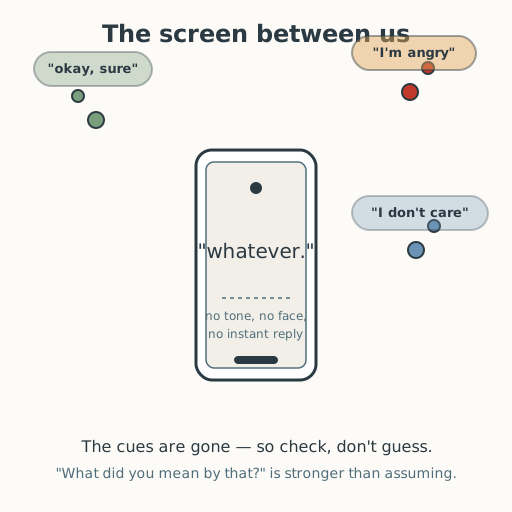
A friend sends one word: “whatever.” In the room with you, their shrug and smile would tell you it is a joke; their crossed arms and hard voice would tell you it is anger. On a screen, the shrug and the hard voice are gone — only the word remains, and it can mean several opposite things at once. From a city apartment to a village where a shared phone is the family’s, the screen sits between people and hides the cues we rely on. Today you learn to read through that screen with care.
Materials
- Digital-message card
- Cue chart
Preparation
- Copy the digital-message card and cue chart.
- Retrieval: recall Lesson 2’s finding — meaning rides on tone and body, not only words. Today the screen strips those away.
Facilitator note
This lesson is written to the learner (“you”). The ideas to land: (1) digital messages remove most nonverbal cues — tone, face, gesture, and immediate back-and-forth — so the same words can be read several ways (reduced-cues communication; Suler 2004, S-343); (2) because the cues are gone, misreading is common, not a personal failure — the skill is to notice and check, not to assume; (3) the screen can also loosen self-restraint (Suler’s “online disinhibition,” S-343), so a pause before sending is a form of care. Model the decoding once as a worked example (S-011). Safety: use only invented, neutral messages; do not ask learners to share real, painful threads. Accessibility: this lesson’s object is the written word, so learners who are deaf or hard of hearing meet it on equal terms — the “missing cues” are named and written, never only heard. For learners who are blind or low vision, read the messages aloud or offer large-print cards, and decode by speaking the possible meanings rather than writing. For learners who cannot easily write by hand, decode aloud, point to a cue on the chart, or answer with a device. The “said aloud versus written” comparison in the outdoor variant should be offered visually or by touch (a written note passed hand to hand) for learners who do not use a hearing voice. The ethics lens: a message that is meant kindly but read harshly can still cause real hurt — so senders and readers both have a responsibility. The egalitarian lens: digital access is not equal — some people share a device, have expensive data, or cannot read and write the same language comfortably; the “text thread” is not everyone’s default. The global & anthropological lens: the same short message is read through different languages, cultures, and norms, which multiplies the ways it can be misread. The technology & environment lens: the screen is a technology that reshapes relationships — we use it, so we must learn its risks as well as its gifts. The critical-thinking lens: for any ambiguous message, list the possible readings before you choose one, then check.
Procedure
- Recall (5 min). From Lesson 2: what two things beside words carry meaning in a conversation? Say them to a partner. Today: what happens when a screen removes them?
- Build the cue chart (8 min). Face to face, you get tone, face, gesture, and instant back-and-forth. On a screen, those cues are missing. Fill the cue chart: what I have face to face versus what is missing on a screen.
- Meet the digital-message card (10 min). Read the message: “whatever.” With no tone and no body, it could be agreement, anger, or indifference — three opposite meanings. The screen did not remove the words; it removed the cues that told you which meaning was meant.
- Model it (10 min). Watch a decoding: “you there?” — Is it worry (“are you okay?”), need (“I need you now”), or annoyance (“why aren’t you answering?”)? Notice: the reader cannot know alone; the responsible move is to check — “what did you mean by that?” — not to assume.
- Practice in pairs (12 min). Decode a second message. List at least two possible meanings. Then write one clearer version that a reader could not easily misread, and one question you could ask the sender to check. Swap and compare.
- Close (5 min). Share one rule for clearer, kinder messages. Remember: when the cues are gone, checking is stronger than guessing.
Differentiation
- Support: Provide a list of possible meanings to choose from before decoding, and a sentence starter for the check (“What did you mean when you wrote ___?”).
- Extension: Take a real, neutral digital exchange and rewrite one message so its meaning is unambiguous without adding emoji.
Assessment
- Formative (observation): Can the learner name the cues a screen removes and give at least two possible readings of an ambiguous message?
- Performance: The pair practice, observed for whether the learner checks rather than assumes.
Home connection
At home, notice one message someone sent or received today. Ask (yourself or them): which cues were missing, and what could it have meant besides what was assumed?
Resources
- On reduced cues and disinhibition in online communication: John Suler, “The Online Disinhibition Effect,” CyberPsychology & Behavior 7(3), 2004 (S-343).
- On digital citizenship and asking where a message comes from: Common Sense Education, “News & Media Literacy,” https://www.commonsense.org/education/digital-citizenship/topic/news-and-media-literacy (S-063).
- On explicit instruction and worked examples: Kirschner, Sweller & Clark (2006), https://doi.org/10.1207/s15326985ep4102_1 (S-011).
- On relationship skills and social awareness: CASEL, https://casel.org/fundamentals-of-sel/ (S-001).